Get your free personalized podcast brief
We scan new podcasts and send you the top 5 insights daily.
The standard economic production function based on Capital and Labor is becoming obsolete. In an economy dominated by AI and robotics, a more useful model distinguishes between Hardware (physical labor, robotics) and Software (cognitive tasks, AI). This new framework better captures the value contributed by both humans and machines.

Related Insights
Instead of eliminating entire jobs, AI unbundles them into tasks. It will replace roughly 80% of these tasks while significantly enhancing the remaining 20%. This creates a "K-shaped" divergence, amplifying those who adapt and leaving behind those who don't.

As AI commoditizes execution and intellectual labor, the only remaining scarce human skill will be judgment: the wisdom to know what to build, why, and for whom. This shifts economic value from effort and hard work to discernment and taste.

The tangible economic effect of the AI boom is currently concentrated in physical capital investment, such as data centers and software, rather than widespread changes in labor productivity or employment. A potential market correction would thus directly threaten this investment-led growth.

The fundamental economic shift is not just job automation but an inversion of roles. AI, as pure intelligence, will become the employer, hiring humans as contractors for physical tasks it cannot perform, like visiting a warehouse or collecting brochures. Intelligence becomes a cloud commodity, while physical presence becomes the service.
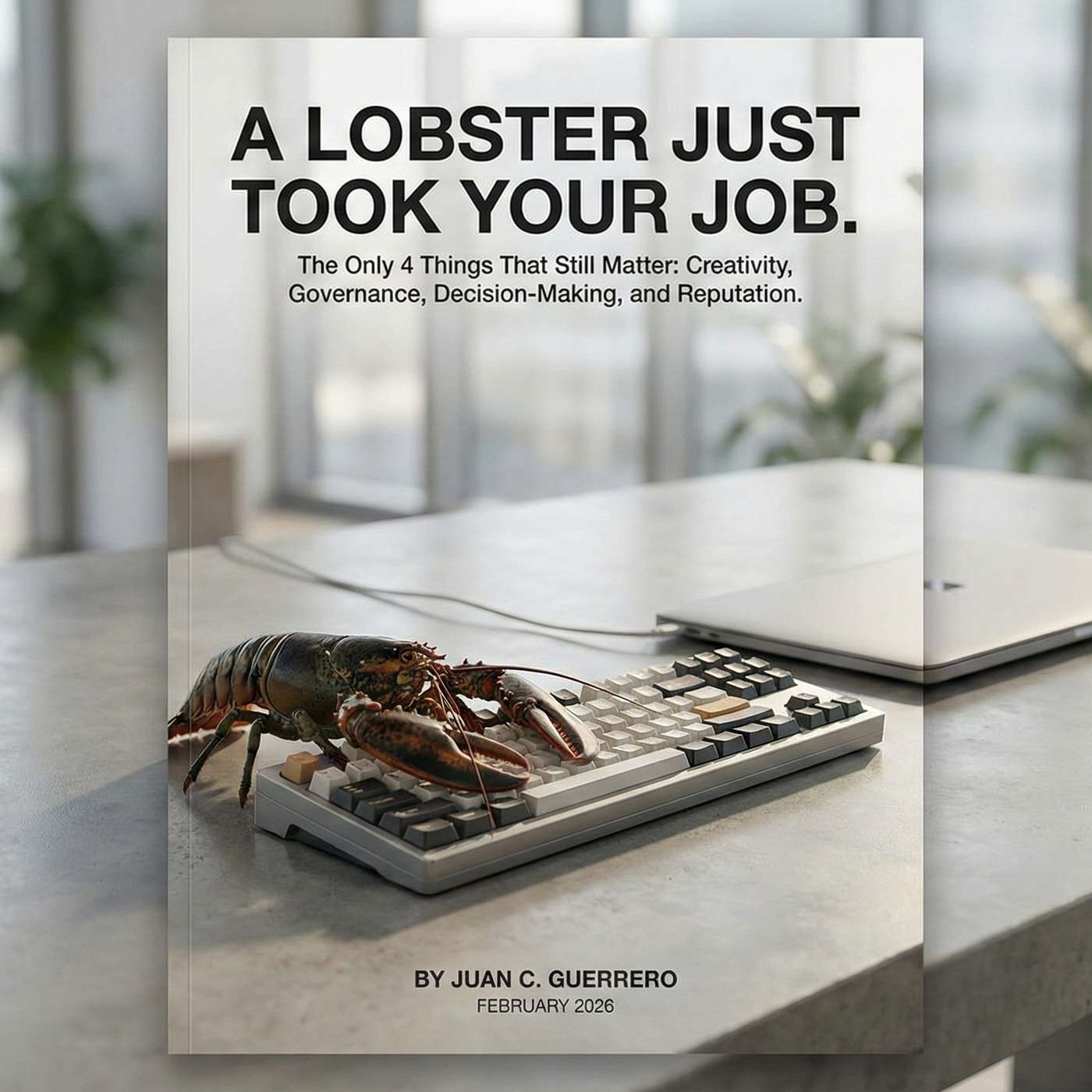
Historically, software engineering required minimal capital—a laptop and internet. AI development now mirrors heavy industry, where the capital asset (like a $10M crane or $100M cargo ship) costs far more than the skilled operator. An engineer's compute budget can now dwarf their salary, changing team economics.

The 50-year supremacy of asset-light software may be an anomaly. If AI makes software creation nearly free, economic value will shift back to the historical mean: tangible assets like infrastructure, energy, and regulated, liability-bearing businesses that touch the physical world.

The Industrial Revolution shifted economic power from land to labor. AI is poised for an equally massive transition, making capital, not labor, the primary driver and limiting factor of production. As AI increasingly substitutes for human labor, access to capital for machines and computation will determine economic output.
Capitalism values scarcity. AI's core disruption is not just automating tasks, but making human-like intellectual labor so abundant that its market value approaches zero. This breaks the fundamental economic loop of trading scarce labor for wages.
Beyond automating tasks, Emad Mostaque's "Intelligence Theory" suggests AI's deepest impact is shifting the foundational axiom of economics. Instead of scarcity, the new core principle is persistence: how complex systems (like firms or AIs) maintain themselves by accurately modeling and predicting reality.

As AI systems become infinitely scalable and more capable, humans will become the weakest link in any cognitive team. The high risk of human error and incorrect conclusions means that, from a purely economic perspective, human cognitive input will eventually detract from, rather than add to, value creation.
