Get your free personalized podcast brief
We scan new podcasts and send you the top 5 insights daily.
The primary effect of AI isn't just making existing tasks more efficient; it's dramatically expanding the scope of what is considered possible. CEOs aren't aiming for a more efficient version of their current company, but a vastly larger one. The new bottleneck for growth is a lack of ambition and imagination.

Related Insights
The conventional wisdom of 'focus on less to achieve more' is inverted by AI. With powerful new tools, the strategic advantage lies in taking on more ambitious projects and exploring ideas that were previously infeasible. AI shaves down the learning curve, making it possible to tackle a wider range of challenges.

The most successful organizations will view AI not as a tool for cost-cutting (doing the same with less) but as an expansionary technology. This mindset focuses on using AI to create new products, enter new markets, and dramatically increase scope, rather than just incremental efficiency gains.

Historically, the effort and resources needed to execute an idea were the biggest hurdles. With AI, the distance between imagination and execution has shrunk dramatically, making creativity the new bottleneck and a key driver of value creation.

The true growth unlocked by AI isn't just efficiency gains on existing tasks. It's the ability to perform entirely new kinds of work. For example, a private equity firm can now exhaustively simulate thousands of buyout opportunities, a depth of analysis that was computationally and financially impossible before.

The true power of AI lies beyond optimizing existing workflows. The key skill is shifting from asking 'How can AI help my job?' to 'What can we do now that was previously impossible or uneconomic?' This reframes AI as a tool for radical innovation, not just incremental efficiency.
The focus on AI automating existing human labor misses the larger opportunity. The most significant value will come from creating entirely new types of companies that are fully autonomous and operate in ways we can't currently conceive, moving beyond simple replacement of today's jobs.

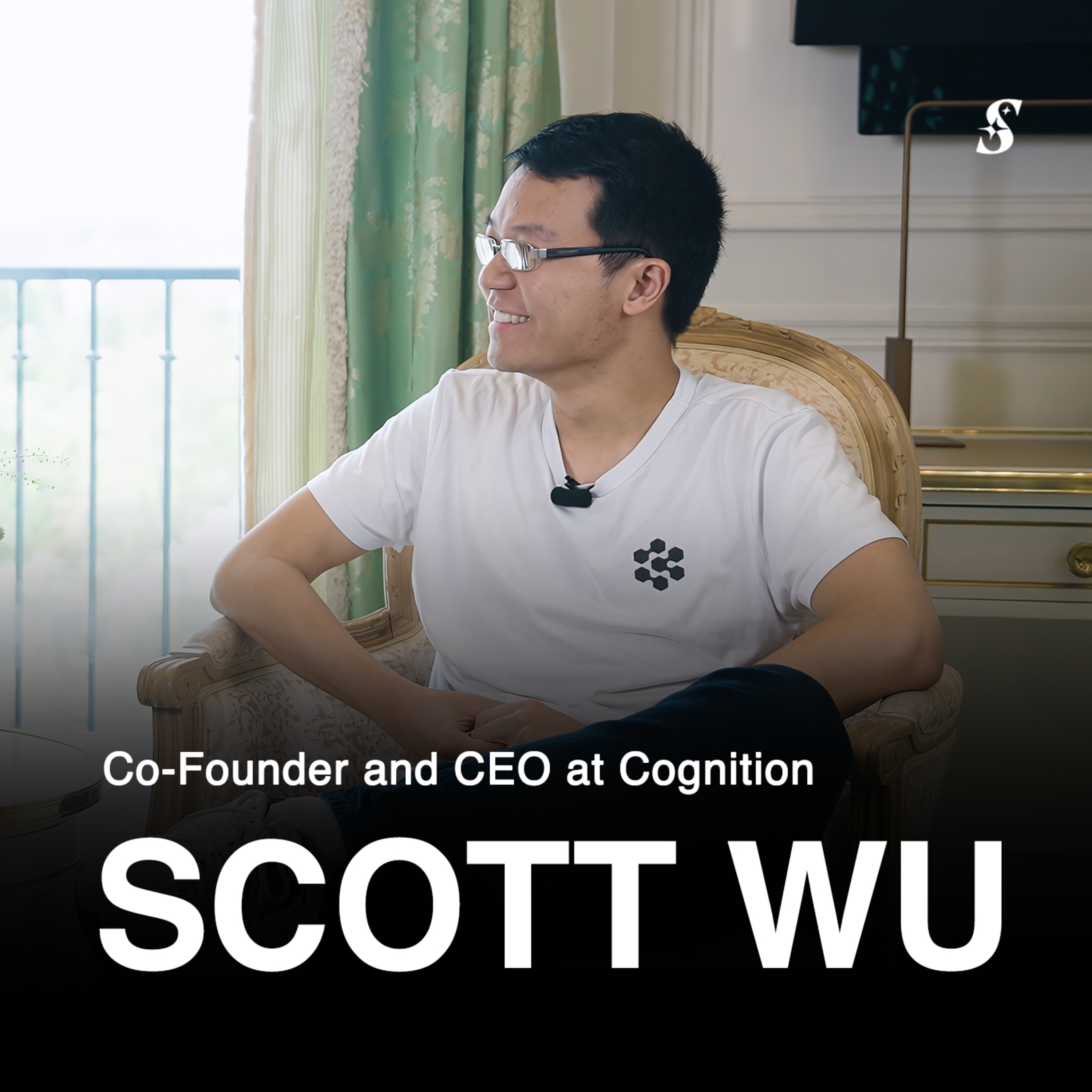
Scott Wu argues that focusing on AI's ability to make existing work more efficient misses the point. The real transformation comes from creating new capacity—enabling the development of things previously impossible, like "single-use software" or "self-driving software," fundamentally changing what businesses can build.
As AI agents eliminate the time and skill needed for technical execution, the primary constraint on output is no longer the ability to build, but the quality of ideas. Human value shifts entirely from execution to creative ideation, making it the key driver of progress.

Businesses are fixated on using AI for productivity and cost-cutting, a path that leads to a "race to the bottom." Its real value lies in democratizing creativity and creating new opportunities for growth that were previously inaccessible.

A common but flawed reaction to AI-driven efficiency is to ask 'how many fewer people do we need?' The more powerful question is 'how much more can we build now?' AI unlocks the potential for teams to tackle previously impossible goals, making it a time to accelerate.
