Get your free personalized podcast brief
We scan new podcasts and send you the top 5 insights daily.
Businesses are fixated on using AI for productivity and cost-cutting, a path that leads to a "race to the bottom." Its real value lies in democratizing creativity and creating new opportunities for growth that were previously inaccessible.

Related Insights
A PwC study reveals the leading 20% of companies capture 75% of AI's economic gains. They focus on using AI to identify new growth opportunities and reinvent business models, rather than simply improving efficiency on existing tasks.

The most successful organizations will view AI not as a tool for cost-cutting (doing the same with less) but as an expansionary technology. This mindset focuses on using AI to create new products, enter new markets, and dramatically increase scope, rather than just incremental efficiency gains.
Focusing on AI for cost savings yields incremental gains. The transformative value comes from rethinking entire workflows to drive top-line growth. This is achieved by either delivering a service much faster or by expanding a high-touch service to a vastly larger audience ("do more").

Most companies use AI for optimization—making existing processes faster and cheaper. The greater opportunity is innovation: using AI to create entirely new forms of value. This "10x thinking" is critical for growth, especially as pure efficiency gains will ultimately lead to a reduced need for human workers.

The true power of AI lies beyond optimizing existing workflows. The key skill is shifting from asking 'How can AI help my job?' to 'What can we do now that was previously impossible or uneconomic?' This reframes AI as a tool for radical innovation, not just incremental efficiency.
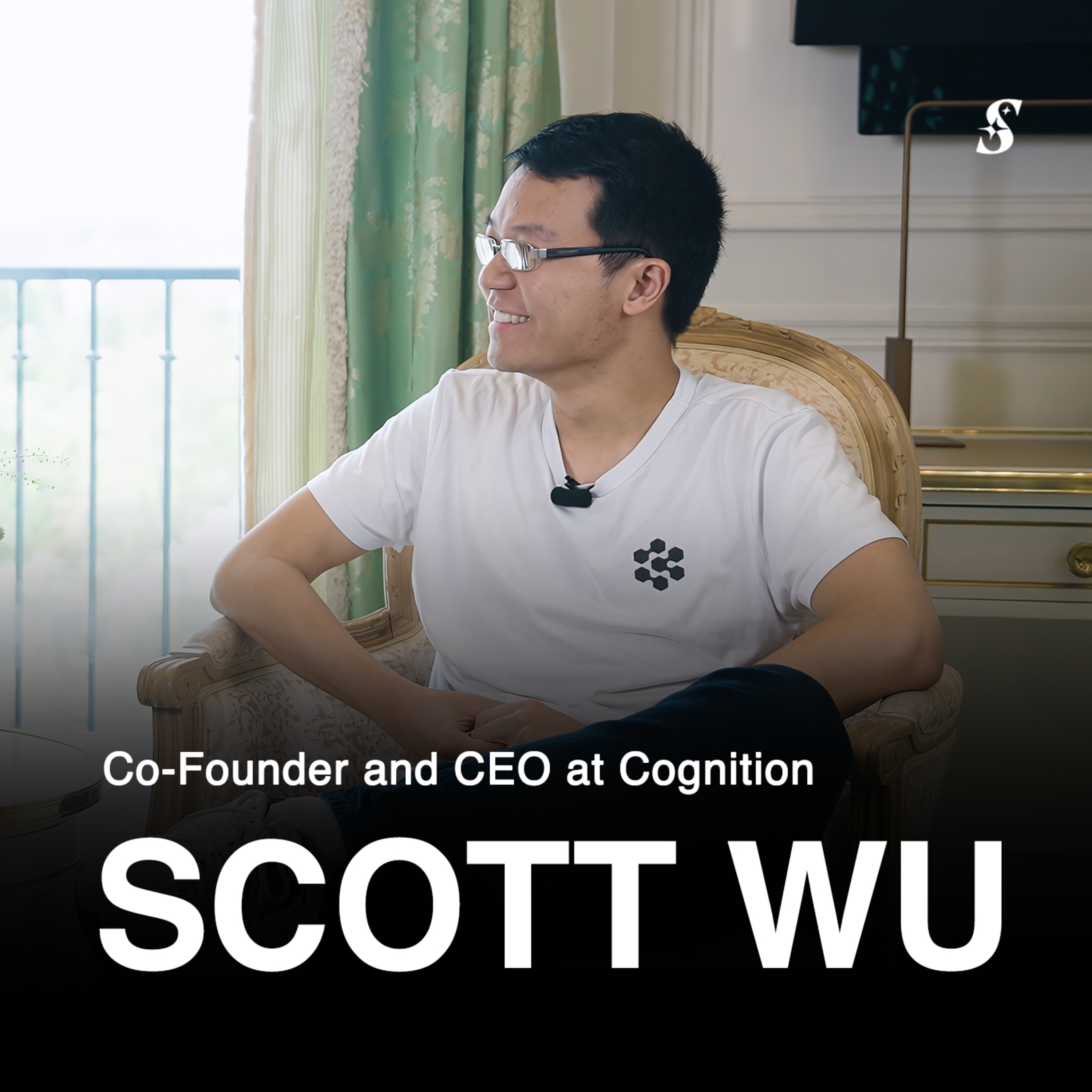
Scott Wu argues that focusing on AI's ability to make existing work more efficient misses the point. The real transformation comes from creating new capacity—enabling the development of things previously impossible, like "single-use software" or "self-driving software," fundamentally changing what businesses can build.
Focusing AI efforts on efficiency and cost reduction offers limited, short-term benefits. The truly transformative approach is to invest in AI to create new revenue streams, enhance product offerings, and grow the business exponentially.

Most view AI for efficiency, but its true power lies in handling routine tasks to free up human talent. This unlocks capacity for strategic, creative, and relationship-driven work that fuels innovation and growth, shifting the question from cost savings to new capabilities.
While AI-driven efficiency is an obvious first step, it often results in workforce reduction if company growth is flat. True differentiation and sustainable advantage come from using AI for innovation—creating new products, markets, and business models to fuel growth.

Initial AI productivity gains (e.g., turning a 2-day task into 10 minutes) are just the start. The true, transformative value emerges when business experts, newly empowered by AI thinking, use that saved time to pursue entirely new, previously impossible work, fundamentally changing business outcomes.