Get your free personalized podcast brief
We scan new podcasts and send you the top 5 insights daily.
AI-driven design exploration uncovers non-obvious solutions that outperform those based on human intuition. Engineers report that AI suggests designs they would have initially dismissed as unworkable, forcing them to re-evaluate their assumptions and learn new physical principles from the model's output.

Related Insights
AI won't replace designers because it lacks taste and subjective opinion. Instead, as AI gets better at generating highly opinionated (though not perfect) designs, it will serve as a powerful exploration tool. This plants more flags in the option space, allowing human designers to react, curate, and push the most promising directions further, amplifying their strategic role.

Experts across fields are experiencing AI solutions that are not just correct but elegant and human-like, solving problems they've worked on for decades. This 'Move 37' moment, named after the surprising Go move by AlphaGo, indicates AI is becoming a creative partner rather than just a productivity tool.

AI tools democratize prototyping, but their true power is in rapidly exploring multiple ideas (divergence) and then testing and refining them (convergence). This dramatically accelerates the creative and validation process before significant engineering resources are committed.

The goal isn't to build one perfect prototype quickly. The real strategic advantage of AI tools is the ability to generate three or four distinct variations of a feature in a short time. This allows teams to explore a wider solution space and make better decisions after hands-on testing.

Recursive Intelligence's AI develops unconventional, curved chip layouts that human designers considered too complex or risky. These "alien" designs optimize for power and speed by reducing wire lengths, demonstrating AI's ability to explore non-intuitive solution spaces beyond human creativity.

For physical design, simulation shouldn't just be a final verification step. Instead, it should be a tool used during model training to build the AI's intuition or "taste." This allows the model to generate high-quality designs quickly at inference time, mirroring how expert human engineers develop their skills.

Unlike text-based AI that relies on descriptive prompts, some advanced design tools for physical components work in reverse. The user defines 'no-go' zones and constraints, and the AI then generates numerous optimized design possibilities within those boundaries.

Radical AI's system explores chemical spaces that human experts intuitively avoid due to past assumptions. This allows it to successfully create novel alloys in elemental families that scientists had written off, demonstrating AI's power to overcome cognitive bias in research.
For creative work like design, AI's true value isn't just accelerating tasks. It's enabling designers to explore a much wider option space, test more possibilities, and apply more craft to the final choice. Since design is non-deterministic, AI serves creative exploration more than simple speed.
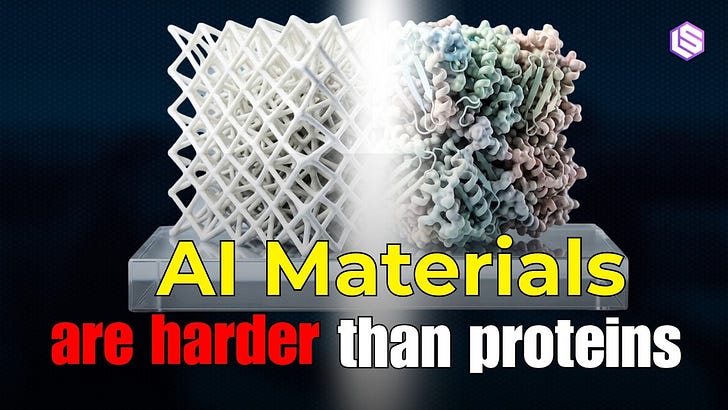
AI models can screen vast material spaces to identify novel solutions that defy conventional chemical intuition. Heather Kulik's group used AI to discover a quantum mechanical phenomenon that made a polymer four times tougher, a design experimentalists admitted they would never have conceived on their own.