Get your free personalized podcast brief
We scan new podcasts and send you the top 5 insights daily.
Instead of placing agents inside a pre-set environment, a more powerful approach for reasoning models is to start with just the agent. Then, give it the tools and skills to boot its own development stack as needed, granting it more autonomy and control over its workspace.

Related Insights
Running multiple, complex AI coding agents simultaneously is computationally prohibitive on local machines. Stripe's success relies on their ability to spin up numerous isolated cloud development environments in parallel, a crucial investment for any team serious about agentic engineering.

The next step for agents is self-awareness: understanding the specifics of their "harness"—the tools, APIs, and constraints of their environment. This awareness is a prerequisite for more advanced behaviors like identifying knowledge gaps and eventually modifying their own system prompts.
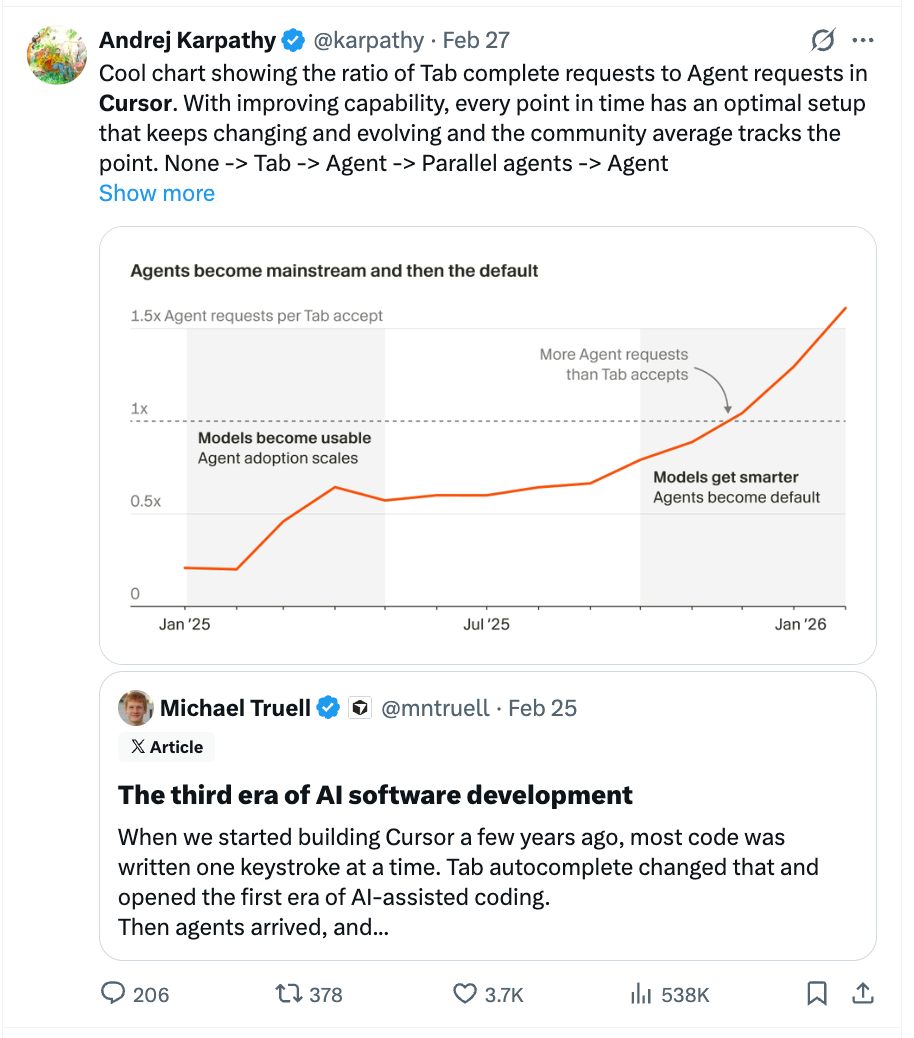
As AI generates more code than humans can review, the validation bottleneck emerges. The solution is providing agents with dedicated, sandboxed environments to run tests and verify functionality before a human sees the code, shifting review from process to outcome.

Cursor discovered that agents need more than just code access. Providing a full VM environment—a "brain in a box" where they can see pixels, run code, and use dev tools like a human—was the step-change needed to tackle entire features, not just minor edits.
Simply giving an AI agent thousands of tools is counterproductive. The real value lies in an 'agentic tool execution layer' that provides just-in-time discovery and managed execution to prevent the agent from getting overwhelmed by its options.

A new software paradigm, "agent-native architecture," treats AI as a core component, not an add-on. This progresses in levels: the agent can do any UI action, trigger any backend code, and finally, perform any developer task like writing and deploying new code, enabling user-driven app customization.

Unlike static tools, agents like Clawdbot can autonomously write and integrate new code. When faced with a new challenge, such as needing a voice interface or GUI control, it can build the required functionality itself, compounding its abilities over time.

The true capability of AI agents comes not just from the language model, but from having a full computing environment at their disposal. Vercel's internal data agent, D0, succeeds because it can write and run Python code, query Snowflake, and search the web within a sandbox environment.

Instead of a standard package install, providing a manual installation from a Git repository allows an AI agent to access and modify its own source code. This unique setup empowers the agent to reconfigure its functionality, restart, and gain new capabilities dynamically.

As AI agents evolve from information retrieval to active work (coding, QA testing, running simulations), they require dedicated, sandboxed computational environments. This creates a new infrastructure layer where every agent is provisioned its own 'computer,' moving far beyond simple API calls and creating a massive market opportunity.
