Get your free personalized podcast brief
We scan new podcasts and send you the top 5 insights daily.
Using the organizational AI "Claude Tag," trivial UI fixes and larger refactors are handled via Slack messages. The AI finds relevant code, creates a draft PR with screenshots, and manages the review process, dramatically accelerating the design-to-code execution loop.
Related Insights
The internal tool includes an annotation feature allowing users to comment directly on the live prototype. These comments are then queued up as tasks for the AI to execute, closing the loop from feedback to implementation and dramatically speeding up the iteration cycle.
Features like Anthropic's Claude Tag embed powerful AI capabilities directly into collaborative platforms like Slack. This moves AI from an individual tool to a group experience, giving non-technical team members access to advanced functions and providing the AI with persistent team context.

With 65% of its product code now written by Claude Tag, Anthropic shows that integrating powerful coding agents into simple chat interfaces enables entire teams to initiate production-ready features from conversations. This dramatically lowers the barrier to software creation for non-coders.
Ramp's internal tool, "Inspect," allows non-technical roles like PMs and designers to generate and merge production-ready code. This dramatically accelerates development for quality-of-life improvements and minor features, activating the entire company as builders, not just the engineering team.

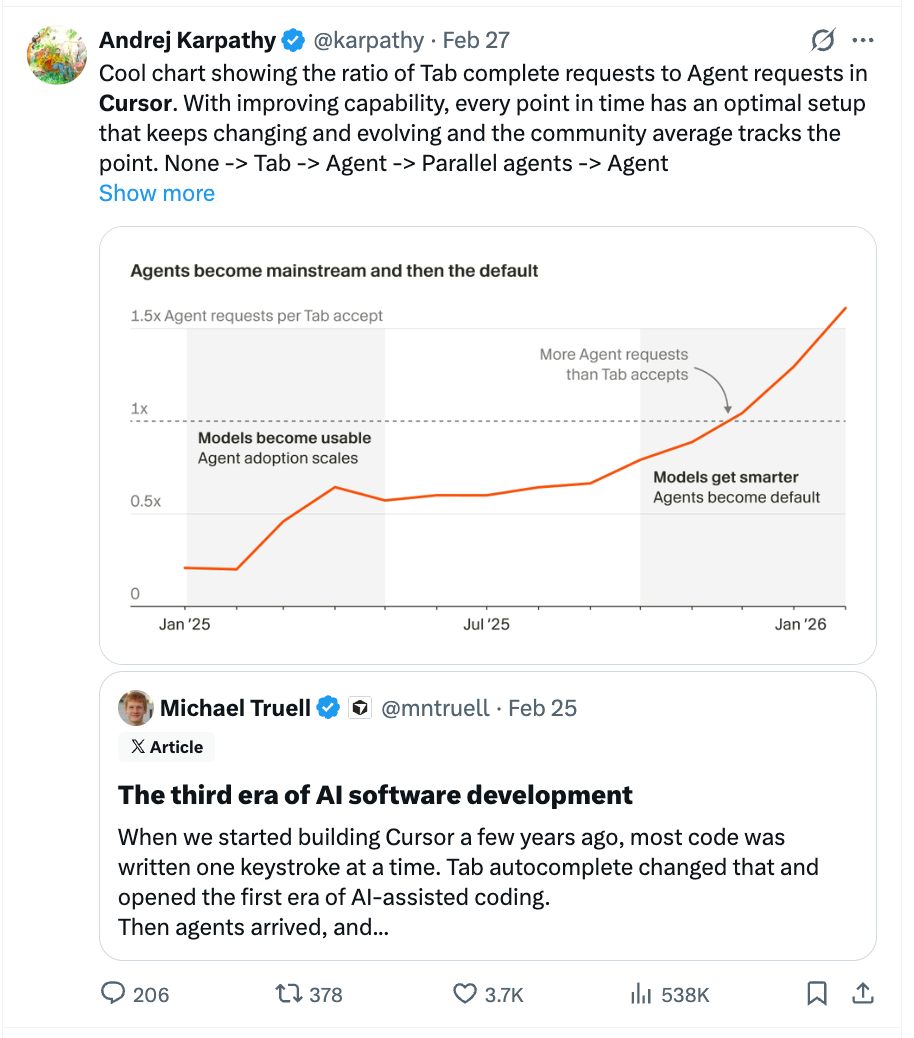
At Cursor, development is increasingly happening in Slack channels. Team members collectively kick off and redirect a cloud agent in a thread, turning development into a collaborative discussion. The IDE becomes a secondary tool, while communication platforms become the primary surface.
Technical executives who stopped coding due to time constraints and the cognitive overhead of modern frameworks are now actively contributing to their codebases again. AI agents handle the boilerplate and syntax, allowing them to focus on logic and product features, often working asynchronously between meetings.

Instead of a multi-week process involving PMs and engineers, a feature request in Slack can be assigned directly to an AI agent. The AI can understand the context from the thread, implement the change, and open a pull request, turning a simple request into a production feature with minimal human effort.
The lines between roles at Uber are blurring. Instead of prioritizing simple bug fixes with engineers, some product managers now use AI agents to write the code themselves. An engineer still reviews it, but this significantly speeds up minor development tasks and changes team dynamics.
AI tools like Claude Cowork can now handle complex tasks like app development, including UX/UI design and coding, from natural language prompts. This dramatically lowers the barrier to creating custom software, as demonstrated by one host building a fully functional meditation app in minutes.

Stripe engineers can initiate a full AI-driven coding task—including provisioning a dev environment and creating a pull request—simply by reacting to a Slack message with an emoji. This dramatically lowers the friction to start work by moving the entry point from a text editor to a chat app.