Get your free personalized podcast brief
We scan new podcasts and send you the top 5 insights daily.
Stripe engineers can initiate a full AI-driven coding task—including provisioning a dev environment and creating a pull request—simply by reacting to a Slack message with an emoji. This dramatically lowers the friction to start work by moving the entry point from a text editor to a chat app.
Related Insights
At Stripe, engineers now collaborate on crafting the perfect prompt to guide AI agents. This new form of teamwork focuses on articulating the problem clearly and providing the right context, rather than co-writing code line-by-line. This can involve other engineers, data sources, or even other agents.
Integrate AI agents directly into core workflows like Slack and institutionalize them as the "first line of response." By tagging the agent on every new bug, crash, or request, it provides an initial analysis or pull request that humans can then review, edit, or build upon.
Because AI agents operate autonomously, developers can now code collaboratively while on calls. They can brainstorm, kick off a feature build, and have it ready for production by the end of the meeting, transforming coding from a solo, heads-down activity to a social one.

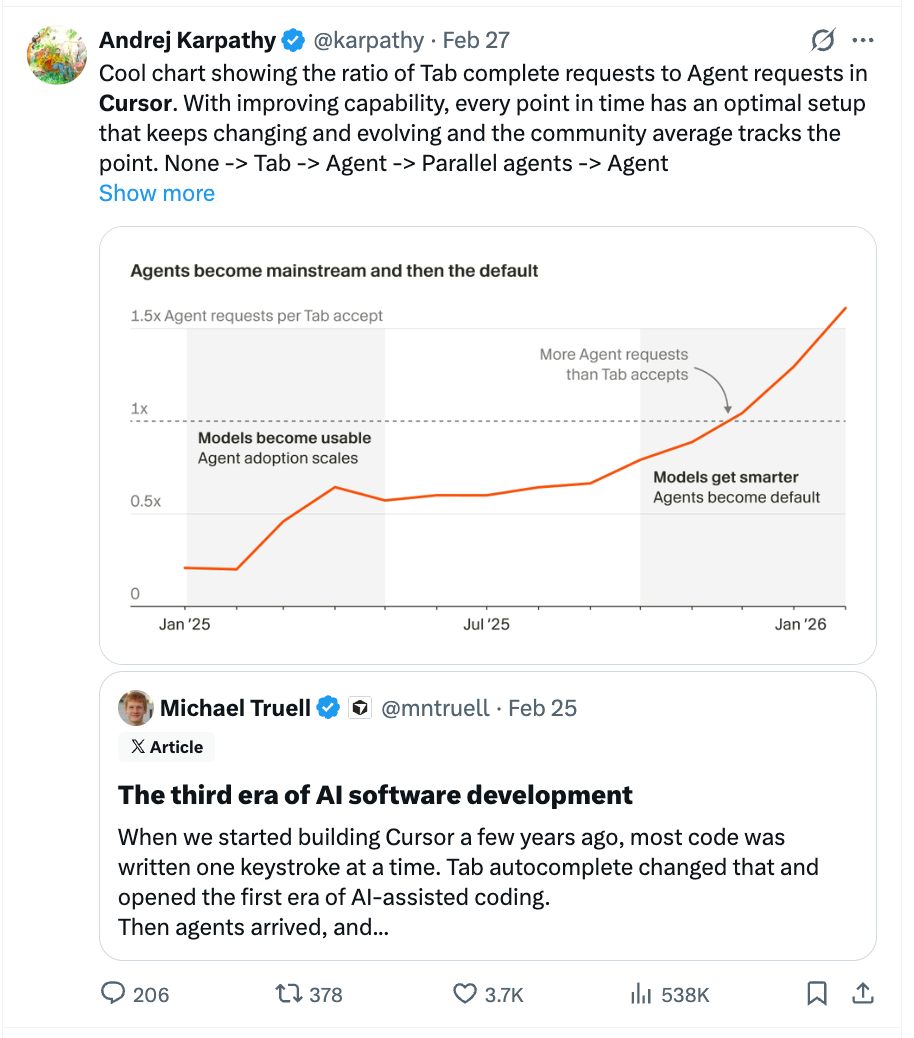
At Cursor, development is increasingly happening in Slack channels. Team members collectively kick off and redirect a cloud agent in a thread, turning development into a collaborative discussion. The IDE becomes a secondary tool, while communication platforms become the primary surface.
Using AI agents in shared Slack channels transforms coding from a solo activity into a collaborative one. Multiple team members can observe the agent's work, provide corrective feedback in the same thread, and collectively guide the task to completion, fostering shared knowledge.
Instead of a multi-week process involving PMs and engineers, a feature request in Slack can be assigned directly to an AI agent. The AI can understand the context from the thread, implement the change, and open a pull request, turning a simple request into a production feature with minimal human effort.
By building internal AI agents directly into Slack, their usage becomes public and visible. This visibility is key for driving adoption; seeing a bot turn a message into a PR creates a "holy shit" moment that sparks curiosity and makes others want to use the tool, creating a natural viral effect.

Spotify has shifted from AI as a developer 'copilot' to AI as the primary coder for senior staff. Top developers now provide natural language instructions for bug fixes or features via Slack during their commute, with an internal platform autonomously writing, validating, and deploying the code to production. This marks a profound change in the software development lifecycle.

A primary benefit of Stripe's 'minions' is reducing the mental and procedural friction to begin a task. Instead of setting up an environment and opening a text editor, an engineer can trigger work from a Slack message, making it easier to tackle small fixes, prototypes, or documentation updates immediately.
Stripe's investment in developer productivity tools for engineers created a structured environment, or "blessed path," that also dramatically improves the success rate of their AI coding agents. Improving DX for your team has a dual benefit for AI adoption.