Get your free personalized podcast brief
We scan new podcasts and send you the top 5 insights daily.
Robinhood's strategy is not just to offer prediction markets as a standalone product. They serve as a top-of-funnel acquisition channel, attracting new, gaming-oriented users who can then be introduced to more stable, long-term products like retirement accounts and banking services.

Related Insights
New platforms frame betting on future events as sophisticated 'trading,' akin to stock markets. This rebranding as 'prediction markets' helps them bypass traditional gambling regulations and attract users who might otherwise shun betting, positioning it as an intellectual or financial activity rather than a game of chance.

While Coinbase's stock is tied to volatile crypto prices, Robinhood's shares tripled by diversifying and aggressively launching new products. Its prediction markets, launched in late 2024, capitalized on a favorable regulatory environment and became the company's fastest-growing business line in its history.

CEO Vlad Tenev views prediction markets as a tool to disrupt massive industries like insurance. He highlights using weather markets to hedge against fire or hurricane risk, creating bespoke, competitive financial products that bypass the cumbersome, expensive traditional insurance brokerage process.
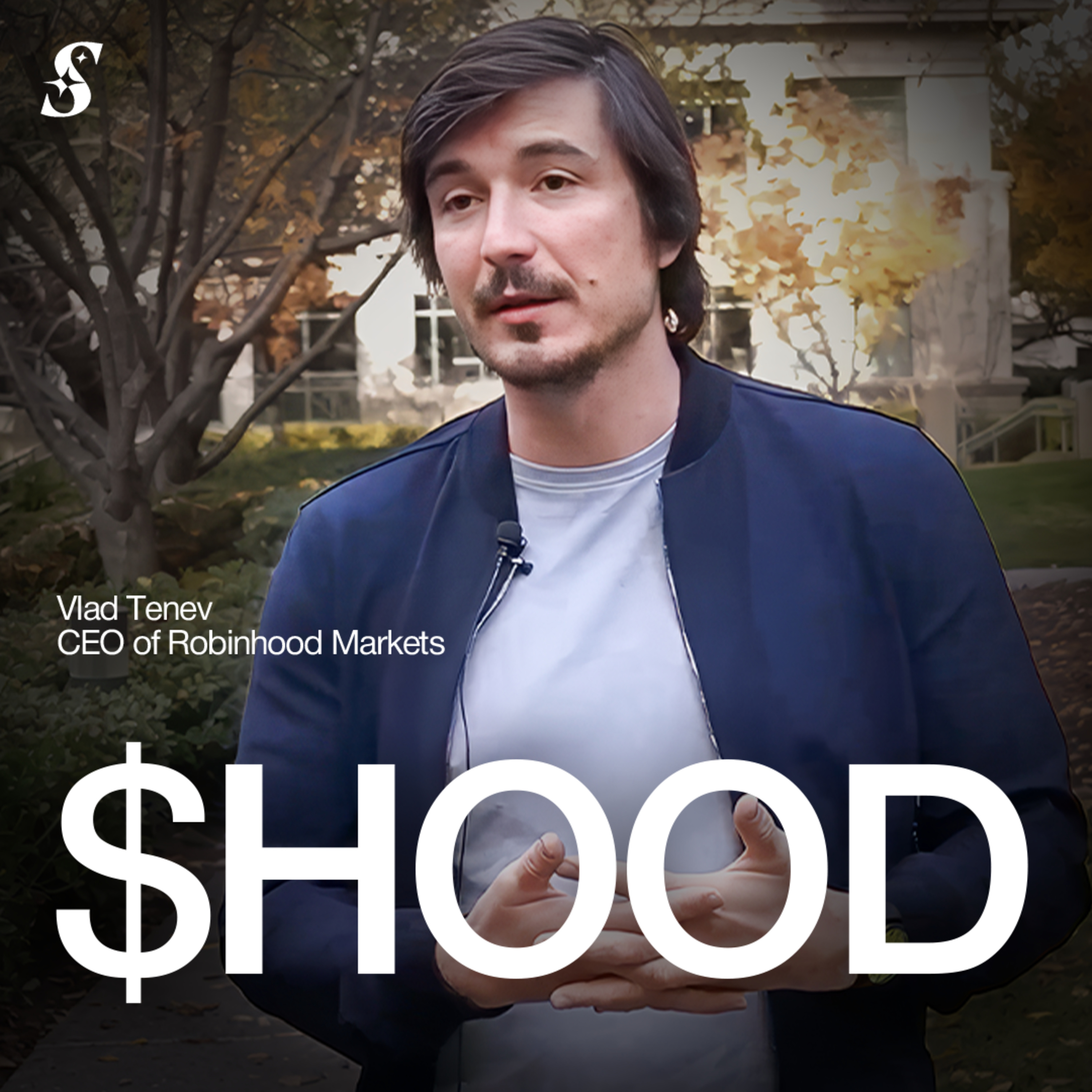
Robinhood CEO Vlad Tenev revealed prediction markets were a distant "2026 plan" until a Supreme Court decision legalized presidential betting. This single regulatory catalyst prompted Robinhood to rush the product to market, where it became a massive success, showing how external events can dramatically accelerate product adoption.

Robinhood users spend two hours a month in the app—5-10x more than users of banking or payment apps like Venmo. This high engagement creates a powerful, low-cost funnel for cross-selling new banking products like credit cards and savings accounts, giving it a key advantage over other fintechs attempting to expand their services.
![Robinhood: Mobile First, Margins Later - [Business Breakdowns, EP.233] thumbnail](https://megaphone.imgix.net/podcasts/943e2e96-b60b-11f0-9176-5bf614c23973/image/074f062475dc76689adfc59319a4e04d.jpg?ixlib=rails-4.3.1&max-w=3000&max-h=3000&fit=crop&auto=format,compress)
Robinhood's zero-commission model was viable because it sidestepped the massive customer acquisition costs (CAC) of its competitors. In 2016, incumbents like E-Trade were spending over $1,000 per customer on marketing, while Robinhood's viral growth made its CAC effectively zero.
Prediction markets are accelerating their normalization by integrating directly into established ecosystems. Partnerships with Google, Robinhood, and the NYSE's owner embed gambling-like activities into everyday financial and informational tools, lowering barriers to entry and lending them legitimacy.
CEO Vlad Tenev considers 2022 the "refounding" of Robinhood. The business model strategically shifted from catering primarily to first-time investors to focusing on more sophisticated, resilient active traders. This pivot drove a 5x increase in product velocity (from one to five major new products per year) and built a more cycle-agnostic business.
Beyond speculation, Robinhood frames prediction markets as a precise hedging tool for real-world risks. A consumer could use a weather contract to financially protect their home from a hurricane, for example, bypassing the high cost and complexity of traditional insurance policies.
Robinhood discovered a counter-intuitive marketing approach: older customers are attracted to the "cool, new thing," while younger, Gen Z customers respond more strongly to messages of stability and longevity. This inversion challenges traditional assumptions about generational marketing in finance.
