Get your free personalized podcast brief
We scan new podcasts and send you the top 5 insights daily.
The value of a harness extends beyond the primary task, like fixing a bug. It can enforce a strict, multi-step process for outcomes, such as automatically documenting the fix in a tool like Linear, generating a specific report format, and initiating customer follow-up, ensuring process consistency.

Related Insights
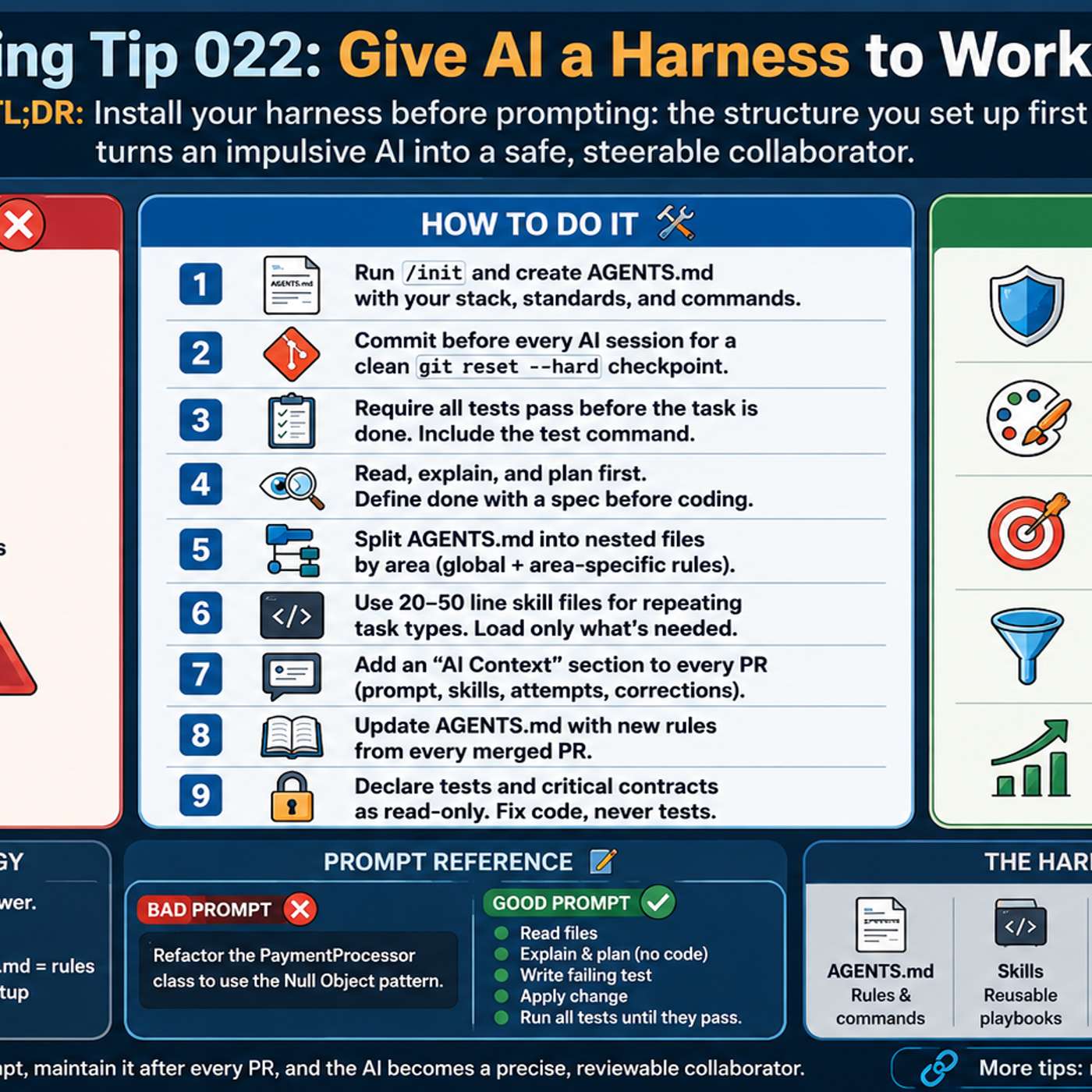
Instead of relying on engineers to remember documented procedures (e.g., pre-commit checklists), encode these processes into custom AI skills. This turns static best-practice documents into automated, executable tools that enforce standards and reduce toil.

An AI agent monitors a support inbox, identifies a bug report, cross-references it with the GitHub codebase to find the issue, suggests probable causes, and then passes the task to another AI to write the fix. This automates the entire debugging lifecycle.

Implementing a comprehensive AI harness requires significant upfront investment. This setup is unnecessary for simple, low-risk tasks like fixing a typo or a minor CSS tweak. The key is to apply controls proportionally, using a full harness for complex changes while allowing simple prompts for minor fixes.
Proving the ROI for developer productivity tools is challenging, as studies on their impact are often inconclusive. A more defensible business model focuses on outright automation of specific tasks (e.g., auto-updating documentation in CI). This provides a clear, outcome-oriented value proposition that is easier to sell.

Use Linear to create engineering tasks that trigger OpenAI's Symphony framework. Agents execute tasks, submit PRs for human review, and autonomously rework based on comments, turning Linear into a central state machine for your codebase that can be managed from anywhere.

When an agent fixes a production issue, a human can instruct it via Slack to also update the core reliability documentation. This not only solves the immediate problem but durably encodes the process knowledge, turning ephemeral conversations into persistent, automated process improvements.
While a powerful model like Mythos was helpful, the real breakthrough came from a custom-built 'harness' that gave the AI specific tools and integrated it into Mozilla's existing bug-fixing pipeline, turning raw model output into verified, actionable reports.
A harness isn't necessarily another AI layer. It's often deterministic code that wraps an AI agent to enforce a specific, repeatable workflow. This 'micromanagement' approach ensures consistency and efficiency for specialized tasks, which general-purpose AI tools lack.
Linear believes AI coding agents remove any excuse for having bugs in a product. They implement a 'zero bugs' policy with a one-week fix SLA. AI agents can now perform the initial triage and even attempt a fix, then tag an engineer for review, dramatically accelerating bug resolution.

Use AI to manage its own development tasks. After a brain dump of project goals, have the AI create tickets in a tool like Linear. Then, let the AI work through the tickets and update its own statuses, significantly reducing your mental load and freeing you up for higher-level review.
