Get your free personalized podcast brief
We scan new podcasts and send you the top 5 insights daily.
A self-referential or self-modifying model, which generates its own update values based on its current state and inputs, is more powerful than a static one. This process is akin to 'learning how to learn,' allowing for greater adaptability and performance on sequential reasoning tasks.

Related Insights
A static agent doesn't improve. To create a continuously learning system, build a secondary agent that observes a human's corrections. This "learner" agent synthesizes patterns from the feedback and suggests updates to the primary agent's instructions, creating a powerful self-improvement cycle.

The concept that AIs can build better AIs, creating an accelerating feedback loop, is no longer theoretical. Leaders from Anthropic, OpenAI, and Google DeepMind have publicly confirmed they are actively using current AI models to develop the next generation, making RSI a practical engineering pursuit.

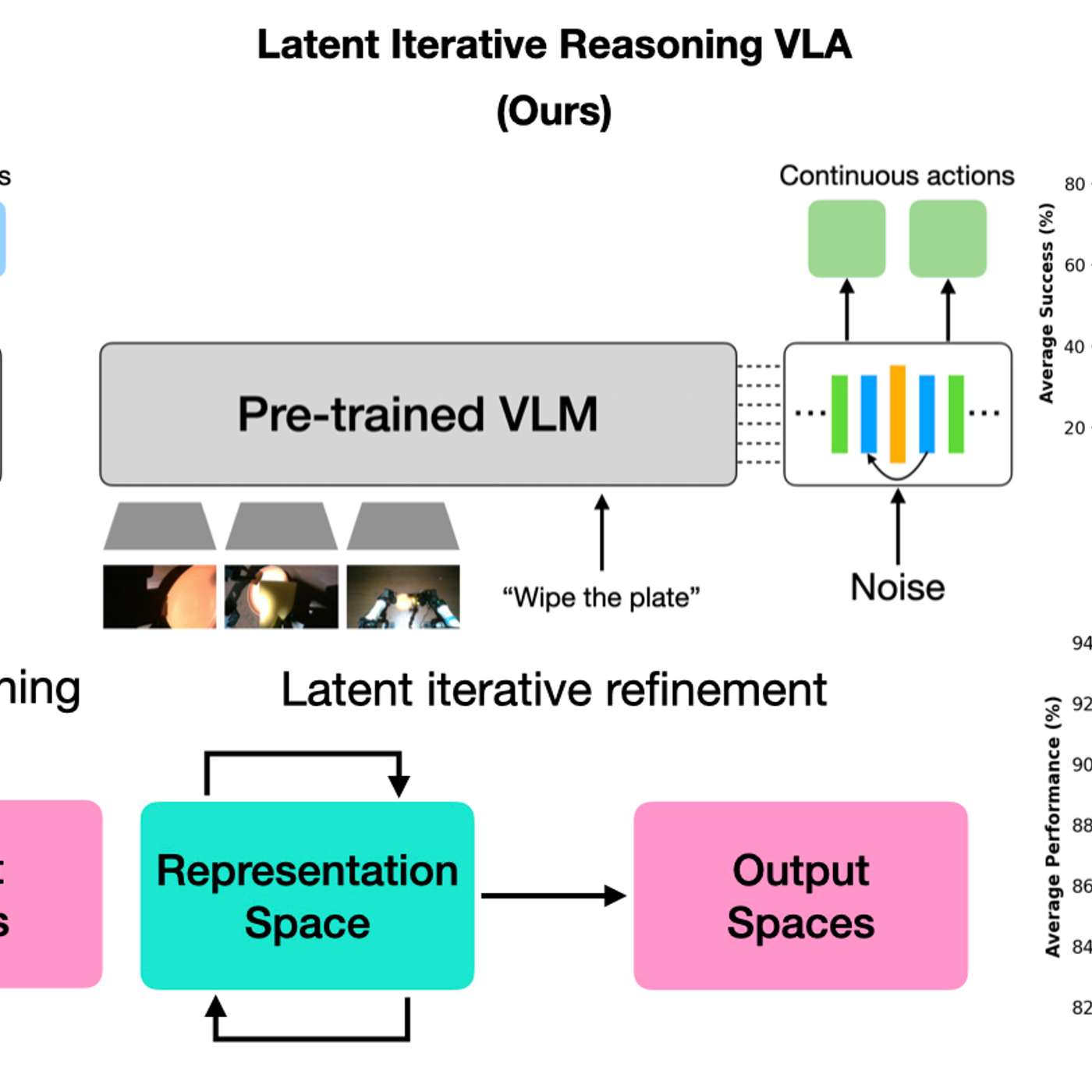
A new model architecture allows robots to vary their internal 'thinking' iterations at test time. This lets practitioners trade response speed for decision accuracy on a case-by-case basis, boosting performance on complex tasks without needing to retrain the model.
Instead of just expanding context windows, the next architectural shift is toward models that learn to manage their own context. Inspired by Recursive Language Models (RLMs), these agents will actively retrieve, transform, and store information in a persistent state, enabling more effective long-horizon reasoning.

Static data scraped from the web is becoming less central to AI training. The new frontier is "dynamic data," where models learn through trial-and-error in synthetic environments (like solving math problems), effectively creating their own training material via reinforcement learning.

The next evolution for AI agents is recursive learning: programming them to run tasks on a schedule to update their own knowledge. For example, an agent could study the latest YouTube thumbnail trends daily to improve its own thumbnail generation skill.

The key to a truly intelligent enterprise AI is not a static model, but one that uses reinforcement learning (RL) to continuously update its own weights overnight based on daily interactions, a concept known as 'continuous learning'.

The key to continual learning is not just a longer context window, but a new architecture with a spectrum of memory types. "Nested learning" proposes a model with different layers that update at different frequencies—from transient working memory to persistent core knowledge—mimicking how humans learn without catastrophic forgetting.

A major flaw in current AI is that models are frozen after training and don't learn from new interactions. "Nested Learning," a new technique from Google, offers a path for models to continually update, mimicking a key aspect of human intelligence and overcoming this static limitation.

Build a feedback loop where an AI system captures performance data for the content it creates. It then analyzes what worked and automatically updates its own skills and models to improve future output, creating a system that learns.
