Get your free personalized podcast brief
We scan new podcasts and send you the top 5 insights daily.
When text used to generate tokenizers differs from the data used during training, anomalies like SolidGoldMagikarp emerge. The model treats these rare strings as common single words like 'the', which triggers erratic, unmapped behaviors when users input those tokens during inference.

Related Insights
Unlike older methods that use an "unknown" placeholder, modern tokenizers built on Byte-Pair Encoding (BPE) can represent any string. When faced with a new word, they don't crash or lose information. Instead, they break it down into the smallest known components, ensuring universal representability.

An LLM's core training objective—predicting the next token—makes it sensitive to the raw frequency of words and numbers online. This creates a subtle but profound flaw: it's more likely to output '30' than '29' in a counting task, not because of logic, but because '30' is statistically more common in its training data.

A generic tokenizer trained on web text might break a medical term like "myocardial" into meaningless pieces. A specialized tokenizer trained on medical texts would keep it as a single unit. This preserves meaning, improves learning efficiency, and prevents wasting the model's limited context window on fragmented words.
Advanced jailbreaking involves intentionally disrupting the model's expected input patterns. Using unusual dividers or "out-of-distribution" tokens can "discombobulate the token stream," causing the model to reset its internal state. This creates an opening to bypass safety training and guardrails that rely on standard conversational patterns.

Beyond the obvious lack of non-English training data, Large Language Models are architecturally biased. Their tokenization process, designed for English, inefficiently breaks down other languages into more fragments. This increases operational costs and reduces comprehension, creating a structural disadvantage.

Models like ChatGPT struggle with basic string manipulation because their fundamental unit of understanding is a "token," which can be a whole word or a sub-word. If a word like "Strawberry" is tokenized into pieces, the model cannot "see" the individual letters to perform tasks like counting them.
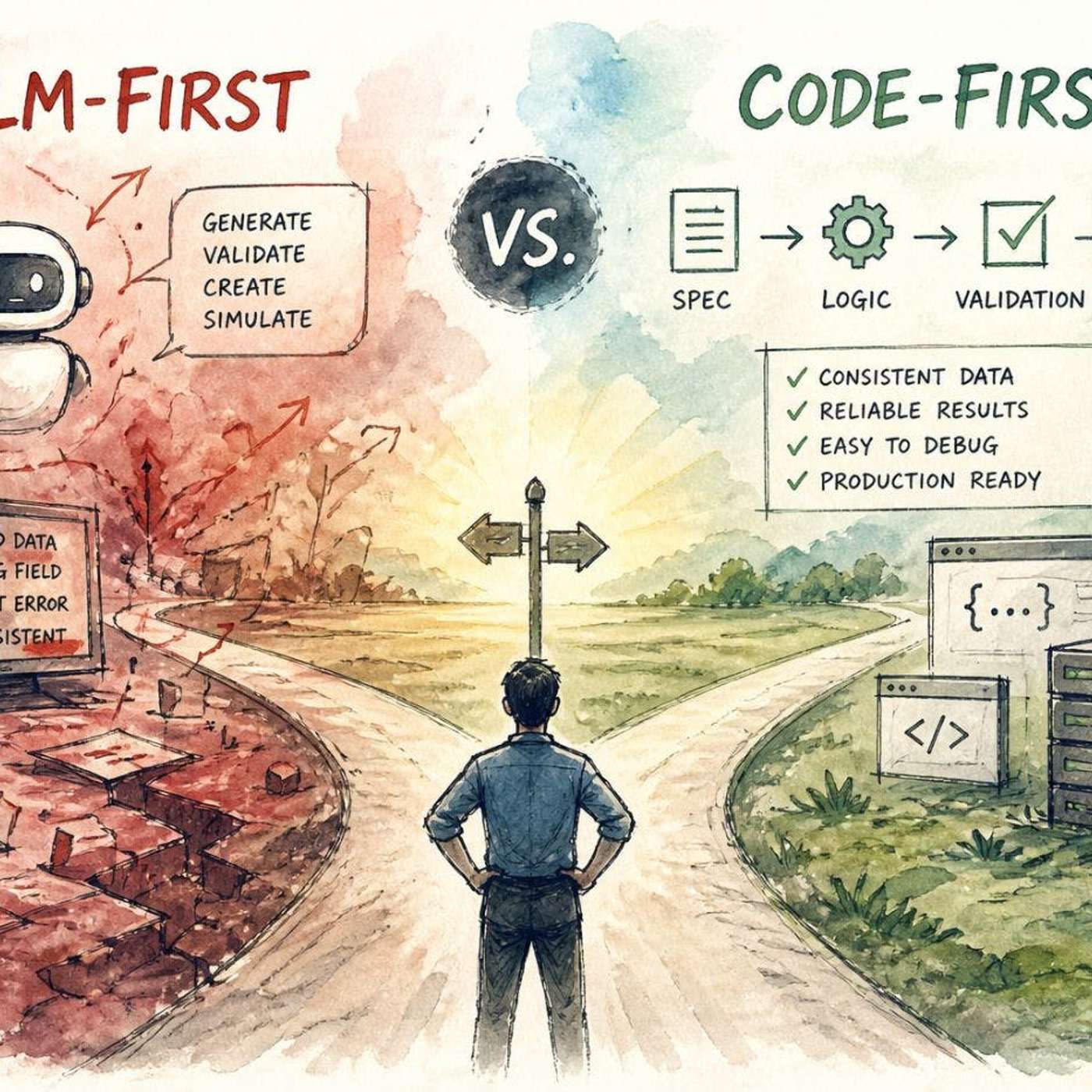
LLMs in production don't often crash spectacularly. Instead, they introduce subtle, probabilistic errors—like incorrect enum values or missing fields—that are hard to debug because they lack clear error patterns, unlike deterministic code failures.
For languages like Sanskrit, a single visual character is often composed of multiple Unicode code points. Standard tokenization breaks these apart into 'orthographic shrapnel', forcing the model to relearn spelling. Splitting by grapheme clusters preserves the meaningful units, making invalid output unrepresentable.
An LLM tasked with choosing a product category generated IDs that looked valid but were non-existent or incorrect. Because these fake IDs didn't trigger errors, they produced silently wrong results. The solution is to always validate model-generated identifiers against an authoritative list.
LLMs are trained to produce high-probability, common information, making it hard to surface rare knowledge. The solution is to programmatically create prompts that combine unlikely concepts. This forces the model into an improbable state, compelling it to search the long tail of its knowledge base rather than relying on common associations.