Get your free personalized podcast brief
We scan new podcasts and send you the top 5 insights daily.
Letting AI coding agents write raw code directly creates fragility and reinvents compliance logic. Instead, OutSystems directs agents to manipulate an intermediate abstraction representing application intent. Once the abstract model satisfies functional needs, deterministic code generation produces the application while automatically inheriting pre-configured enterprise control planes, security standards, and role-based access controls without breaking existing systems.

Related Insights
For core business automations, agentic AIs that "guess" are expensive and unreliable. A superior approach uses tools that convert natural language into deterministic, code-like workflows, which run consistently and use AI only when necessary.

AI models often produce functional but sloppy code. To combat this, embed a specific software architecture, like a "service layer architecture," into the agent's instructions. This forces the AI to write clean, organized, and human-readable code crucial for long-term maintenance and collaboration.

Contrary to the vision of free-wheeling autonomous agents, most business automation relies on strict Standard Operating Procedures (SOPs). Products like OpenAI's Agent Builder succeed by providing deterministic, node-based workflows that enforce business logic, which is more valuable than pure autonomy.

Don't give LLMs full control. Use deterministic code for core logic, validation, and enforcing rules. Delegate only tasks requiring flexibility or understanding of unstructured input to the LLM, treating it as a specialized component, not the entire system.
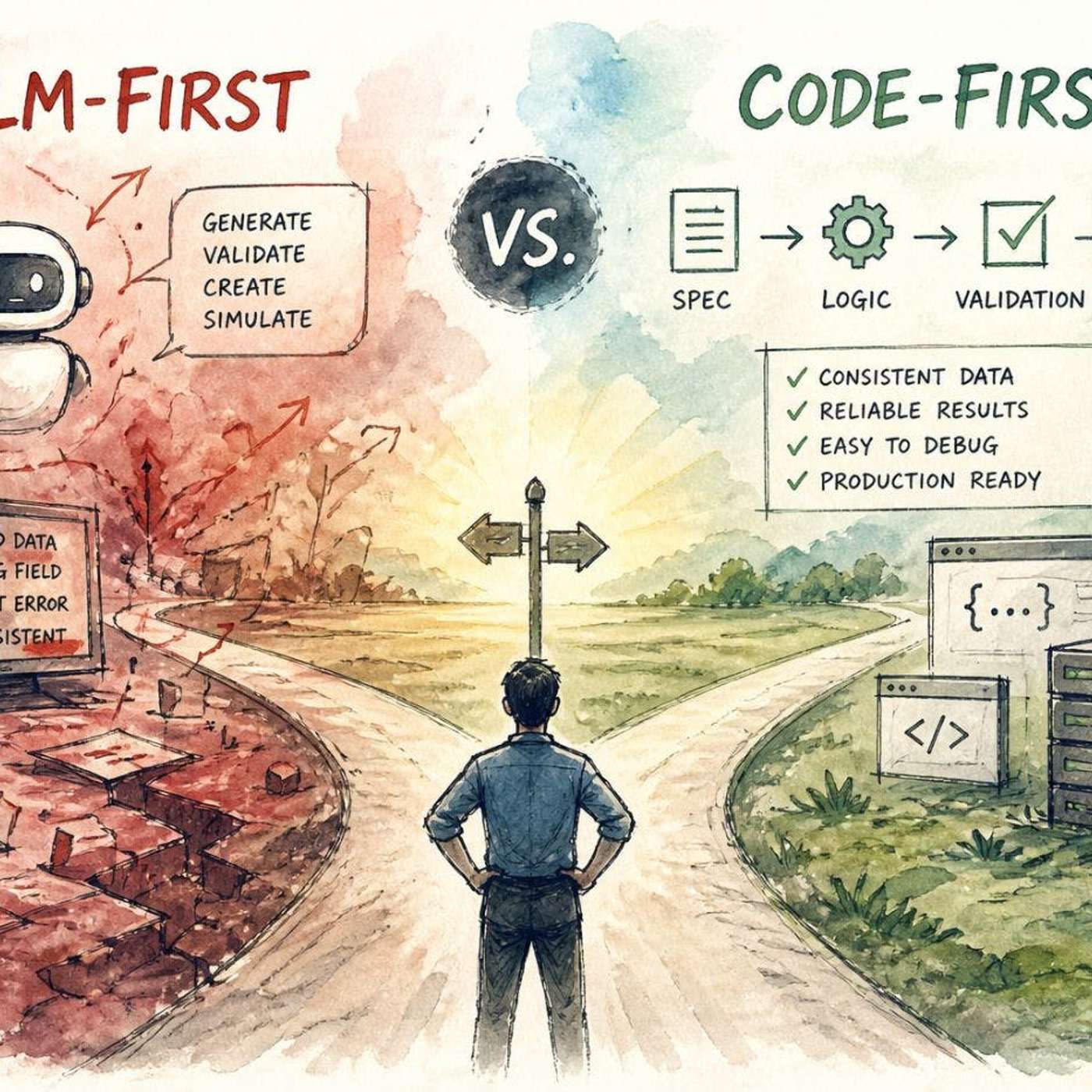
Future-proofing is no longer just about scalable code. It's about creating systems with primitives and abstractions that AI agents can understand and reason about. This applies to both technical infrastructure and operational documents like SOPs, which must be made machine-legible.

To prevent a "ball of mud" codebase, OpenAI's system defines strict architectural layers using package boundaries and folder structures. By convention and tooling, different roles are restricted to specific layers—designers to the UI, PMs to business logic—ensuring modularity and preventing architectural decay.

To control costs, security, and governance, enterprises are moving from interactive, ad-hoc agent use to a 'software factory' model. This approach systematizes the entire work lifecycle, automating processes and minimizing the risks associated with inconsistent human operation of powerful AI tools.

Relying solely on natural language prompts like 'always do this' is unreliable for enterprise AI. LLMs struggle with deterministic logic. Salesforce developed 'AgentForce Script,' a dedicated language to enforce rules and ensure consistent, repeatable performance for critical business workflows, blending it with LLM reasoning.

Chamath's "Software Factory" is a control plane for the entire SDLC, not just a coding tool. It provides governance, auditability, and synchronization from intent to production. This is the level of rigor large, regulated enterprises need, contrasting sharply with simple "vibe coding" assistants.

Fully autonomous AI agents are not yet viable in enterprises. Alloy Automation builds "semi-deterministic" agents that combine AI's reasoning with deterministic workflows, escalating to a human when confidence is low to ensure safety and compliance.