Get your free personalized podcast brief
We scan new podcasts and send you the top 5 insights daily.
Designing new materials involves balancing multiple competing objectives, like cost, stability, and performance. Active learning is particularly powerful for navigating these trade-offs, offering a 100-1000x speedup for each objective you add, making it ideal for finding the 'needle in a haystack' material.
Related Insights
Prof. Cho argues that modern models already extract most correlations from passive datasets. The next leap in sample efficiency will come from AI agents that can actively choose what data to collect, intentionally making rare, insightful events ("aha moments") more frequent.

Instead of training models to generalize across many problems, this approach focuses on finding the single best solution for one specific task, like a new material or algorithm. The model itself can be discarded; the value is in the single, world-changing artifact it produces.

The traditional scientific method in materials science—hypothesize, experiment, learn—is being replaced. AI enables a new paradigm: treating the vast space of all possible molecules as a searchable database. Scientists can now query for materials with desired properties, radically accelerating discovery.

Google DeepMind's AI has expanded the catalog of known stable crystals from 40,000 to over 400,000. These AI-predicted materials are now being lab-tested and could lead to breakthroughs in physics-limited industries by enabling technologies like better electric vehicle batteries and superconductors.

Designing a chip is not a monolithic problem that a single AI model like an LLM can solve. It requires a hybrid approach. While LLMs excel at language and code-related stages, other components like physical layout are large-scale optimization problems best solved by specialized graph-based reinforcement learning agents.

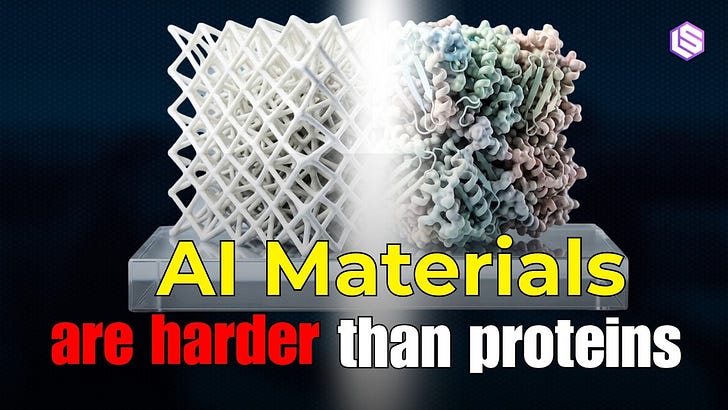
Unlike protein folding, which benefited from the CASP competition's experimental ground truth data, materials science lacks large-scale, high-quality experimental datasets. Existing data often comes from low-fidelity simulations, meaning even the best AI models are trained on imperfect information, hindering a major breakthrough.
After two decades of experience and carefully tuning a model by hand, Karpathy was surprised when his automated research agent, running overnight, discovered superior hyperparameter configurations he had missed. This shows AI's power to surpass deep human expertise in objective optimization tasks.

Instead of running hundreds of brute-force experiments, machine learning models analyze historical data to predict which parameter combinations will succeed. This allows teams to focus on a few dozen targeted experiments to achieve the same process confidence, compressing months of work into weeks.

Instead of exhaustively listing all possible database indexes, the IA2 system uses a smarter approach. It employs validation rules, permutations, and heuristics to generate a refined set of high-potential index candidates. This creates a more focused and relevant "action space" for the reinforcement learning agent to explore, leading to more efficient training and better index selection.

AI models can screen vast material spaces to identify novel solutions that defy conventional chemical intuition. Heather Kulik's group used AI to discover a quantum mechanical phenomenon that made a polymer four times tougher, a design experimentalists admitted they would never have conceived on their own.