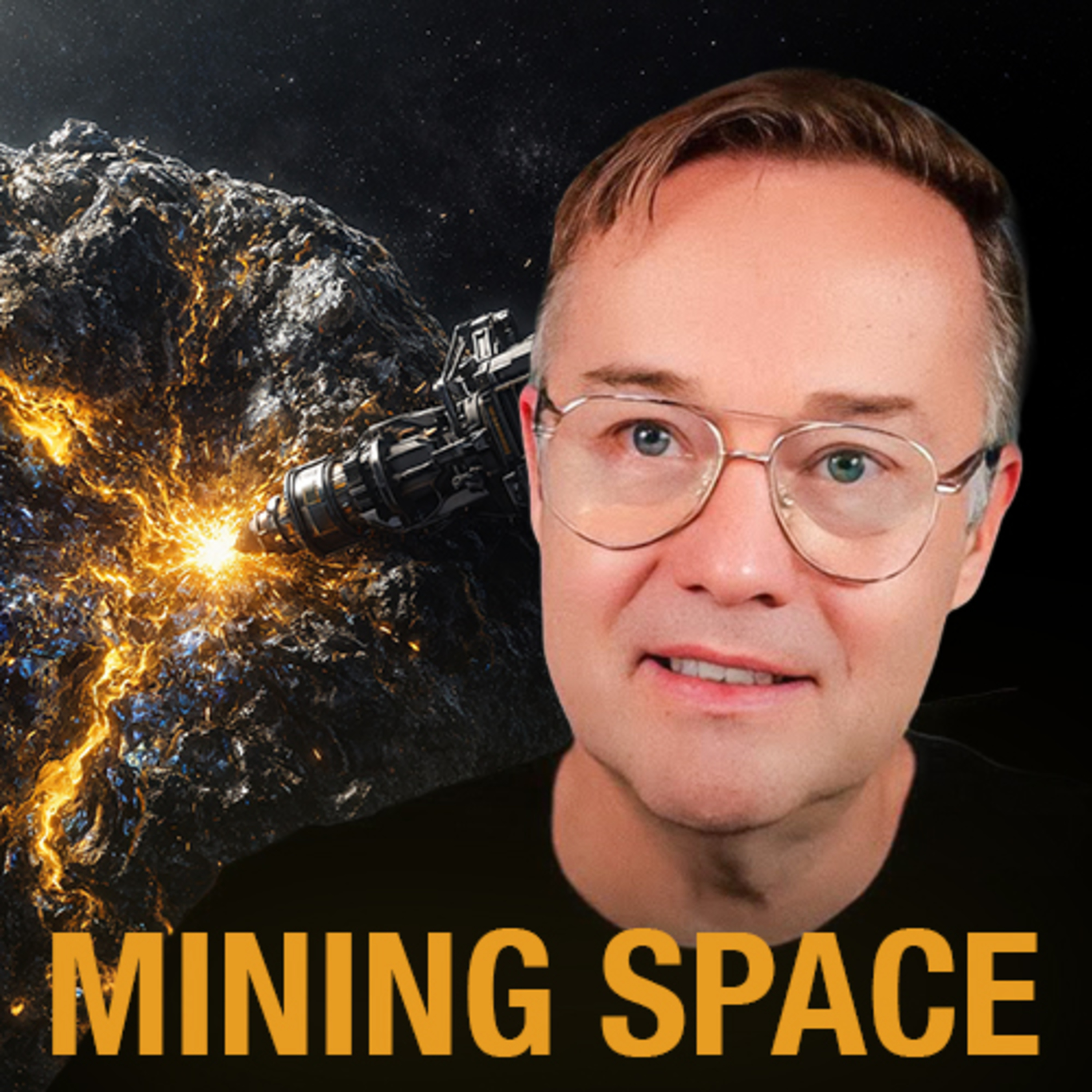
AstroForge's CEO Matt Gialich details the unit economics of their missions. Each mission costs around $10.4 million with a potential return of $105 million from platinum group metals. This high-risk, high-reward model only needs a 1-in-10 success rate to be viable, framing it like an angel investment portfolio.
AstroForge's approach to landing on near-earth asteroids is more like a docking procedure than a traditional landing. By targeting specific metal-rich asteroids, which are magnetic, their spacecraft can simply use magnets to attach itself to the surface, a more delicate and efficient method than depicted in sci-fi.
The primary driver for AstroForge's asteroid mining isn't just securing rare materials, but achieving superior economics. CEO Matt Gialich states their model could yield 90% gross margins, a stark contrast to the 14% margins of the world's best platinum mines in South Africa, fundamentally changing the industry's financial landscape.
AstroForge's CEO Matt Gialich champions radical transparency, especially after setbacks. When their Odin mission failed, the company published detailed articles explaining exactly what went wrong and how they planned to fix it. This approach builds trust with stakeholders and institutionalizes learning from mistakes.
Templar's Sam Dare clarifies that BitTensor (Tau) abstracts the blockchain to its most fundamental layer: incentives. Instead of focusing on smart contracts or value transfer, it provides a framework for creating "incentive games" where self-interested miners are compelled to produce valuable outputs, like training an AI model, to earn rewards.
Templar's decentralized AI training model doesn't require specific GPUs. Instead, it defines the validation criteria for a correct output. This forces miners to find the most economically efficient hardware and software combination to solve the problem, a process Sam Dare calls "emergence," where optimal solutions arise from the incentive structure itself.
Sam Dare of Templar frames decentralized AI's mission not as direct competition with giants like OpenAI, but as creating optionality. It enables a new market for those who cannot afford massive, centralized training runs, such as nations seeking "Sovereign AI" or researchers exploring niche pre-training, thereby expanding the market.
OpenOats creator Yazeen Alirahim's core vision was beyond transcription. Inspired by Y Combinator's internal "startup manual," the goal was to create an agent that surfaces relevant, curated wisdom from a knowledge base in real-time during conversations, providing insights that users wouldn't have thought to look up themselves.
To handle the influx of contributions to his OpenOats project, creator Yazeen Alirahim built "Auto Maintainer," an AI bot powered by Claude. This bot autonomously manages the GitHub repository by researching bugs, responding to issues, creating pull requests, merging code, and deploying fixes, escalating only high-risk issues to him.
The reported $5.6 billion budget for HBO's new Harry Potter series is justified by focusing on long-term customer value. The goal is to acquire a small percentage of the 100M+ global fanbase as loyal subscribers, whose lifetime value and downstream revenue from theme parks and merchandise makes the investment viable.
Templar's Sam Dare argues the perceived GPU scarcity is misunderstood. The actual bottleneck is the limited supply of the latest, well-connected GPUs in data centers. His project aims to create algorithms that can effectively utilize the vast, distributed network of consumer-grade and older enterprise GPUs, unlocking a massive new compute resource.
To achieve its disruptive $10 million mission cost, AstroForge makes a critical trade-off: data bandwidth. CEO Matt Gialich explains they operate at an extremely low data rate of just 400 bits per second at the asteroid. This makes high-fidelity video impossible but keeps essential communication affordable for a commercial deep space venture.