Get your free personalized podcast brief
We scan new podcasts and send you the top 5 insights daily.
A common anti-pattern is interleaving dynamic data like UI state or user permissions directly into the conversational history sent to an LLM. This 'poisons the semantic chain' and causes context loss. Resilient systems use strict schema separation, placing system telemetry in a dedicated configuration block within the prompt.

Related Insights
Instead of relying on lossy LLM-based summarization, architect agent memory into three tiers: an ephemeral scratchpad for immediate tasks, a deterministic state machine for history (e.g., Redis), and a semantic anchor (e.g., vector store) for global knowledge lookup.

Relying on the context of a chat session is a mistake, as it disappears or gets compacted over time. To ensure consistent AI behavior and create a traceable record, rules and project context must be externalized into version-controlled 'skill files' or configurations that the AI reads at the start of every session.
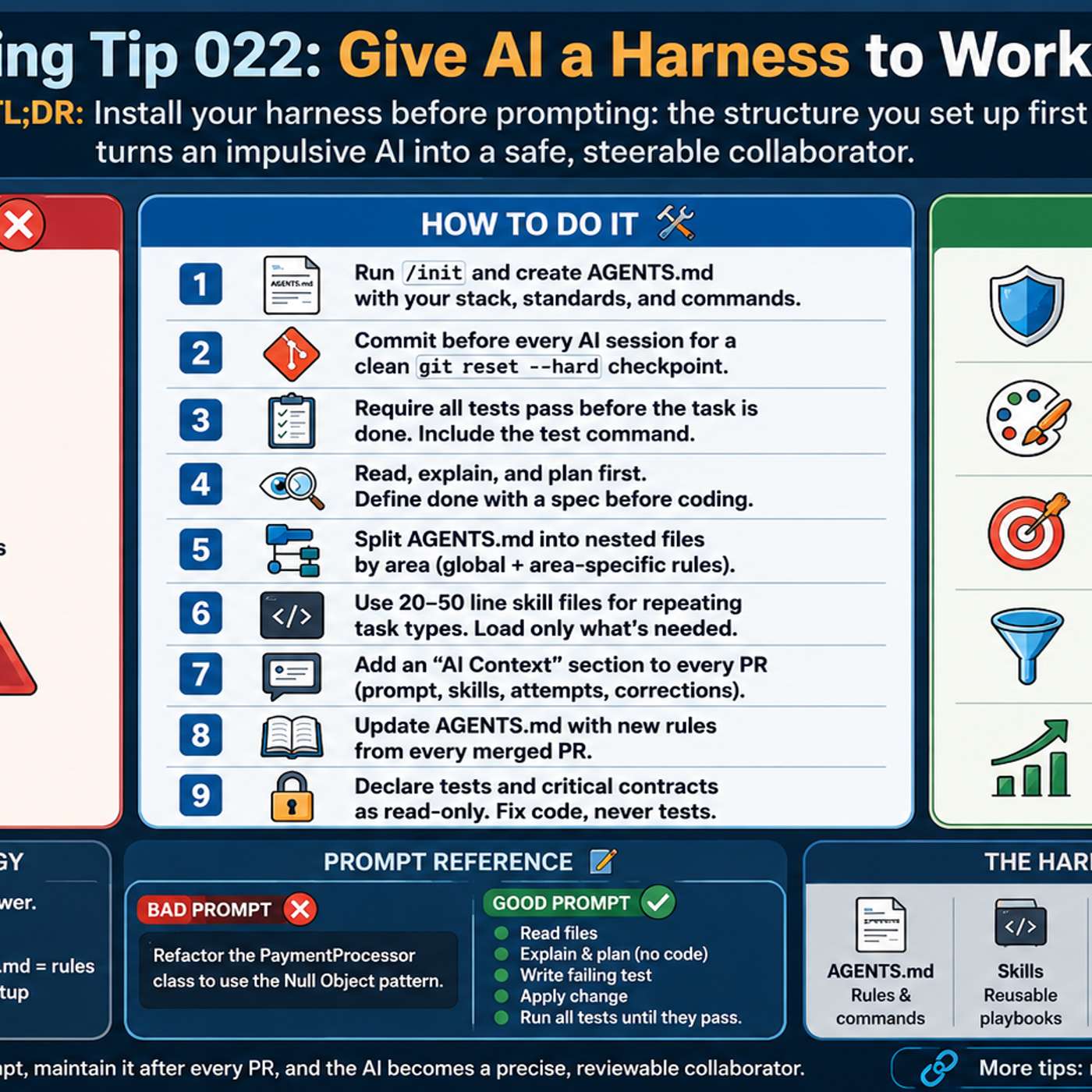
Relying on prompt engineering for safety is insufficient and easily bypassed. The expert consensus is to build safeguards directly into the system's architecture. Architectural controls are immutable during runtime, whereas prompt-level controls can be manipulated or overridden by clever user inputs.

Simply stuffing all historical data into a large context window is counterproductive. The model's attention gets diluted by repetitive tool logs and intermediate data, making it struggle to find original instructions. This "signal versus noise" problem leads to hallucinations and degraded performance.
While prompt engineering is the interface, context engineering is the "magic" for production systems. It involves strategically managing what information (session history, knowledge base) fits into the model's limited context window. This art directly impacts both cost and performance.

Long-running AI agents don't fail because the model is unintelligent. They fail because default memory management, like unmonitored append-only context windows, corrupts their state. This is a software engineering problem that requires an architectural solution, not better prompting or model tuning.
Long, continuous AI chat threads degrade output quality as the context window fills up, making it harder for the model to recall early details. To maintain high-quality results, treat each discrete feature or task as a new chat, ensuring the agent has a clean, focused context for each job.

Long conversations degrade LLM performance as attention gets clogged with irrelevant details. An expert workflow is to stop, ask the model to summarize the key points of the discussion, and then start a fresh chat with that summary as the initial prompt. This keeps the context clean and the model on track.

Large Language Models are inherently stateless. Creating conversational memory is not about finding a smarter model, but about engineering a robust backend infrastructure. The true intelligence of a multi-turn AI assistant resides in this system's ability to manage state, not the model itself.
To prevent an LLM's performance from degrading in a long conversation, a phenomenon called "context rot," it is best to separate tasks. Use one context window for content generation and a new, fresh window for evaluation tasks like applying a rubric. This avoids bias and improves output quality.
