Get your free personalized podcast brief
We scan new podcasts and send you the top 5 insights daily.
Long, continuous AI chat threads degrade output quality as the context window fills up, making it harder for the model to recall early details. To maintain high-quality results, treat each discrete feature or task as a new chat, ensuring the agent has a clean, focused context for each job.

Related Insights
People struggle with AI prompts because the model lacks background on their goals and progress. The solution is 'Context Engineering': creating an environment where the AI continuously accumulates user-specific information, materials, and intent, reducing the need for constant prompt tweaking.

When an AI coding assistant gets off track, Tim McLear asks it to generate a summary prompt for another AI to take over. This "resume work" prompt forces the AI to consolidate the context and goal. This summary often reveals where the AI misunderstood the request, allowing him to correct the course and restart with a cleaner prompt.
Before delegating a complex task, use a simple prompt to have a context-aware system generate a more detailed and effective prompt. This "prompt-for-a-prompt" workflow adds necessary detail and structure, significantly improving the agent's success rate and saving rework.

When building Spiral, a single large language model trying to both interview the user and write content failed due to "context rot." The solution was a multi-agent system where an "interviewer" agent hands off the full context to a separate "writer" agent, improving performance and reliability.

When an AI model gives nonsensical responses after a long conversation, its context window is likely full. Instead of trying to correct it, reset the context. For prototypes, fork the design to start a new session. For chats, ask the AI to summarize the conversation, then start a new chat with that summary.
Building a single, all-purpose AI is like hiring one person for every company role. To maximize accuracy and creativity, build multiple custom GPTs, each trained for a specific function like copywriting or operations, and have them collaborate.

Don't fear deploying a specialized, multi-agent customer experience. Even if a customer interacts with several different AI agents, it's superior to being bounced between human agents who lose context. Each AI agent can retain the full conversation history, providing a more coherent and efficient experience.
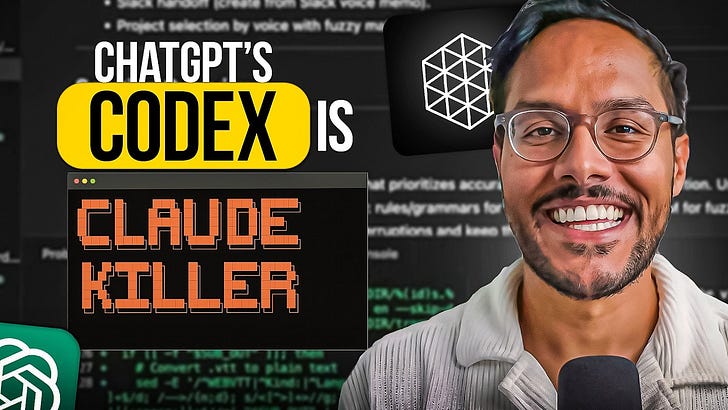
When a conversation with Codex approaches its context window limit, using `/new` erases all history. The `/compact` command is a better alternative. It instructs the LLM to summarize the current conversation into a shorter form, freeing up tokens while retaining essential context for continued work.
Long conversations degrade LLM performance as attention gets clogged with irrelevant details. An expert workflow is to stop, ask the model to summarize the key points of the discussion, and then start a fresh chat with that summary as the initial prompt. This keeps the context clean and the model on track.

The simple "tool calling in a loop" model for agents is deceptive. Without managing context, token-heavy tool calls quickly accumulate, leading to high costs ($1-2 per run), hitting context limits, and performance degradation known as "context rot."