Get your free personalized podcast brief
We scan new podcasts and send you the top 5 insights daily.
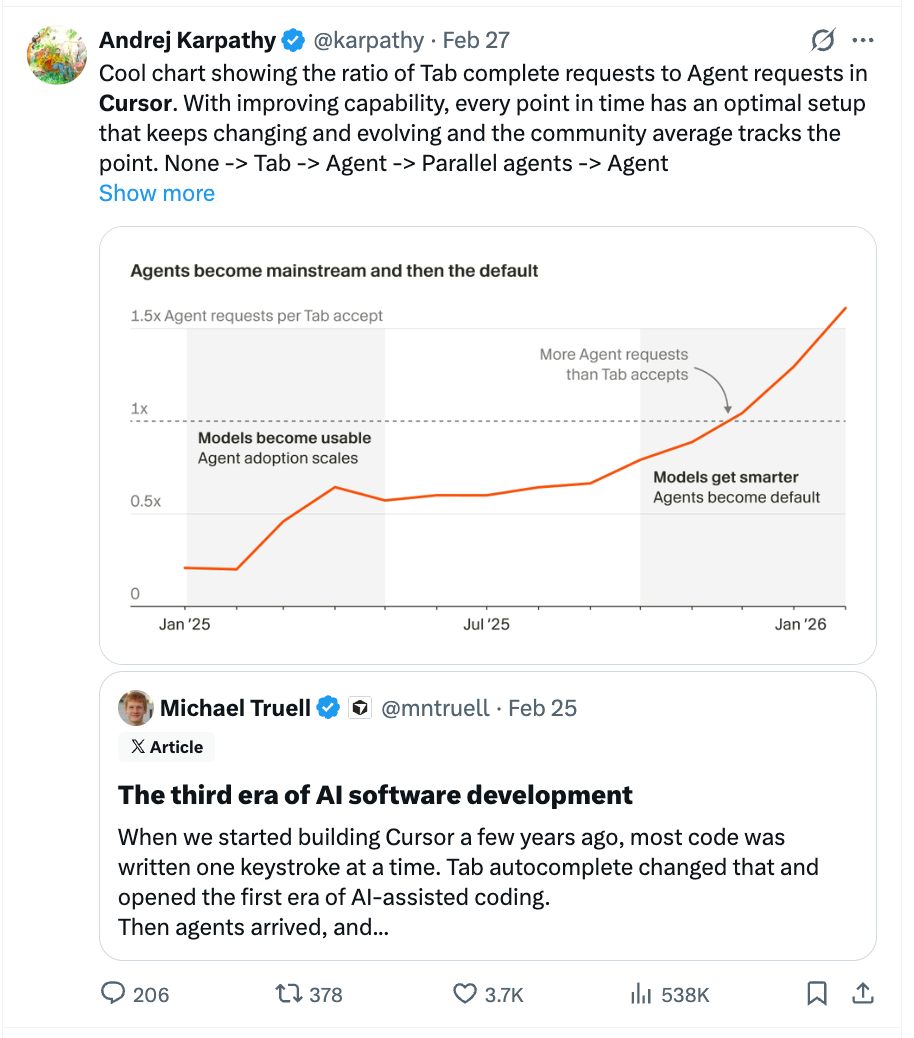
For bug fixes, Cursor's agents can be instructed to first reproduce a bug and create a video of it happening. They then fix it and make a second video showing the same workflow succeeding. This TDD-like "red-green" video proof dramatically increases confidence in the fix.
Related Insights
An AI agent monitors a support inbox, identifies a bug report, cross-references it with the GitHub codebase to find the issue, suggests probable causes, and then passes the task to another AI to write the fix. This automates the entire debugging lifecycle.

Enhance pull requests by using Playwright to automatically screen-record a demonstration of the new feature. This video is then attached to the PR, giving code reviewers immediate visual context of the changes, far beyond what static code can show.

AI code editors can be tasked with high-level goals like "fix lint errors." The agent will then independently run necessary commands, interpret the output, apply code changes, and re-run the commands to verify the fix, all without direct human intervention or step-by-step instructions.
To combat the bottleneck of reviewing massive, AI-generated pull requests, Cursor's agents create video demos of the features they build. This provides a much more accessible entry point for human review than a giant diff, helping to quickly align on the direction.
Use Playwright to give Claude Code control over a browser for testing. The AI can run tests, visually identify bugs, and then immediately access the codebase to fix the issue and re-validate. This creates a powerful, automated QA and debugging loop.
To make its AI agents robust enough for production, Sierra runs thousands of simulated conversations before every release. These "AI testing AI" scenarios model everything from angry customers to background noise and different languages, allowing flaws to be found internally before customers experience them.

In traditional software, code is the source of truth. For AI agents, behavior is non-deterministic, driven by the black-box model. As a result, runtime traces—which show the agent's step-by-step context and decisions—become the essential artifact for debugging, testing, and collaboration, more so than the code itself.
A common failure with AI agents is underspecified prompts leading to incorrect implementations (e.g., a checkbox instead of a toggle). Video demos provide immediate visual feedback, creating a shared artifact that makes these misalignments obvious without needing to run the code locally.
To get the best results from an AI agent, provide it with a mechanism to verify its own output. For coding, this means letting it run tests or see a rendered webpage. This feedback loop is crucial, like allowing a painter to see their canvas instead of working blindfolded.

An agent's effectiveness is limited by its ability to validate its own output. By building in rigorous, continuous validation—using linters, tests, and even visual QA via browser dev tools—the agent follows a 'measure twice, cut once' principle, leading to much higher quality results than agents that simply generate and iterate.