Get your free personalized podcast brief
We scan new podcasts and send you the top 5 insights daily.
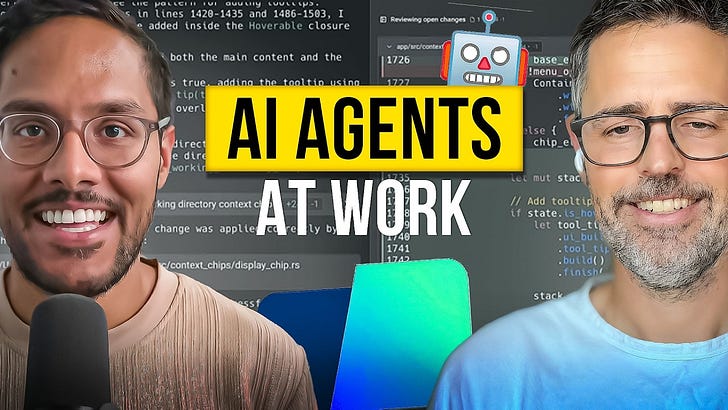
AI code editors can be tasked with high-level goals like "fix lint errors." The agent will then independently run necessary commands, interpret the output, apply code changes, and re-run the commands to verify the fix, all without direct human intervention or step-by-step instructions.

Related Insights
The power of tools like Claude Code comes from giving the AI access to fundamental command-line tools (e.g., `bash`, `grep`). This allows the AI to compose novel solutions and lets product teams define new features using simple English prompts rather than hard-coded logic.

AI's impact on coding is unfolding in stages. Phase 1 was autocomplete (Copilot). We're now in Phase 2, defined by interactive agents where developers orchestrate tasks with prompts. Phase 3 will be true automation, where agents independently handle complete, albeit simpler, development workflows without direct human guidance.
Cognition's CEO highlights five ideal, immediately delegable tasks for AI coding assistants: miscellaneous front-end fixes, version upgrades and migrations, documentation generation, initial incident response, and writing unit tests for existing code.
As AI generates more code than humans can review, the validation bottleneck emerges. The solution is providing agents with dedicated, sandboxed environments to run tests and verify functionality before a human sees the code, shifting review from process to outcome.

Structure your development workflow to leverage the AI agent as a parallel processor. While you focus on a hands-on coding task in the main editor window, delegate a separate, non-blocking task (like scaffolding a new route) to the agent in a side panel, allowing it to "cook in the background."
Unlike previous models that frequently failed, Opus 4.5 allows for a fluid, uninterrupted coding process. The AI can build complex applications from a simple prompt and autonomously fix its own errors, representing a significant leap in capability and reliability for developers.
Instead of writing Python or TypeScript to prototype an AI agent, PM Dennis Yang writes a "super MVP" using plain English instructions directly in Cursor. He leverages Cursor's built-in agentic capabilities, model switching, and tool-calling to test the agent's logic and flow without writing a single line of code.
To maximize an AI agent's effectiveness, establish foundational software engineering practices like typed languages, linters, and tests. These tools provide the necessary context and feedback loops for the AI to identify, understand, and correct its own mistakes, making it more resilient.
It's infeasible for humans to manually review thousands of lines of AI-generated code. The abstraction of review is moving up the stack. Instead of checking syntax, developers will validate high-level plans, two-sentence summaries, and behavioral outcomes in a testing environment.
Historically, developer tools adapted to a company's codebase. The productivity gains from AI agents are so significant that the dynamic has flipped: for the first time, companies are proactively changing their code, logging, and tooling to be more 'agent-friendly,' rather than the other way around.
