Get your free personalized podcast brief
We scan new podcasts and send you the top 5 insights daily.
A properly trained user can achieve superior cost-per-task efficiency even with more expensive models. This is because skilled prompt engineering and workflow design reduce waste and rework. The focus should be on user training, not just orchestrating to the cheapest available model.

Related Insights
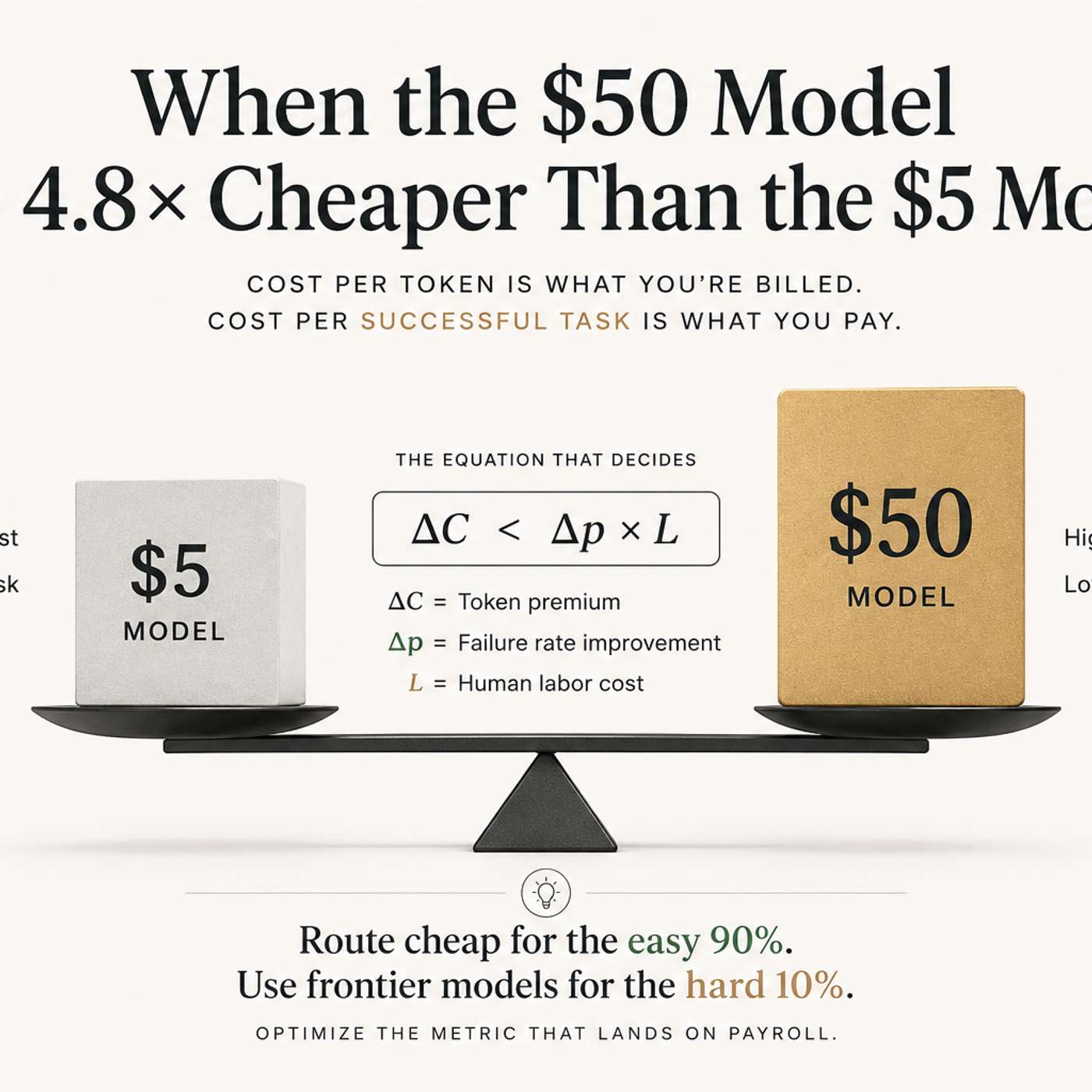
The decision to use a cheaper but less reliable AI model hinges on the cost of human labor to fix errors. Teams with high engineering salaries can justify premium models for even minor reliability gains, while lower-cost teams should use them more selectively. Your staffing costs directly inform your AI architecture.
High productivity isn't about using AI for everything. It's a disciplined workflow: breaking a task into sub-problems, using an LLM for high-leverage parts like scaffolding and tests, and reserving human focus for the core implementation. This avoids the sunk cost of forcing AI on unsuitable tasks.

While choosing a leading vendor is important, the ultimate success of an AI agent hinges on the deep, continuous training you invest. An average tool with excellent, hands-on training will outperform a top-tier tool with zero effort put into its refinement.
Instead of asking an AI for a one-off task, identify recurring workflows and have the AI turn them into a "skill." This creates a reusable asset that dramatically improves efficiency and output quality over time, turning the user into a system builder.

As AI models become more efficient, cost-per-token is an increasingly misleading metric. A more capable model might be more expensive per token but far cheaper per completed task because it requires fewer steps or revisions. The focus of economic evaluation must shift from the raw input cost to the final output cost.

The critical new AI skill isn't just using the most powerful model, but discerning when a free, private local model is sufficient versus when an expensive cloud model is necessary. This model-to-task matching instinct separates amateurs from pros by optimizing for cost, speed, and privacy.

OpenAI CEO Sam Altman advocates for evaluating AI models on "per-task pricing"—the total cost to achieve a desired outcome. This shifts focus from cheap per-token costs to overall efficiency, where a smarter, more expensive model can be cheaper for completing the final task.
Focusing on token pricing is misleading. A more powerful model may be more expensive per token but significantly cheaper per task because its higher efficiency requires fewer prompts and iterations to achieve a final result. The correct way to measure cost-effectiveness is by the total cost to complete a job, not the price of the raw material.
Top-tier language models are becoming commoditized in their excellence. The real differentiator in agent performance is now the 'harness'—the specific context, tools, and skills you provide. A minimalist, well-crafted harness on a good model will outperform a bloated setup on a great one.
A cheap model that fails often becomes expensive due to retries, fallbacks, and human review. The true measure of economic efficiency is the cost to reliably complete a task, not the raw inference cost, which can be a misleading metric at scale.
