Get your free personalized podcast brief
We scan new podcasts and send you the top 5 insights daily.
Effective collaboration between physicians, data scientists, and business leaders requires a dedicated 'bridging communicator.' This person understands both clinical implications and data science requirements, translating medical needs into technical tasks and outputs into clinical insights, preventing specialists from working in isolation.

Related Insights
A senior engineer's greatest impact often comes not from being the deepest technical expert, but from having enough context across multiple domains (marketing, PR, engineering) to act as a translator. They synthesize information and help teams with deep expertise navigate complex, cross-functional decisions.

The most significant skills gap in AI is not purely technical. It is the lack of professionals who combine deep data science skills with a strong understanding of business strategy. These "well-rounded experts" who can bridge the gap between technical and business teams are critical for successful AI deployment.
Blippar's CMO, who couldn't code, attributes her success to translating complex technology into compelling messages. Turning 'image recognition computer vision' into 'the Harry Potterification of print' is a superpower that bridges the gap between innovators and the market, proving more valuable than technical expertise alone.

In a highly technical field, a leader's job is not to be the smartest person in the room. Instead, their role is to surround themselves with brilliant specialists, ask the right questions to connect disparate pieces of information, and guide the collective expertise toward a single, unified goal.

A key skill in building a deep tech team is identifying individuals who can bridge the gap between complex science and business reality. These "translators" can articulate highly technical concepts in plain English, clarifying clinical relevance and commercial viability for decision-makers.

The unreliability of traditional data sources is breaking down organizational silos. Business leaders are now required to become more technically fluent, asking deep questions about data integrity, while tech teams must translate their work into clear business cases, leading to a convergence of roles.

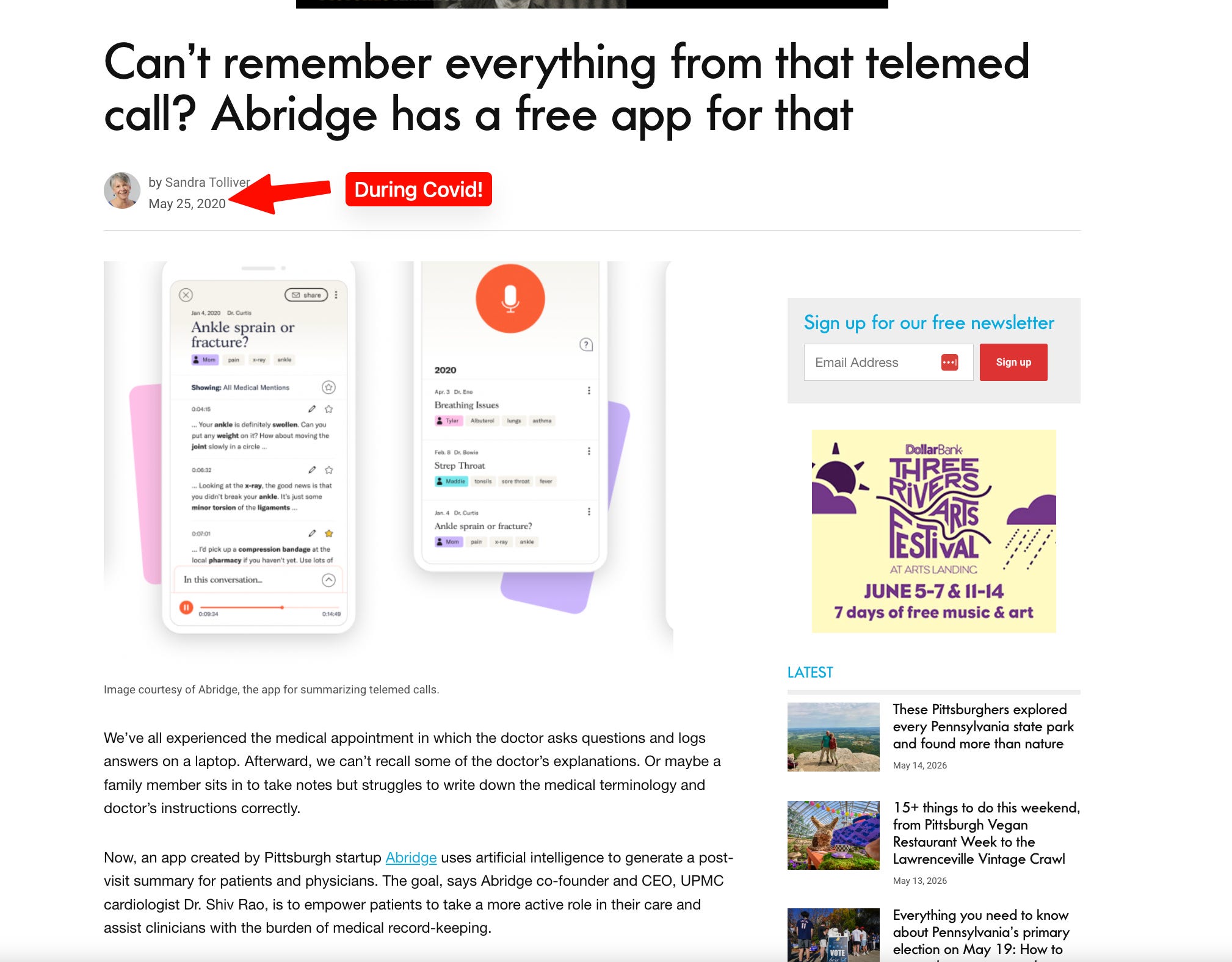
Abridge's secret weapon for building clinically relevant products is the "clinician scientist" role. These are team members with clinical backgrounds (e.g., MDs) who are also deeply technical. By embedding them in product teams, the company ensures that clinical usefulness and safety are baked into development and evaluation from day one.
A key leadership skill is reading the room and translating deep technical discussions into concise answers that address a stakeholder's actual needs. Engineers often get lost in detail; leaders must guide the conversation back to the core question and its business implications.

The primary obstacle preventing healthcare from using its data is not technology but the scarcity of professionals possessing deep expertise in both medicine and data science. This talent gap is the root cause of issues like data silos and complexity, as effectively working with the data requires understanding both domains.
A CEO without a deep scientific background can thrive in biotech by acting as a synthesizer. The key is not to blindly delegate to experts, but to ask probing questions, understand the interplay between disciplines (regulatory, clinical, etc.), and connect them for effective decision-making.