Get your free personalized podcast brief
We scan new podcasts and send you the top 5 insights daily.
A powerful application of AI goals is directing an agent to process an entire error log, like from Sentry. The AI can autonomously categorize issues, implement fixes, and replay historical events to validate the solution until all recorded errors are resolved, effectively automating the eradication of tech debt.

Related Insights
Systematically review production traces ("open coding"), categorize the observed errors ("axial coding"), and then count them. This simple process transforms subjective "vibe checks" and messy logs into a prioritized, data-backed roadmap for improving your AI application, giving PMs a superpower.
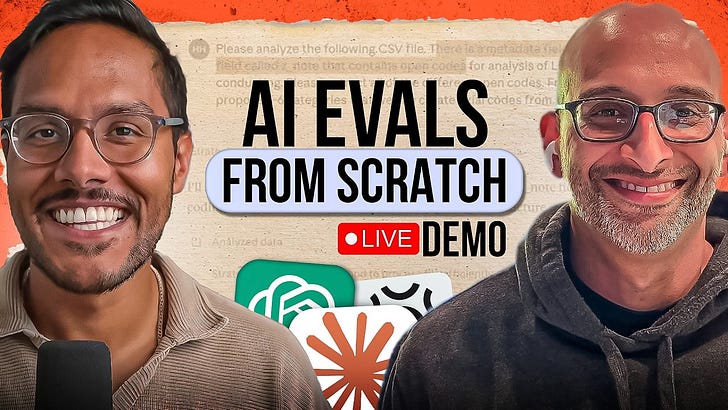
A cutting-edge pattern involves AI agents using a CLI to pull their own runtime failure traces from monitoring tools like Langsmith. The agent can then analyze these traces to diagnose errors and modify its own codebase or instructions to prevent future failures, creating a powerful, human-supervised self-improvement loop.
An AI agent monitors a support inbox, identifies a bug report, cross-references it with the GitHub codebase to find the issue, suggests probable causes, and then passes the task to another AI to write the fix. This automates the entire debugging lifecycle.

AI makes achieving a zero-item backlog a feasible reality. The ability to quickly resolve tech debt, perform migrations, and tackle long-standing "wish list" items means teams no longer have to choose between maintenance and new features.

When an AI tool makes a mistake, treat it as a learning opportunity for the system. Ask the AI to reflect on why it failed, such as a flaw in its system prompt or tooling. Then, update the underlying documentation and prompts to prevent that specific class of error from happening again in the future.

AI coding tools have surpassed simple assistance. Expert ML researchers now delegate debugging entirely, feeding an error log to the model and trusting its proposed fix without inspection. This signifies a shift towards AI as an autonomous problem-solver, not just a helper.

Linear believes AI coding agents remove any excuse for having bugs in a product. They implement a 'zero bugs' policy with a one-week fix SLA. AI agents can now perform the initial triage and even attempt a fix, then tag an engineer for review, dramatically accelerating bug resolution.

Newman's most critical infrastructure for AI-assisted development is a universal logging service for all his apps (front-end, back-end, mobile). When a bug appears, he can tell an AI agent to "debug this," and it can analyze the comprehensive logs to find the root cause without guesswork.

To automate bug fixing, connect an AI agent to your error reporting (Sentry), database (Supabase), and log drains (Acxiom). When a bug is reported, the agent can autonomously replay events from logs, diagnose the root cause of the failure, and eventually fix it, creating a powerful self-healing loop for your application.

The future of IT support is proactive, not reactive. By ingesting historical ticket data and system logs, AI can perform root cause analysis to identify underlying issues—like an outdated driver causing crashes—and automatically deploy a fix before users are even aware a problem exists.
