Get your free personalized podcast brief
We scan new podcasts and send you the top 5 insights daily.
To automate bug fixing, connect an AI agent to your error reporting (Sentry), database (Supabase), and log drains (Acxiom). When a bug is reported, the agent can autonomously replay events from logs, diagnose the root cause of the failure, and eventually fix it, creating a powerful self-healing loop for your application.

Related Insights
A cutting-edge pattern involves AI agents using a CLI to pull their own runtime failure traces from monitoring tools like Langsmith. The agent can then analyze these traces to diagnose errors and modify its own codebase or instructions to prevent future failures, creating a powerful, human-supervised self-improvement loop.
An AI agent monitors a support inbox, identifies a bug report, cross-references it with the GitHub codebase to find the issue, suggests probable causes, and then passes the task to another AI to write the fix. This automates the entire debugging lifecycle.

Integrate AI agents directly into core workflows like Slack and institutionalize them as the "first line of response." By tagging the agent on every new bug, crash, or request, it provides an initial analysis or pull request that humans can then review, edit, or build upon.

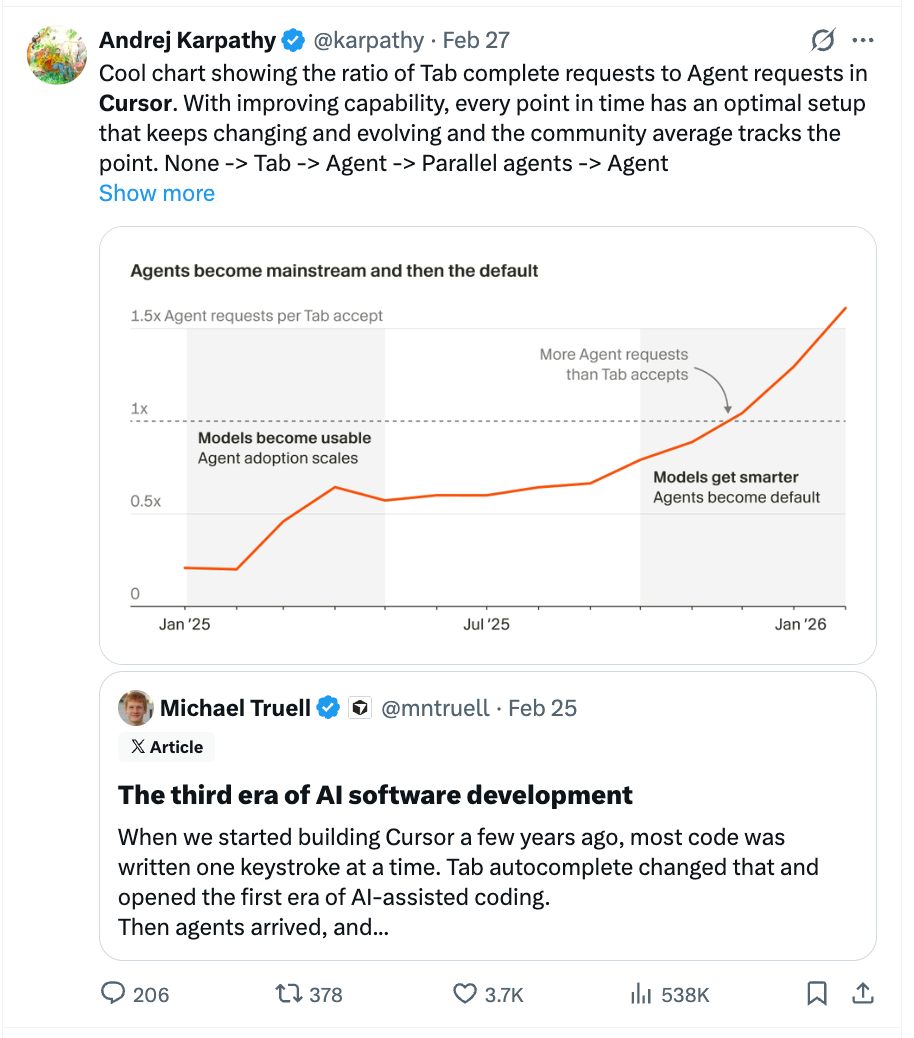
Cursor's "cloud agent diagnosis" command allows a primary agent to spin up specialized sub-agents that use integrations like Datadog to explore logs and diagnose another agent's failure. This creates a multi-agent system where agents act as external debuggers for each other.
The shift toward code-based data pipelines (e.g., Spark, SQL) is what enables AI-driven self-healing. An AI agent can detect an error, clone the code, rewrite it using contextual metadata, and redeploy it to the cluster—a process that is nearly impossible with proprietary, interface-driven ETL tools.

Establish a powerful feedback loop where the AI agent analyzes your notes to find inefficiencies, proposes a solution as a new custom command, and then immediately writes the code for that command upon your approval. The system becomes self-improving, building its own upgrades.

Task your AI agent with its own maintenance by creating a recurring job for it to analyze its own files, skills, and schedules. This allows the AI to proactively identify inefficiencies, suggest optimizations, and find bugs, such as a faulty cron scheduler.
Composio uses an internal agent pipeline to build and test its tool integrations. When a tool fails in production for any reason, this pipeline is invoked in real-time to create and swap in a newer, improved version, creating a self-healing system.

Linear believes AI coding agents remove any excuse for having bugs in a product. They implement a 'zero bugs' policy with a one-week fix SLA. AI agents can now perform the initial triage and even attempt a fix, then tag an engineer for review, dramatically accelerating bug resolution.

Building a visual debugging tool for trace files is wasted effort when an AI agent can directly analyze the raw data and provide the answer. Optimizing for human legibility in the debugging process is a mistake when the agent, not a human, is doing the fixing.