Get your free personalized podcast brief
We scan new podcasts and send you the top 5 insights daily.
Travis Kalanick argues that Tesla has become the new benchmark for investors evaluating physical AI companies. Similar to how Web 2.0 startups were asked "Why won't Google kill you?", today's robotics and automation founders must now justify their existence against the perceived dominance of Tesla.

Related Insights
The robotics sector is poised for a hype cycle collapse as companies inevitably miss ambitious timelines. This environment favors incumbents like Tesla and Waymo, who have deep capital reserves and manufacturing expertise, mirroring the evolution of the self-driving car industry.

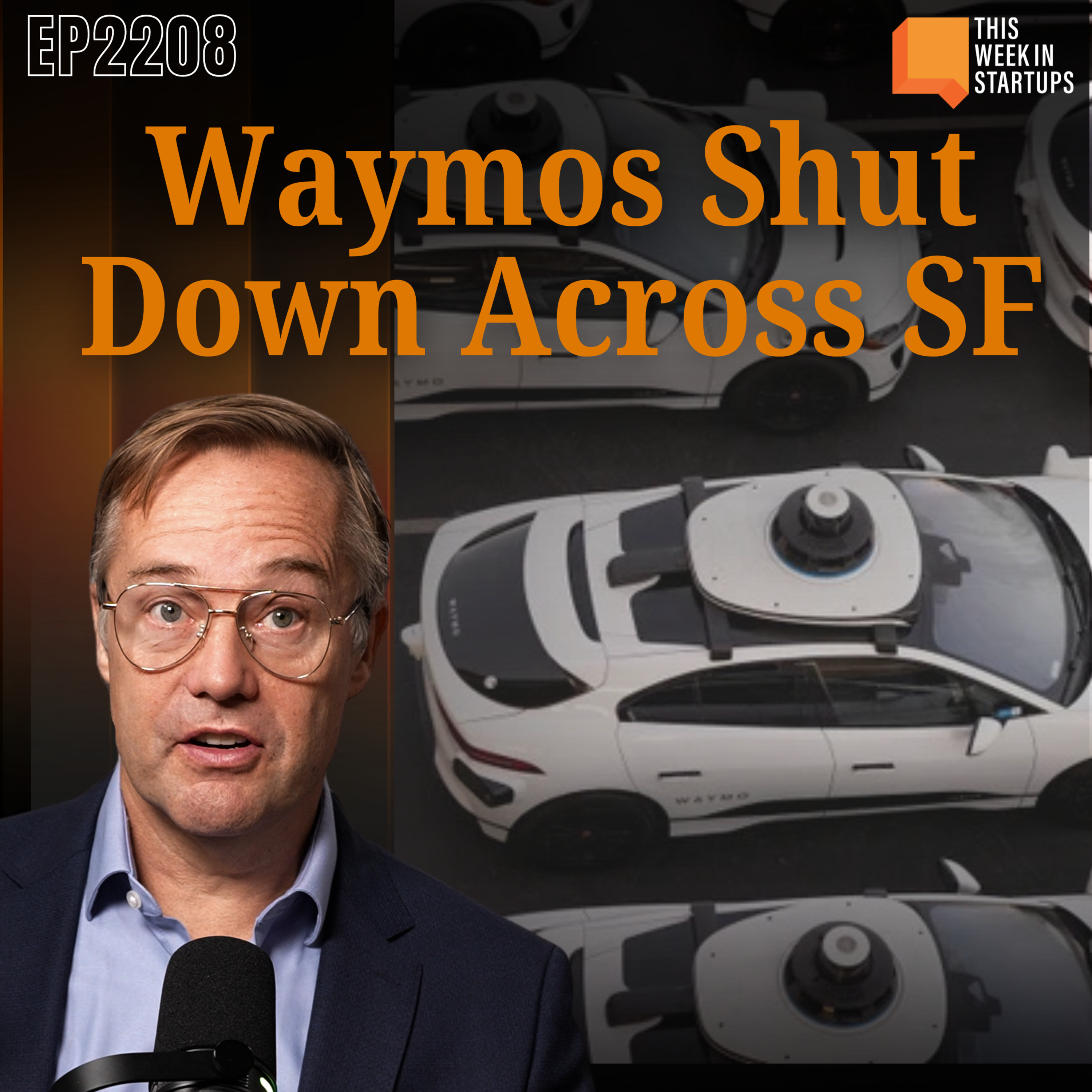
A breakdown of Tesla's market cap suggests its autonomous driving business, which has minimal commercial revenue, is valued at roughly $500B. In contrast, Waymo, a functioning and revenue-generating competitor, is valued at a fraction of that, making it a compelling investment by comparison.
Elon Musk's Optimus project is predicted to become history's most successful product, overshadowing Tesla's automotive achievements. This suggests investors should evaluate Tesla as a robotics and AI company, not just a car manufacturer, for long-term growth.

RJ Scaringe argues that successful, neural net-based autonomy requires a rare combination of ingredients: full control of the perception stack, a large vehicle fleet for data collection, massive capital, and GPU access. He believes only a handful of companies, including Rivian, Tesla, and Waymo, possess all the necessary components to compete.

Despite shrinking profits, Tesla's stock is near all-time highs. Investors aren't valuing its current car business (the "avocados") but its future potential in robotics and autonomy (the "tree's growth"). This contrasts with legacy automakers, seen as old trees with no growth left.

As tech giants like Google and Amazon assemble the key components of the autonomy stack (compute, software, connectivity), the real differentiator becomes the ability to manufacture cars at scale. Tesla's established manufacturing prowess is a massive advantage that others must acquire or build to compete.
Tying Elon Musk's compensation to an astronomical $8.5 trillion market cap—a goal unreachable through car sales alone—is an explicit signal to investors. Tesla is no longer a car company; its future and valuation are now staked entirely on robotics and autonomous technology.

Initially criticized for forgoing expensive LIDAR, Tesla's vision-based self-driving system compelled it to solve the harder, more scalable problem of AI-based reasoning. This long-term bet on foundation models for driving is now converging with the direction competitors are also taking.
To achieve scalable autonomy, Flywheel AI avoids expensive, site-specific setups. Instead, they offer a valuable teleoperation service today. This service allows them to profitably collect the vast, diverse datasets required to train a generalizable autonomous system, mirroring Tesla's data collection strategy.

The transition from selling cars to operating a RoboTaxi network transforms Tesla's business model. A car sold for a one-time $4,000 profit could generate $200,000 in profit over a five-year period as an autonomous taxi. This 100x increase in lifetime value per unit represents a massive financial unlock for the company.
