Get your free personalized podcast brief
We scan new podcasts and send you the top 5 insights daily.
RJ Scaringe argues that successful, neural net-based autonomy requires a rare combination of ingredients: full control of the perception stack, a large vehicle fleet for data collection, massive capital, and GPU access. He believes only a handful of companies, including Rivian, Tesla, and Waymo, possess all the necessary components to compete.

Related Insights
Autonomous vehicle technology will likely become a commodity layer, with most manufacturers providing their cars to existing ride-sharing networks like Uber and Lyft. Only a few companies like Tesla have the brand and scale to pursue a vertically-integrated, closed-network strategy.
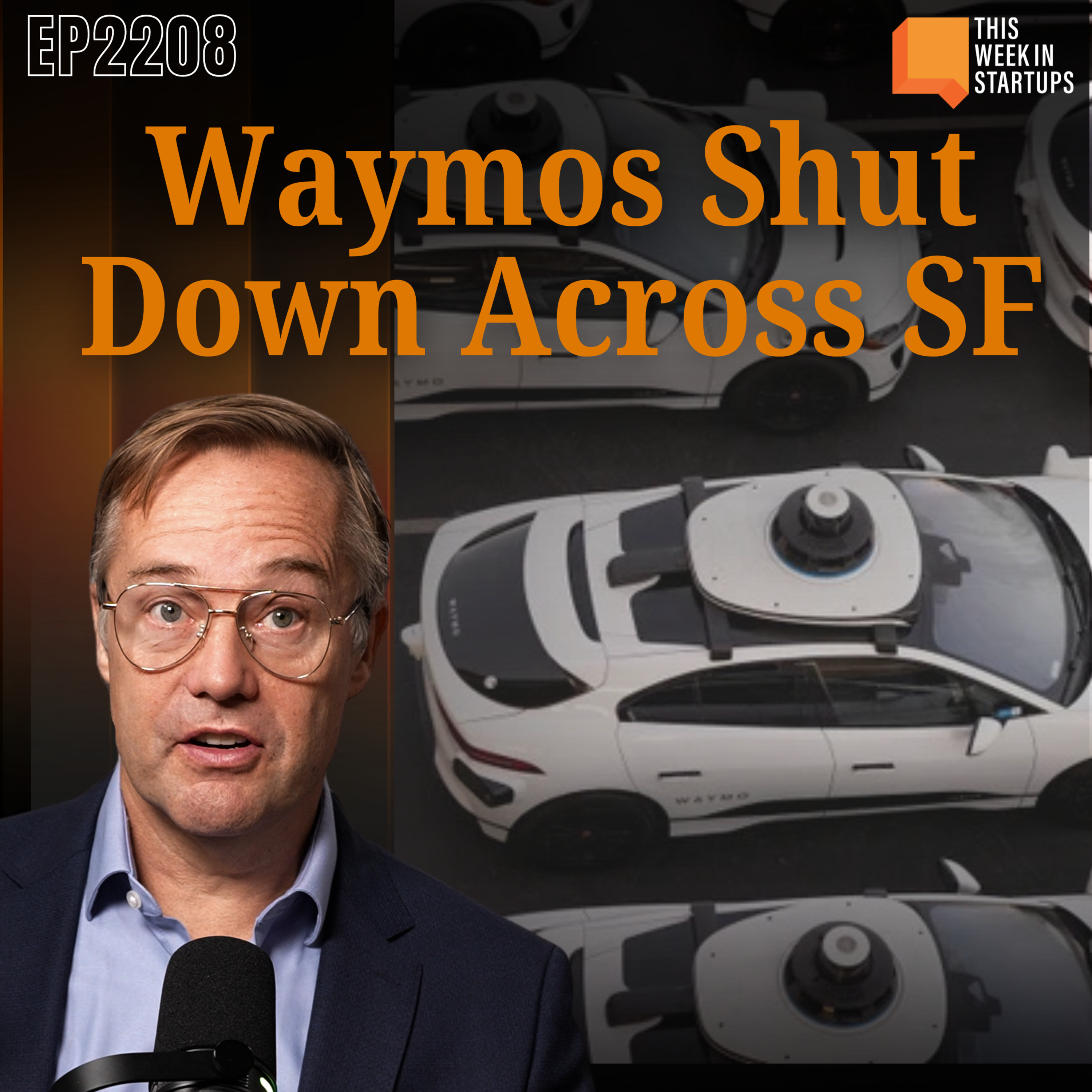
While large language models (LLMs) converge by training on the same public internet data, autonomous driving models will remain distinct. Each company must build its own proprietary dataset from its unique sensor stack and vehicle fleet. This lack of a shared data foundation means different automakers' AI driving behaviors and capabilities will likely diverge over time.
The seamless experience of an autonomous vehicle hides a complex backend. A subsidiary company, FlexDrive, manages a fleet for services like cleaning, charging, maintenance, and teleoperation. This "fleet management" layer represents a significant, often overlooked, part of the AV value chain and business model.

Rivian's CEO explains that early autonomous systems, which were based on rigid rules-based "planners," have been superseded by end-to-end AI. This new approach uses a large "foundation model for driving" that can improve continuously with more data, breaking through the performance plateau of the older method.

By eschewing expensive LiDAR, Tesla lowers production costs, enabling massive fleet deployment. This scale generates exponentially more real-world driving data than competitors like Waymo, creating a data advantage that will likely lead to market dominance in autonomous intelligence.

As tech giants like Google and Amazon assemble the key components of the autonomy stack (compute, software, connectivity), the real differentiator becomes the ability to manufacture cars at scale. Tesla's established manufacturing prowess is a massive advantage that others must acquire or build to compete.
While public focus is often on expensive sensors like LiDAR, Rivian's CEO states the onboard compute for AI inference is an order of magnitude more expensive than the entire perception stack. This cost reality drove Rivian to design its own chip in-house, enabling it to deploy high-level autonomy capabilities across all its vehicles affordably.
Initially criticized for forgoing expensive LIDAR, Tesla's vision-based self-driving system compelled it to solve the harder, more scalable problem of AI-based reasoning. This long-term bet on foundation models for driving is now converging with the direction competitors are also taking.

To achieve scalable autonomy, Flywheel AI avoids expensive, site-specific setups. Instead, they offer a valuable teleoperation service today. This service allows them to profitably collect the vast, diverse datasets required to train a generalizable autonomous system, mirroring Tesla's data collection strategy.

Despite just launching its first-generation autonomy system, Rivian completely reset it, throwing away all the code and hardware. CEO RJ Scaringe said the decision was easy because it was obvious that the old rules-based architecture had a 0% chance of being competitive against modern neural net-based approaches.