Get your free personalized podcast brief
We scan new podcasts and send you the top 5 insights daily.
Stripe's internal 'Minions' are AI agents that handle the entire coding workflow from prompt to PR. The key success metric is the percentage of PRs created in 'one shot'—without any human iteration—prioritizing true automation over mere assistance.

Related Insights
The ease of creating PRs with AI agents shifts the developer bottleneck from code generation to code validation. The new challenge is not writing the code, but gaining the confidence to merge it, elevating the importance of review, testing, and CI/CD pipelines.
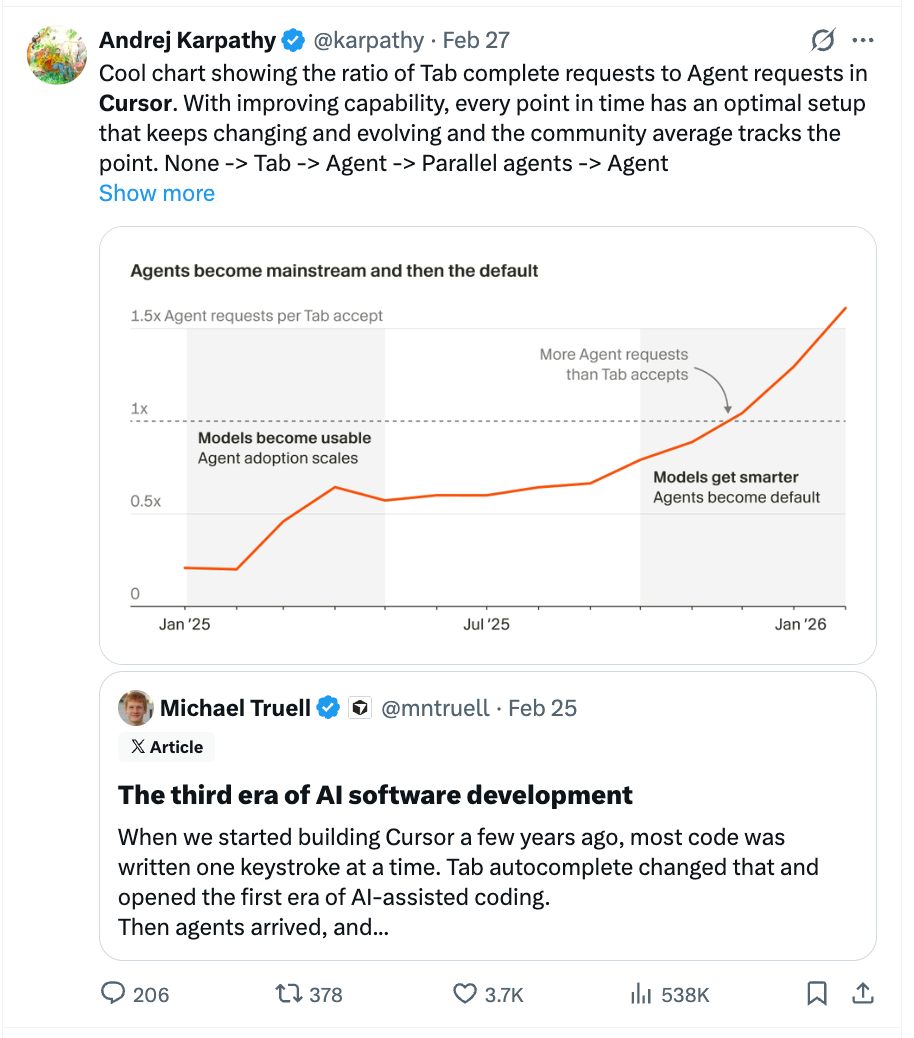
Traditional software development focuses on adding features for a user to operate. In the AI era, the product roadmap should be measured by the amount of work the software can perform autonomously, directly saving the customer time and freeing them from tedious tasks.
Measuring AI's impact by output metrics like 'percent of agent-written code' or 'number of PRs merged' is a trap. These metrics say nothing about value. Instead, focus on counterbalance metrics that measure quality and meaningful impact, such as a reduction in bugs or positive user feedback.

The latest AI coding assistants facilitate a massive leap in developer productivity. The host demonstrated this by merging 44 pull requests and adding nearly 93,000 lines of code in just five days, a workload that would typically take an entire team months to complete, making the scale of the impact concrete.

With AI generating 1,300 pull requests weekly at Stripe, the critical path is shifting. When coding becomes a commodity, the bottleneck moves to human review and validation. Engineering teams must refocus from pure creation to oversight and quality assurance at scale.
Inspired by fully automated manufacturing, this approach mandates that no human ever writes or reviews code. AI agents handle the entire development lifecycle from spec to deployment, driven by the declining cost of tokens and increasingly capable models.

With AI agents autonomously generating pull requests, the primary constraint in software development is no longer writing code but the human capacity to review it. Companies like Block are seeing PRs per engineer increase massively, creating a new challenge for engineering managers to solve.

Stripe engineers can initiate a full AI-driven coding task—including provisioning a dev environment and creating a pull request—simply by reacting to a Slack message with an emoji. This dramatically lowers the friction to start work by moving the entry point from a text editor to a chat app.
A primary benefit of Stripe's 'minions' is reducing the mental and procedural friction to begin a task. Instead of setting up an environment and opening a text editor, an engineer can trigger work from a Slack message, making it easier to tackle small fixes, prototypes, or documentation updates immediately.
Stripe's investment in developer productivity tools for engineers created a structured environment, or "blessed path," that also dramatically improves the success rate of their AI coding agents. Improving DX for your team has a dual benefit for AI adoption.