Get your free personalized podcast brief
We scan new podcasts and send you the top 5 insights daily.
AI is moving beyond command-and-response. In a demonstrated workflow, an Anthropic AI agent unpromptedly joined a Slack discussion, pulled data from multiple sources to analyze a problem, generated design mockups, and facilitated a conversation between a human designer and engineer. The AI becomes an active, intelligent participant.

Related Insights
Anthropic's Claude Tag represents what Andre Karpathy calls the "third major redesign of LLM UI." It moves AI from a solo tool (website/app) to a persistent, asynchronous entity within collaborative spaces like Slack, where it acts as a full team member absorbing shared context.

Features like Anthropic's Claude Tag embed powerful AI capabilities directly into collaborative platforms like Slack. This moves AI from an individual tool to a group experience, giving non-technical team members access to advanced functions and providing the AI with persistent team context.
When implementing a design from a Figma file, Anthropic's AI identified a gap, made its own design call, and explained why its solution was better. This shows a shift from AI as a tool that follows instructions to a partner that contributes its own reasoning to improve the outcome.
The next generation of agents won't just wait for explicit instructions. After a user mentioned buying a MacBook without asking for help, the AI independently researched the best price and presented a link the next morning. This shows a shift from a command-based tool to a proactive partner.

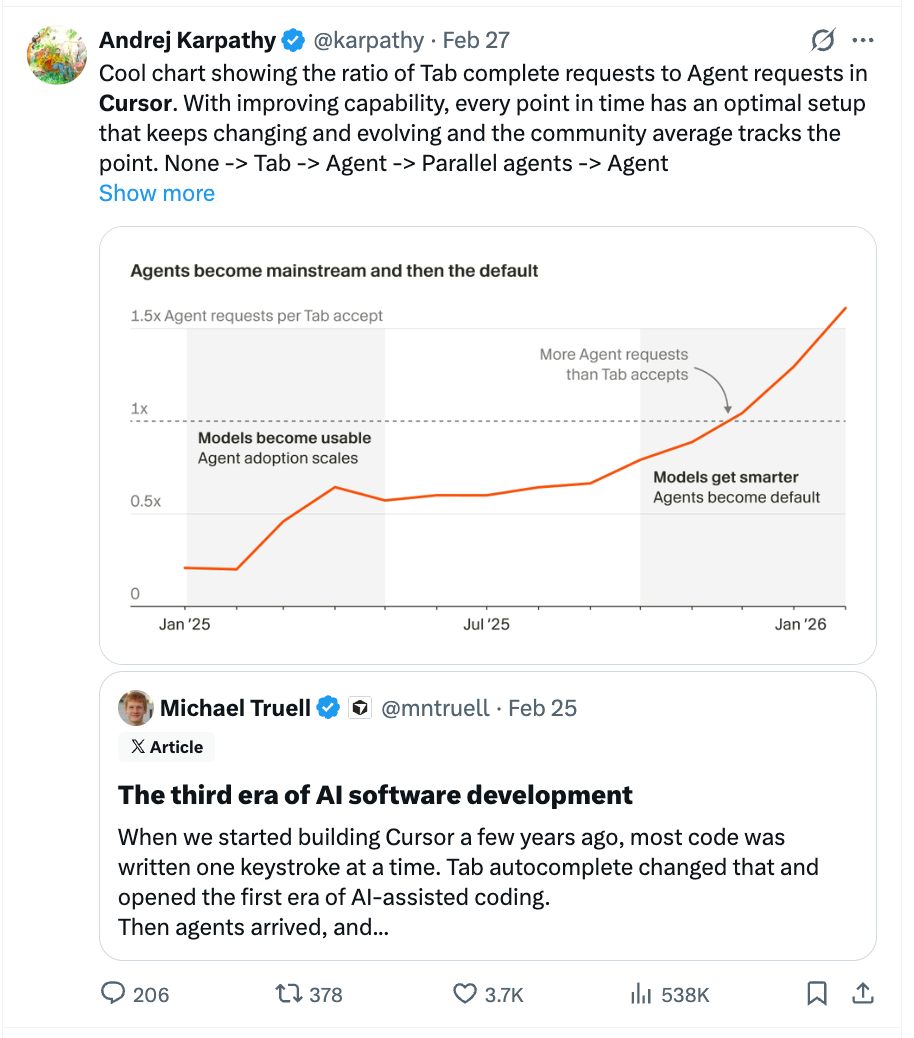
At Cursor, development is increasingly happening in Slack channels. Team members collectively kick off and redirect a cloud agent in a thread, turning development into a collaborative discussion. The IDE becomes a secondary tool, while communication platforms become the primary surface.
Most AI tools are single-player experiences. Linear is designing its agent sessions to be shared, collaborative spaces. Multiple people, like a PM and a designer, can jump into the same chat with an agent, see its work, and give it feedback together, collapsing the collaboration loop.

Recent updates from Anthropic's Claude mark a fundamental shift. AI is no longer a simple tool for single tasks but has become a system of autonomous "agents" that you orchestrate and manage to achieve complex outcomes, much like a human team.

The primary interface for AI is shifting from a prompt box to a proactive system. Future applications will observe user behavior, anticipate needs, and suggest actions for approval, mirroring the initiative of a high-agency employee rather than waiting for commands.

Modern AI platforms like Google's Stitch and AI Studio are moving beyond simple command execution. They proactively suggest functional improvements (like page-turning animations) and explain their implementation choices, transforming the user from a director into a collaborator.
The current chatbot model of asking a question and getting an answer is a transitional phase. The next evolution is proactive AI assistants that understand your environment and goals, anticipating needs and taking action without explicit commands, like reminding you of a task at the opportune moment.
