Get your free personalized podcast brief
We scan new podcasts and send you the top 5 insights daily.
Manali says that in rituximab-refractory follicular lymphoma she avoids chemotherapy such as bendamustine because a later CD19 CAR T option may be compromised by prior bendamustine. She would rather use Epco-R2 or MosinLen, preserving the CAR T path for patients who need it. She frames this as a key sequencing decision.

Related Insights
For third-line follicular lymphoma, where both CAR-T and bispecifics are approved, experts are leaning towards CAR-T. The long-term follow-up data for CAR-T suggests a potential for cure, making it a more compelling option for eligible patients despite logistical challenges.

Data from both DLBCL and follicular lymphoma studies show that recent bendamustine exposure negatively impacts T-cell quality, leading to poorer CAR T-cell therapy outcomes. This effect is most pronounced if the drug was given within a year of T-cell collection, making it a critical factor in long-term treatment sequencing.

A key hesitation in adopting the tafasitamab-lenalidomide-R-CHOP regimen is the theoretical risk of CD19 antigen loss. If a patient becomes refractory, their eligibility and the efficacy of subsequent CD19-targeted CAR T-cell therapy could be compromised, influencing upfront treatment decisions.

In follicular lymphoma, the treatment goal is durable remission with manageable toxicity, not necessarily a cure. Therefore, clinicians frequently prefer using a bispecific antibody first, reserving the more complex and toxic CAR-T cell therapy for transformed disease or after a bispecific fails.
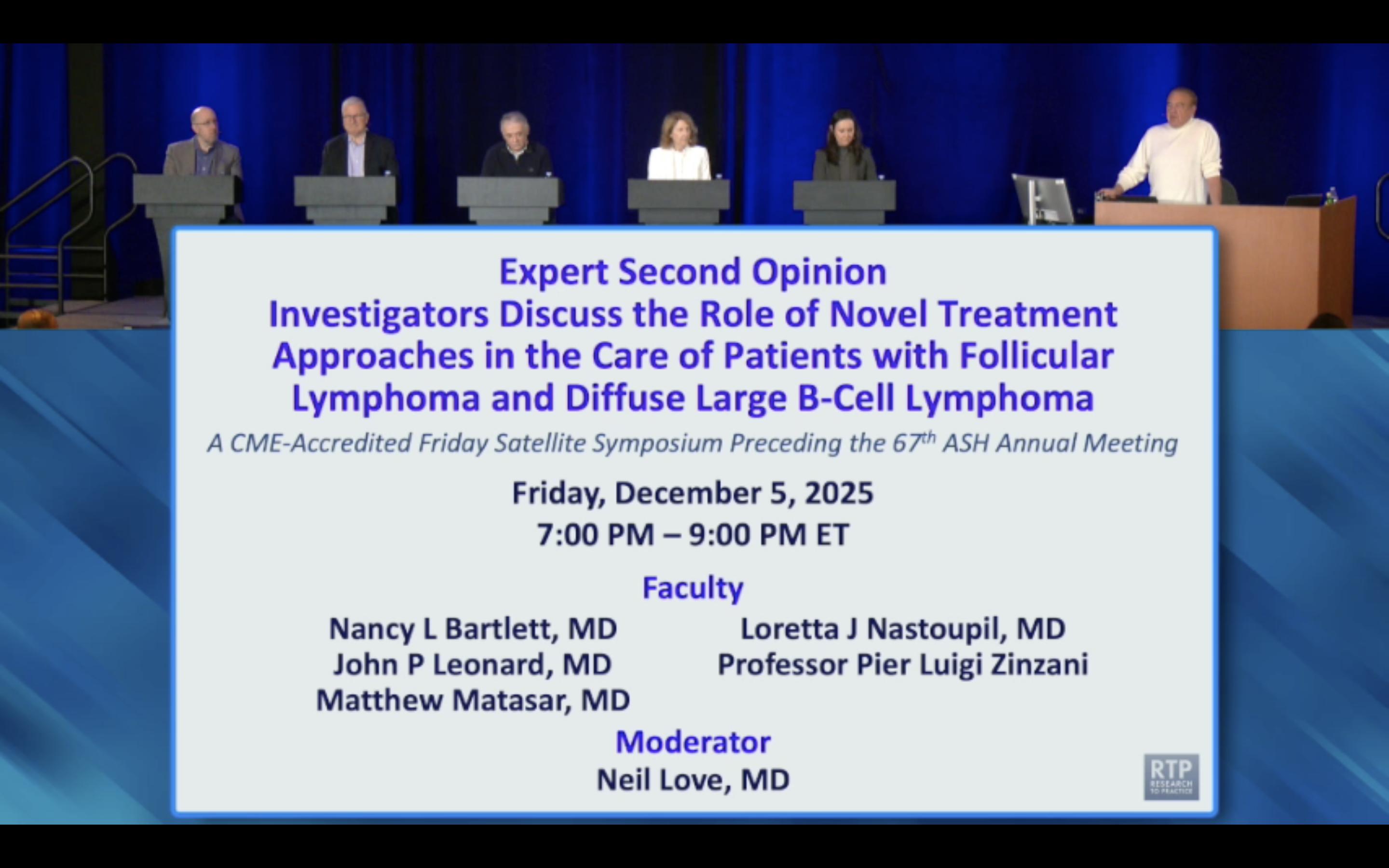
Manali says third-line DLBCL still favors CD19 CAR T when patients are eligible and CAR-naive, because about 40% have a flat five-year curve suggesting cure. Bispecifics show durable complete responses at three years, but follow-up is shorter. She sequences CAR T first, then a CD20 bispecific.
When choosing between novel combinations in relapsed follicular lymphoma, a logical strategy is to use tafasitamab-lenalidomide-rituximab (Tafa-R2) first. After progression, single-agent epcoritamab remains highly effective. The reverse is not true, as tafasitamab monotherapy would not be effective after epcoritamab-R2 failure, making the initial choice critical.

Clinicians should not be deterred from using CD19 CAR T-cell therapy in patients who have previously received other CD19-targeting agents like tafasitamab. Preclinical and retrospective clinical data suggest prior exposure does not impair CAR T efficacy, and therefore re-testing for CD19 expression is unnecessary.
Using a BCMA bispecific antibody first can exhaust a patient's T-cells or cause tumors to lose the BCMA target, rendering a subsequent BCMA-targeted CAR-T therapy ineffective. The optimal sequence is CAR-T first, which preserves T-cell function and BCMA expression, leaving bispecifics as a viable later-line option.

Despite new therapies for follicular lymphoma (FL), bendamustine-rituximab (BR) will likely remain the community standard due to its simplicity. This may create a growing gap in treatment approaches between academic centers using novel agents and community practices favoring the familiar BR regimen.
A key clinical concern with CD19-directed therapies is antigen loss, which could prevent future CAR T-cell treatments. Data from the INMIND trial alleviates this fear, showing that 23 of 24 post-treatment lymphoma samples retained CD19 expression, suggesting tofacitimab does not preclude subsequent CAR-T therapy.