Get your free personalized podcast brief
We scan new podcasts and send you the top 5 insights daily.
Microsoft's staggering $625 billion in Remaining Performance Obligations (RPO), largely from long-term compute contracts, serves as a key financial justification for its heavy AI CapEx. This metric shows that it's not just Microsoft forecasting growth, but the entire industry committing to future compute needs.

Related Insights
While high capex is often seen as a negative, for giants like Alphabet and Microsoft, it functions as a powerful moat in the AI race. The sheer scale of spending—tens of billions annually—is something most companies cannot afford, effectively limiting the field of viable competitors.
AI companies with the foresight to sign long-term, multi-year compute contracts gain a significant margin advantage. They lock in prices based on past valuations, while competitors are forced to buy capacity at much higher current market rates driven up by the increasing value of new AI models.

While AI model providers may overstate demand, the most telling signal comes from TSMC. Their decision to significantly increase capital expenditure on new fabs, a multi-year and irreversible commitment, indicates a strong, cynical belief in the long-term reality of AI compute demand.

The world's most profitable companies view AI as the most critical technology of the next decade. This strategic belief fuels their willingness to sustain massive investments and stick with them, even when the ultimate return on that spending is highly uncertain. This conviction provides a durable floor for the AI capital expenditure cycle.

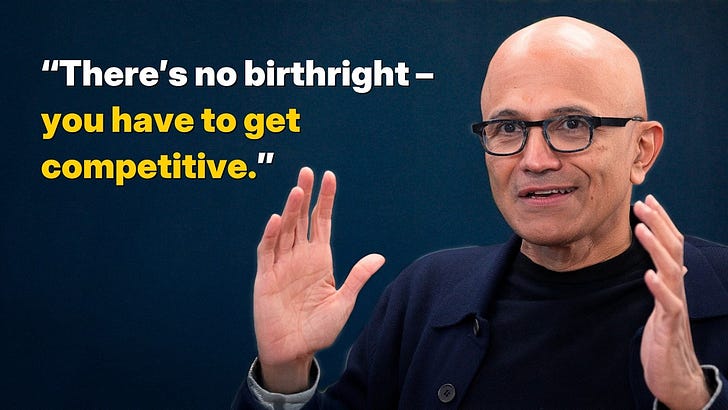
To navigate the massive capital requirements of AI, Nadella reframes the investment in cutting-edge training infrastructure. Instead of being purely reactive to customer demand, a significant portion is considered R&D, allowing for sustained, order-of-magnitude scaling necessary for breakthroughs.
The end of subsidized AI pricing is forcing companies to confront its true operational expense. As AI bills begin to rival payroll, a fundamental transition is occurring where capital expenditure on silicon (CapEx) is displacing operational expenditure on human neurons (OpEx), reshaping corporate budgets.

Unlike the dot-com era's speculative infrastructure buildout for non-existent users, today's AI CapEx is driven by proven demand. Profitable giants like Microsoft and Google are scrambling to meet active workloads from billions of users, indicating a compute bottleneck, not a hype cycle.

A significant portion of hyperscalers' massive capital expenditures is allocated to long-lead-time items like data center construction and power agreements for capacity that will only come online in the next 3-5 years. This spending is a forward-looking indicator of their multi-year scaling plans.
Instead of viewing compute as a cost center, OpenAI treats it as a revenue generator, analogous to hiring salespeople. The core belief is that demand for AI capabilities is so vast that they can never build compute fast enough to satisfy it, justifying massive, forward-looking infrastructure investments.

Despite possessing frontier models through its OpenAI investment, Microsoft's cloud growth is throttled by the physical limitation of data center and AI hardware availability. This bottleneck directly caps Azure's revenue potential, demonstrating that AI dominance is fundamentally dependent on solving real-world infrastructure challenges.