Get your free personalized podcast brief
We scan new podcasts and send you the top 5 insights daily.
Modern chatbot UIs obscure crucial model uncertainty by presenting single, definitive token generations. Bigelow advocates moving away from retro command-line-style chat boxes toward graphical interfaces that reveal token log probabilities, branching alternative completions, and the exact junctures where decision uncertainty collapsed.

Related Insights
The need for explicit user transparency is most critical for nondeterministic systems like LLMs, where even creators don't always know why an output was generated. Unlike a simple rules engine with predictable outcomes, AI's "black box" nature requires giving users more context to build trust.

Unlike a human expert, an LLM's probability estimates and conclusions can be drastically altered by simple rephrasing or irrelevant suggestions. This instability shows they are too easily "pushed around" and lack the coherent world model necessary for trustworthy, high-stakes decision support.
Current chat interfaces are compared to the command-line: they require users to learn a specific, procedural way of communicating ('prompt engineering'). New interaction models, which allow for natural, multimodal communication, could be AI's 'GUI moment,' democratizing access by letting users focus on the task, not the tool.

Offering separate models or modes for chat and reasoning is a flawed approach that fractures the model's underlying intelligence. Optimizing for conversational style (RLHF) inherently degrades calibration and logical consistency. The goal should be a single, smooth, reliable cognitive core, not specialized, conflicting versions.
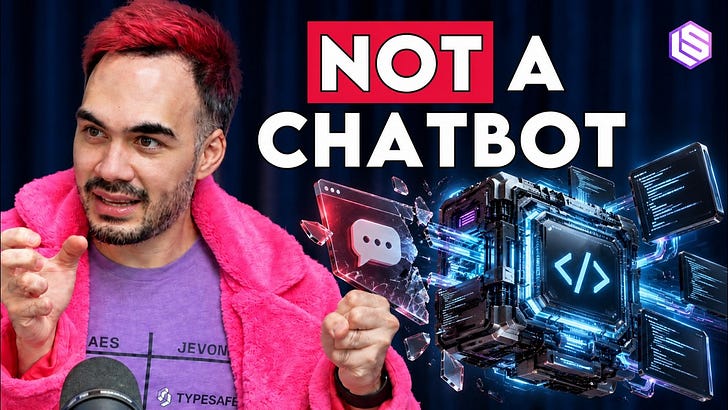
The current chatbot interface is not the final form for AI. Drawing a parallel to the personal computer's evolution from text prompts to GUIs and web browsers, Marc Andreessen argues that radically different and superior user experiences for AI are yet to be invented.

The next frontier for conversational AI is not just better text, but "Generative UI"—the ability to respond with interactive components. Instead of describing the weather, an AI can present a weather widget, merging the flexibility of chat with the richness of a graphical interface.

Eric Bigelow's resampling experiments reveal that a model's final answer often hinges on stochastic coin flips during next-token sampling. Even arbitrary tokens like open parentheses can cause sudden probability distribution collapses, forcing downstream reasoning chains to strictly adapt to earlier sampled choices.
Unlike graphical interfaces that use progressive disclosure to hide complexity, CLIs for developers demand high information density. The linear nature of terminal output means all relevant information must be presented upfront, especially when model reliability is low.
Advanced models are moving beyond simple prompt-response cycles. New interfaces, like in OpenAI's shopping model, allow users to interrupt the model's reasoning process (its "chain of thought") to provide real-time corrections, representing a powerful new way for humans to collaborate with AI agents.

Instead of forcing AI to be as deterministic as traditional code, we should embrace its "squishy" nature. Humans have deep-seated biological and social models for dealing with unpredictable, human-like agents, making these systems more intuitive to interact with than rigid software.