Get your free personalized podcast brief
We scan new podcasts and send you the top 5 insights daily.
The current chatbot interface is not the final form for AI. Drawing a parallel to the personal computer's evolution from text prompts to GUIs and web browsers, Marc Andreessen argues that radically different and superior user experiences for AI are yet to be invented.

Related Insights
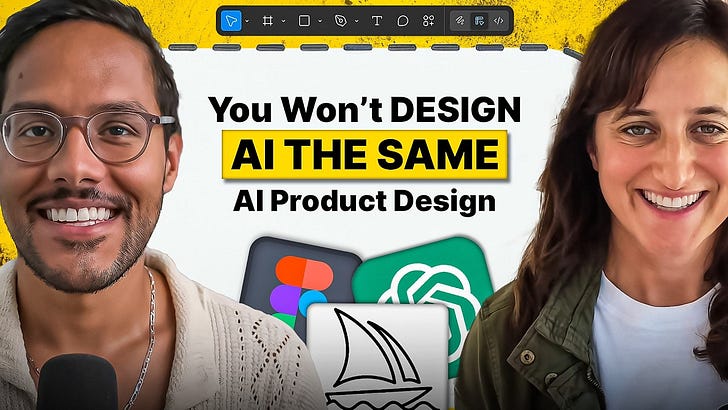
Figma CEO Dylan Field predicts we will look back at current text prompting for AI as a primitive, command-line interface, similar to MS-DOS. The next major opportunity is to create intuitive, use-case-specific interfaces—like a compass for AI's latent space—that allow for more precise control beyond text.
Current text-based prompting for AI is a primitive, temporary phase, similar to MS-DOS. The future lies in more intuitive, constrained, and creative interfaces that allow for richer, more visual exploration of a model's latent space, moving beyond just natural language.

The true evolution of voice AI is not just adding voice commands to screen-based interfaces. It's about building agents so trustworthy they eliminate the need for screens for many tasks. This shift from hybrid voice/screen interaction to a screenless future is the next major leap in user modality.

Comparing chat interfaces to the MS-DOS command line, Atlassian's Sharif Mansour argues that while chat is a universal entry point for AI, it's the worst interface for specialized tasks. The future lies in verticalized applications with dedicated UIs built on top of conversational AI, just as apps were built on DOS.

The primary interface for managing AI agents won't be simple chat, but sophisticated IDE-like environments for all knowledge workers. This paradigm of "macro delegation, micro-steering" will create new software categories like the "accountant IDE" or "lawyer IDE" for orchestrating complex AI work.

While chatbots are an effective entry point, they are limiting for complex creative tasks. The next wave of AI products will feature specialized user interfaces that combine fine-grained, gesture-based controls for professionals with hands-off automation for simpler tasks.
AI is best understood not as a single tool, but as a flexible underlying interface. It can manifest as a chat box for some, but its real potential is in creating tailored workflows that feel native to different roles, like designers or developers, without forcing everyone into a single interaction model.

The primary interface for AI is shifting from a prompt box to a proactive system. Future applications will observe user behavior, anticipate needs, and suggest actions for approval, mirroring the initiative of a high-agency employee rather than waiting for commands.
The next frontier for conversational AI is not just better text, but "Generative UI"—the ability to respond with interactive components. Instead of describing the weather, an AI can present a weather widget, merging the flexibility of chat with the richness of a graphical interface.

Chatbots are fundamentally linear, which is ill-suited for complex tasks like planning a trip. The next generation of AI products will use AI as a co-creation tool within a more flexible canvas-like interface, allowing users to manipulate and organize AI-generated content non-linearly.