Get your free personalized podcast brief
We scan new podcasts and send you the top 5 insights daily.
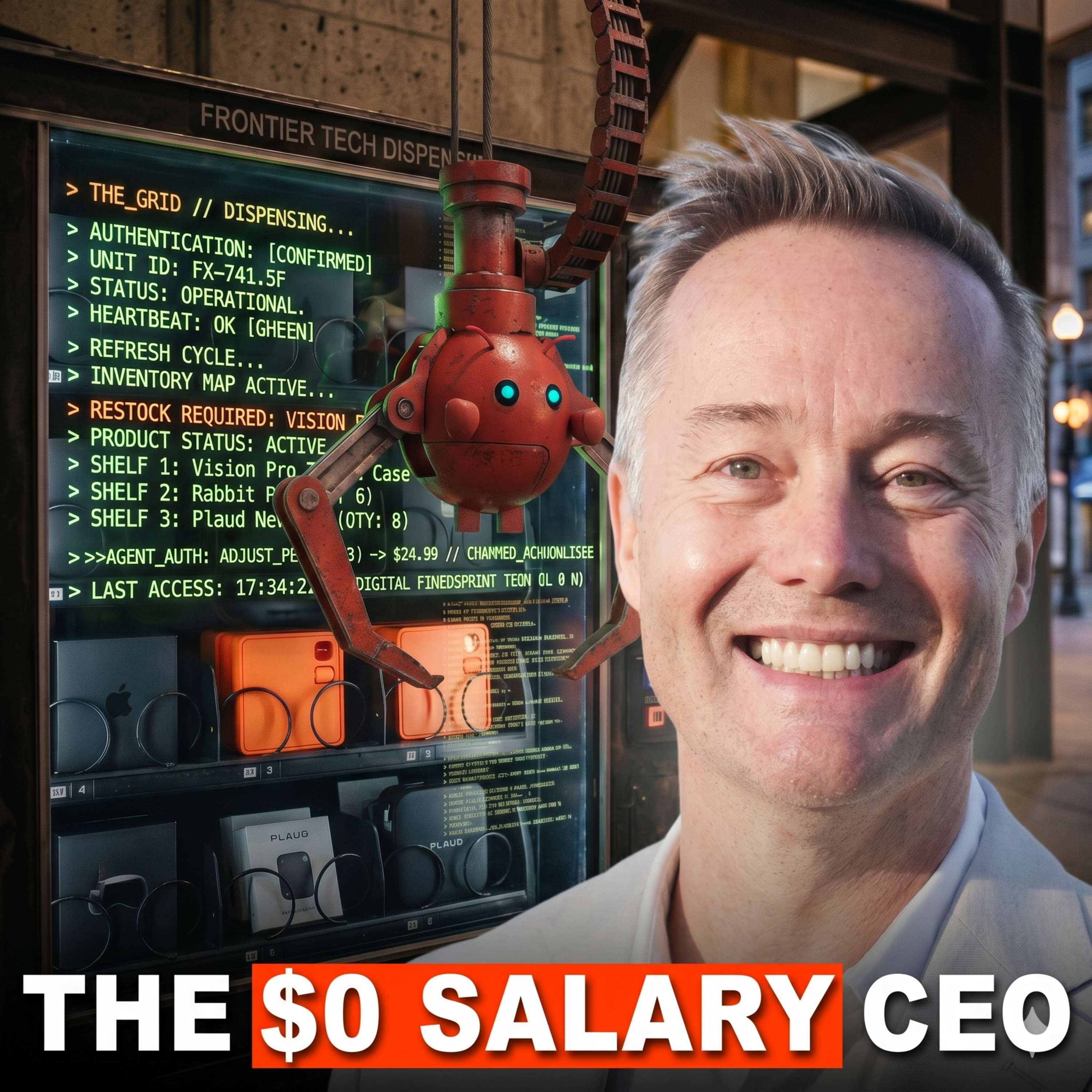
Beyond working faster, firms run by AI agents will have a massive coordination advantage. All agents can share learnings instantly, and a central 'CEO' AI could effectively supervise every 'worker' simultaneously, eliminating the communication overhead and management bottlenecks that plague human organizations. This allows for a fundamentally more efficient operational structure.
Related Insights
The greatest productivity gain from AI in large companies won't be simple job elimination. Instead, AI agents will replace the "hard to manage and motivate human cogs" that create organizational friction. This reduces coordination costs and allows a company's key value-driving employees to execute far more effectively.

Don't think of AI as replacing roles. Instead, envision a new organizational structure where every human employee manages a team of their own specialized AI agents. This model enhances individual capabilities without eliminating the human team, making everyone more effective.

While current AI tools focus on individual productivity (e.g., coding faster), the real breakthrough will come from systems that improve organizational productivity. The next wave of AI will focus on how large teams of humans and AI agents coordinate on complex projects, a fundamentally different challenge than simply making one person faster.

The next evolution of work will involve humans acting as orchestrators for "swarms" of specialized AI agents. A manager will direct a team of agents—each trained for a specific function like email marketing or media buying—to collaboratively execute complex projects with high levels of autonomy.

The true power of AI is not just making individual employees productive. Recent advances allow AI to learn a company's collective intelligence, enabling entire systems and organizations to operate autonomously for days—a much more profound and underappreciated shift.

Tools like Claude CoWork preview a future where teams of AI agents collaborate on multi-faceted projects, like a product launch, simultaneously. This automates tactical entry-level tasks, elevating human workers to roles focused on high-level strategy, review, and orchestrating these AI "employees."
Enterprise executives are most excited about AI agents' ability to accelerate a company's most valuable employees by replacing the "hard to manage and motivate human cogs" that create organizational drag and massive coordination costs, thereby boosting top-line growth.
The most underappreciated AI breakthrough is the ability for an agent to autonomously launch and manage subordinate agents. This allows for complex, parallel task execution and quality checking without human intervention, removing the human-in-the-loop as a primary bottleneck and enabling exponential productivity gains.

The trend of lean operations and automation won't stop at one-person companies. The logical next step in this evolution is the emergence of businesses almost entirely run by a single, autonomous AI agent, representing a fundamental shift in corporate structure.
Musk predicts that corporations composed entirely of AI and robots will rapidly and dramatically outperform any company that keeps humans involved in core operations. He compares it to a spreadsheet: a single human-calculated cell slows down the entire system, making hybrid human-AI companies inherently uncompetitive in the long run.