Get your free personalized podcast brief
We scan new podcasts and send you the top 5 insights daily.
The most underappreciated AI breakthrough is the ability for an agent to autonomously launch and manage subordinate agents. This allows for complex, parallel task execution and quality checking without human intervention, removing the human-in-the-loop as a primary bottleneck and enabling exponential productivity gains.

Related Insights
Instead of serial tasking, advanced users are becoming "agent jockeys," managing multiple AI instances simultaneously. Each agent performs a complex task in the background (e.g., ad generation, outreach), requiring the user to context-switch and manage a portfolio of automated workstreams to maximize output.
![Claude Code marketing masterclass [from idea to making $$] thumbnail](https://assets.flightcast.com/workspaces/vde7jbg9rfhsyiw9o46f9sj8/podcasts/ordbkg8yojpehffas7vr7qpc/t8c97hs8oy7a2xnobsfu5p42.jpg)
The workflow of a "100x engineer" involves managing multiple AI coding agents simultaneously, with each agent working independently on tasks. The engineer's role shifts from writing code to orchestrating these agents, rotating attention between them like a conductor directing an orchestra.

The focus in AI engineering is shifting from making a single agent faster (latency) to running many agents in parallel (throughput). This "wider pipe" approach gets more total work done but will stress-test existing infrastructure like CI/CD, which wasn't built for this volume.
Tools like Claude CoWork preview a future where teams of AI agents collaborate on multi-faceted projects, like a product launch, simultaneously. This automates tactical entry-level tasks, elevating human workers to roles focused on high-level strategy, review, and orchestrating these AI "employees."

The next evolution for autonomous agents is the ability to form "agentic teams." This involves creating specialized agents for different tasks (e.g., research, content creation) that can hand off work to one another, moving beyond a single user-to-agent relationship towards a system of collaborating AIs.

The current wave of AI, particularly agentic technology, is not just another incremental improvement. It's a confluence of major technological shifts, enabling automation at a rate of 5-10% per week, leading to exponential increases in productivity that dwarf prior innovations like cloud or mobile.
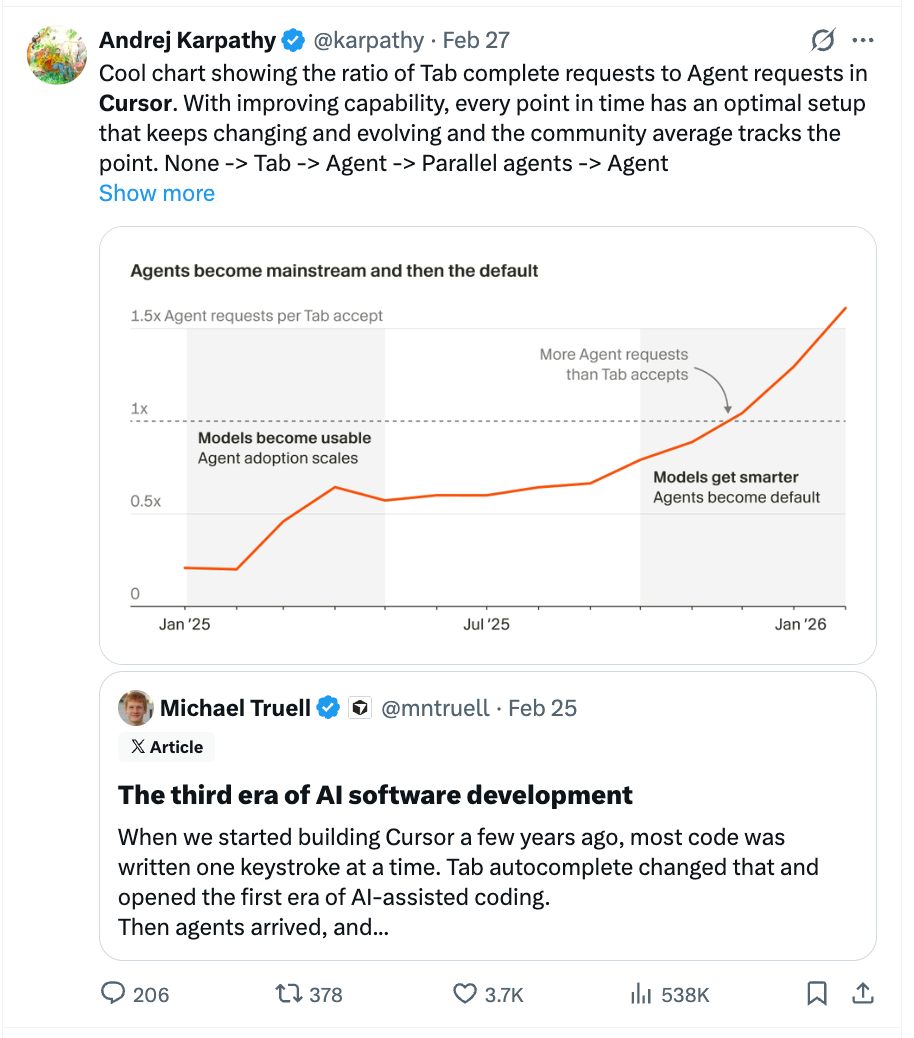
The evolution from AI autocomplete to chat is reaching its next phase: parallel agents. Replit's CEO Amjad Masad argues the next major productivity gain will come not from a single, better agent, but from environments where a developer manages tens of agents working simultaneously on different features.

Complex AI development uses a pool of specialized agents. Like ants building a hill, some are workers, some are managers, and some review and discard bad code. This collaborative, layered system produces emergent results without a single orchestrator.

The next leap in productivity isn't just using an AI assistant for synchronous tasks. It's becoming an "IC manager of agents," overseeing a team of 20-30 AI agents working concurrently on long-running, asynchronous tasks, creating a massive leverage factor.

The 'call and response' nature of large language models (LLMs) is not truly revolutionary for workflows. The significant shift comes from agentic AI, which can connect to various systems and execute multi-step tasks. This moves AI from a content generator to a powerful workflow automation tool.
