Get your free personalized podcast brief
We scan new podcasts and send you the top 5 insights daily.
Clinicians often worry that steroid premedication or mitigation blunts the cytotoxic efficacy of bispecific antibodies. Dr. Budde points out that once T cells or CAR-T cells are fully activated, they become remarkably resistant to the immunosuppressive effects of steroids in both laboratory models and clinical practice, validating the safe use of steroids for toxicity management without compromising anti-tumor activity.

Related Insights
Drugs like cervatimig are engineered for improved safety. They feature a silenced Fc portion to prevent prolonged toxicity and a low-affinity CD3 binder that engages T-cells more physiologically. This design reduces the likelihood of high-grade cytokine release syndrome (CRS) and neurotoxicity.

In follicular lymphoma, the treatment goal is durable remission with manageable toxicity, not necessarily a cure. Therefore, clinicians frequently prefer using a bispecific antibody first, reserving the more complex and toxic CAR-T cell therapy for transformed disease or after a bispecific fails.
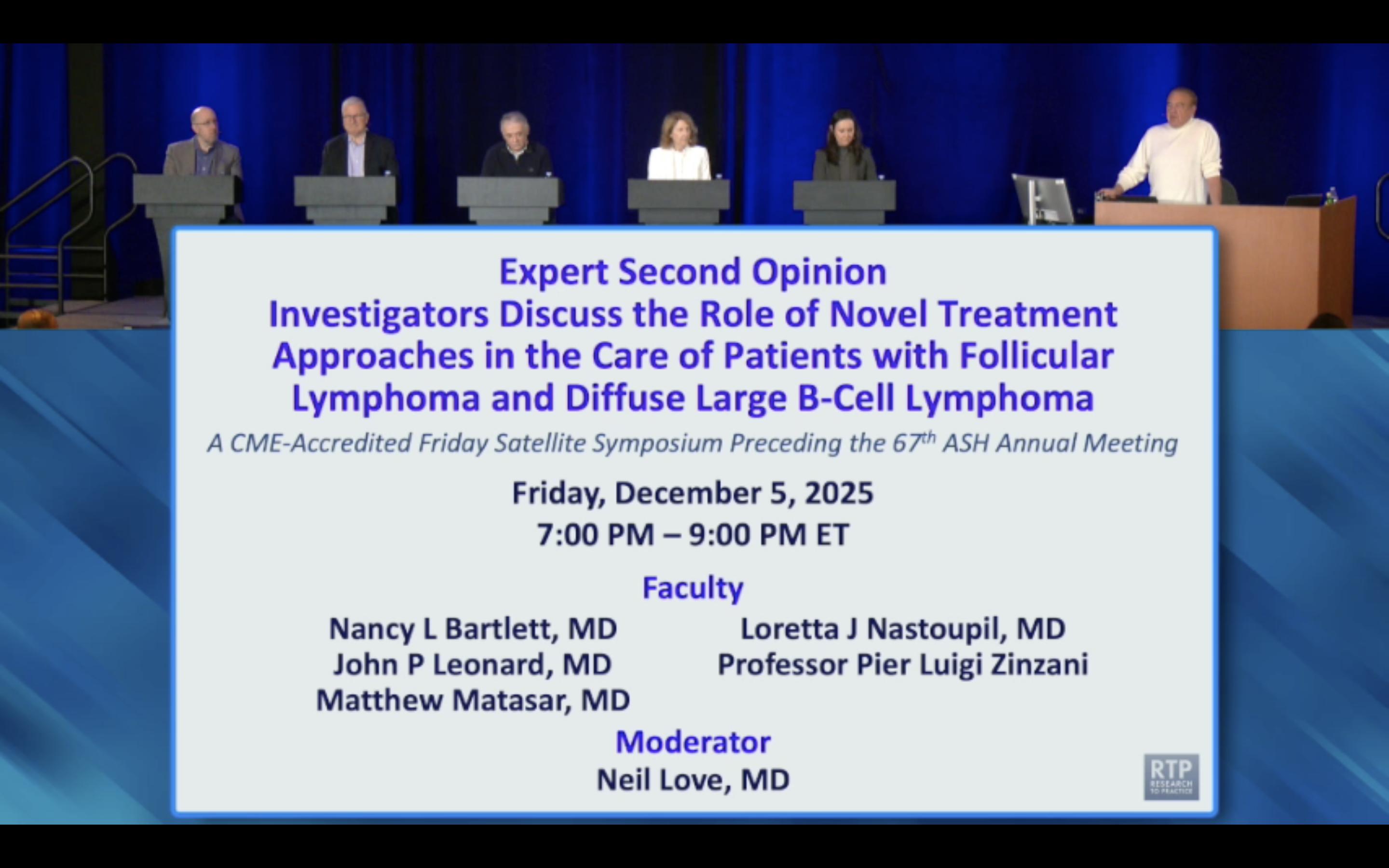
To mitigate the risk of severe Cytokine Release Syndrome (CRS) from bispecific antibodies in patients with high tumor burden, a debulking strategy is effective. Administering two initial cycles of chemotherapy dramatically reduces disease volume, leading to almost zero CRS when the bispecific is introduced, making the treatment much safer.
For DLBCL patients awaiting CAR-T cell therapy, particularly those with aggressive disease, bispecific antibodies are the preferred bridging strategy. This approach effectively controls disease and reduces tumor burden for better CAR-T outcomes, while avoiding the T-cell depleting effects of traditional chemotherapy.
Unlike older IMiDs where T-cell effects are secondary, CELMoDs have a powerful, independent pro-T-cell mechanism. This dual action is so significant that in the future, CELMoDs will be prescribed not just for their direct anti-myeloma effects, but specifically to enhance the efficacy of T-cell therapies like CAR-T and bispecific antibodies.
Using a BCMA bispecific antibody first can exhaust a patient's T-cells or cause tumors to lose the BCMA target, rendering a subsequent BCMA-targeted CAR-T therapy ineffective. The optimal sequence is CAR-T first, which preserves T-cell function and BCMA expression, leaving bispecifics as a viable later-line option.

Belantamab's primary mechanism, immunogenic cell death, does not exhaust T-cells. This unique quality allows clinicians to use it as a first BCMA-targeted agent without compromising the efficacy of subsequent T-cell redirecting therapies like CAR T or bispecifics.

Rather than viewing bispecific antibodies and CAR-T cell therapy as mutually exclusive, Dr. Budde uses bispecific combinations as an off-the-shelf bridging strategy. High tumor burden and refractory disease reduce CAR-T response rates; administering an initial truncated course of bispecific combinations debulks aggressive lymphoma into deep remissions before transitioning patients to single-infusion CAR-T to complete treatment.
Beyond their direct anti-myeloma effects, CELMoDs potently activate the immune system. This positions them as ideal partners for immunotherapies like CAR T and bispecifics, with the potential to restore immune function and overcome resistance to T-cell redirecting therapies.
Giving prophylactic tocilizumab before bispecific antibody administration is a highly effective strategy to mitigate Cytokine Release Syndrome (CRS). This approach can reduce CRS rates from ~70% to 5-14%, making outpatient step-up dosing a much more feasible and safer option for community oncology centers.
