Get your free personalized podcast brief
We scan new podcasts and send you the top 5 insights daily.
In 2019, 99% of workloads used a single GPU, not because researchers lacked bigger problems, but because the tooling for multi-GPU training was too complex. PyTorch Lightning's success at Facebook AI demonstrated that simplifying the process could unlock massive, latent demand for scaled-up computation.

Related Insights
Before becoming a world-famous library, PyTorch Lightning started as "Research Lib," a personal tool Will Falcon built on Theano to accelerate his undergraduate neuroscience research. Its purpose was to avoid rewriting boilerplate code, allowing him to iterate on scientific ideas faster, demonstrating that powerful tools often solve personal problems first.
The original playbook of simply scaling parameters and data is now obsolete. Top AI labs have pivoted to heavily designed post-training pipelines, retrieval, tool use, and agent training, acknowledging that raw scaling is insufficient to solve real-world problems.

The progress in deep learning, from AlexNet's GPU leap to today's massive models, is best understood as a history of scaling compute. This scaling, resulting in a million-fold increase in power, enabled the transition from text to more data-intensive modalities like vision and spatial intelligence.
The progression from early neural networks to today's massive models is fundamentally driven by the exponential increase in available computational power, from the initial move to GPUs to today's million-fold increases in training capacity on a single model.

The plateauing performance-per-watt of GPUs suggests that simply scaling current matrix multiplication-heavy architectures is unsustainable. This hardware limitation may necessitate research into new computational primitives and neural network designs built for large-scale distributed systems, not single devices.
While AI inference can be decentralized, training the most powerful models demands extreme centralization of compute. The necessity for high-bandwidth, low-latency communication between GPUs means the best models are trained by concentrating hardware in the smallest possible physical space, a direct contradiction to decentralized ideals.

To operate thousands of GPUs across multiple clouds and data centers, Fal found Kubernetes insufficient. They had to build their own proprietary stack, including a custom orchestration layer, distributed file system, and container runtimes to achieve the necessary performance and scale.
When splitting jobs across thousands of GPUs, inconsistent communication times (jitter) create bottlenecks, forcing the use of fewer GPUs. A network with predictable, uniform latency enables far greater parallelization and overall cluster efficiency, making it more important than raw 'hero number' bandwidth.

Pre-training requires constant, high-bandwidth weight synchronization, making it difficult across data centers. Newer Reinforcement Learning (RL) methods mostly do local forward passes to generate data, only sending back small amounts of verified data, making distributed training more practical.
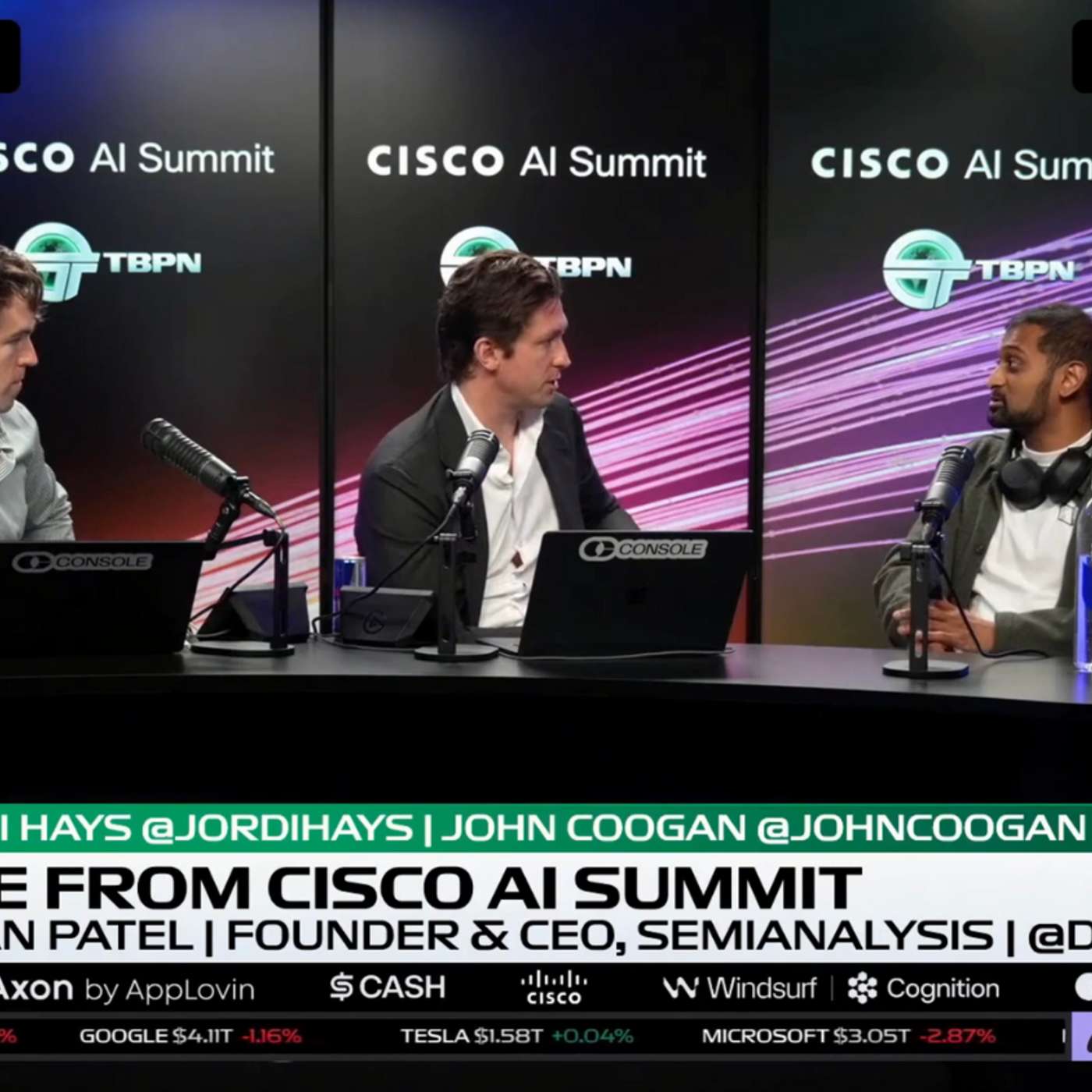
Cohere intentionally designs its enterprise models to fit within a two-GPU footprint. This hard constraint aligns with what the enterprise market can realistically deploy and afford, especially for on-premise settings, prioritizing practical adoption over raw scale.