Get your free personalized podcast brief
We scan new podcasts and send you the top 5 insights daily.
A designer built an animated modal in a lightweight "playground" environment. To move it to production, they fed the entire code directory to an LLM and asked it to "make this work in production." The LLM flawlessly translated it, shocking the engineering team.

Related Insights
Prototyping directly in the production environment makes high-quality interactions achievable without extensive resources. This dissolves the traditional design dilemma of sacrificing quality for speed, allowing teams to build better products faster.

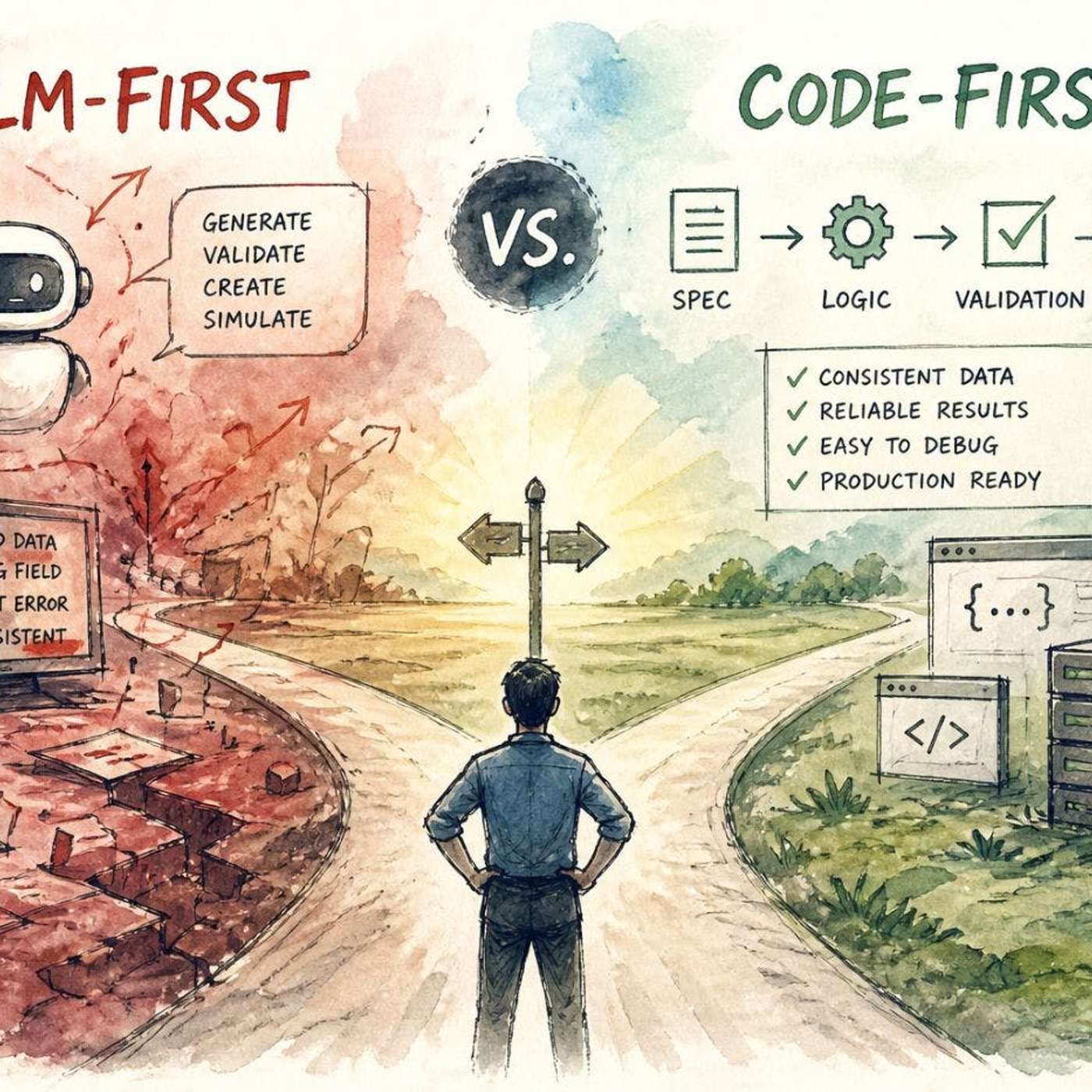
An 'LLM-first' approach, where the model handles core logic, creates impressive demos but lacks production reliability. A 'code-first' approach, using code for structure and LLMs for specific tasks, is less flashy but proves robust and debuggable in real-world applications.
For experienced coders, LLMs eliminate the steep learning curve for new platforms. Max Levchin, who had never built an iOS app, created a custom A/V remote control app for his home because an AI agent handled the research and setup, letting him focus on the core logic.

When production code is the only source of truth, designers use AI to capture the live product and convert it back into a high-fidelity, componentized Figma file. This solves the common issue of undocumented engineering changes creating design drift.

To validate a new front-end design system, the CEO defines a clear, modern unit test: take a screenshot of an existing web page, feed it and the URL to an LLM like Claude, and ask it to replicate the page using the new system. If the AI can do it successfully, the system is proven effective.
Move beyond basic AI prototyping by exporting your design system into a machine-readable format like JSON. By feeding this into an AI agent, you can generate high-fidelity, on-brand components and code that engineers can use directly, dramatically accelerating the path from idea to implementation.

AI-driven code generation relies on design systems for instructions. A weak system leads to poor code output, making the design system a critical foundation for engineering quality and speed, not just a design team's responsibility.
High-fidelity, code-based prototypes are replacing static mockups as the primary artifact for design-to-engineering handoffs. At Stripe, engineers can use the prototype's code as a direct source of truth, minimizing translation errors and ambiguity from design to production.

Instead of writing complex descriptive prompts for animations, designers at Notion sketch keyframes in Figma, take screenshots, and feed them to an LLM. The AI's computer vision interprets the visual steps and generates the animation code, streamlining the motion design process.
To encourage designers and PMs to code with AI, Notion built a simplified, isolated codebase or "playground." This lowered the barrier to entry and fear of the terminal, allowing them to feel the AI and prototype effectively without breaking production code.