Get your free personalized podcast brief
We scan new podcasts and send you the top 5 insights daily.
While companies are still focused on quantifying the immediate benefits of AI adoption, the market's narrative has quickly pivoted. Investors are now more concerned with the long-term, negative consequences of powerful AI, such as industry-wide disruption and deflationary pressures.

Related Insights
Stock market investors are pricing in rapid, significant productivity gains from AI to justify high valuations. This sets up a binary outcome: either investors are correct, leading to massive productivity growth that could disrupt the job market, or they are wrong, resulting in a painful stock market correction when those gains fail to materialize.

Beyond simple productivity gains, AI will eliminate the need for entire service-based transactions, such as paying for basic legal documents or second medical opinions. This substitution of paid services with free AI output can act as a direct deflationary headwind, a counterintuitive effect to the typical AI-fueled growth narrative.

Initially, investors rewarded companies for huge AI spending announcements. Now, this same news causes stock market jitters. The anxiety stems from historical parallels like the internet boom, where overexcited investors backed the wrong companies and lost fortunes, even though the technology ultimately succeeded.

IBM's stock plunged 13% after an Anthropic blog post about an *existing* AI capability (COBOL modernization). This indicates investors are finally grappling with the long-term disruptive implications of AI on legacy businesses, reacting to the strategic threat itself rather than waiting for a specific new product launch.

Initially viewed as a growth driver, Generative AI is now seen by investors as a major disruption risk. This sentiment shift is driven by the visible, massive investments in AI infrastructure without corresponding revenue growth appearing in established enterprise sectors, causing a focus on potential downside instead of upside.

The true disruption from AI is not a single bot replacing a single worker. It's the immense leverage granted to individuals who can deploy thousands of autonomous AI agents. This creates a massive multiplication of productivity and economic power for a select few, fundamentally altering labor market dynamics from one-to-one replacement to one-to-many amplification.
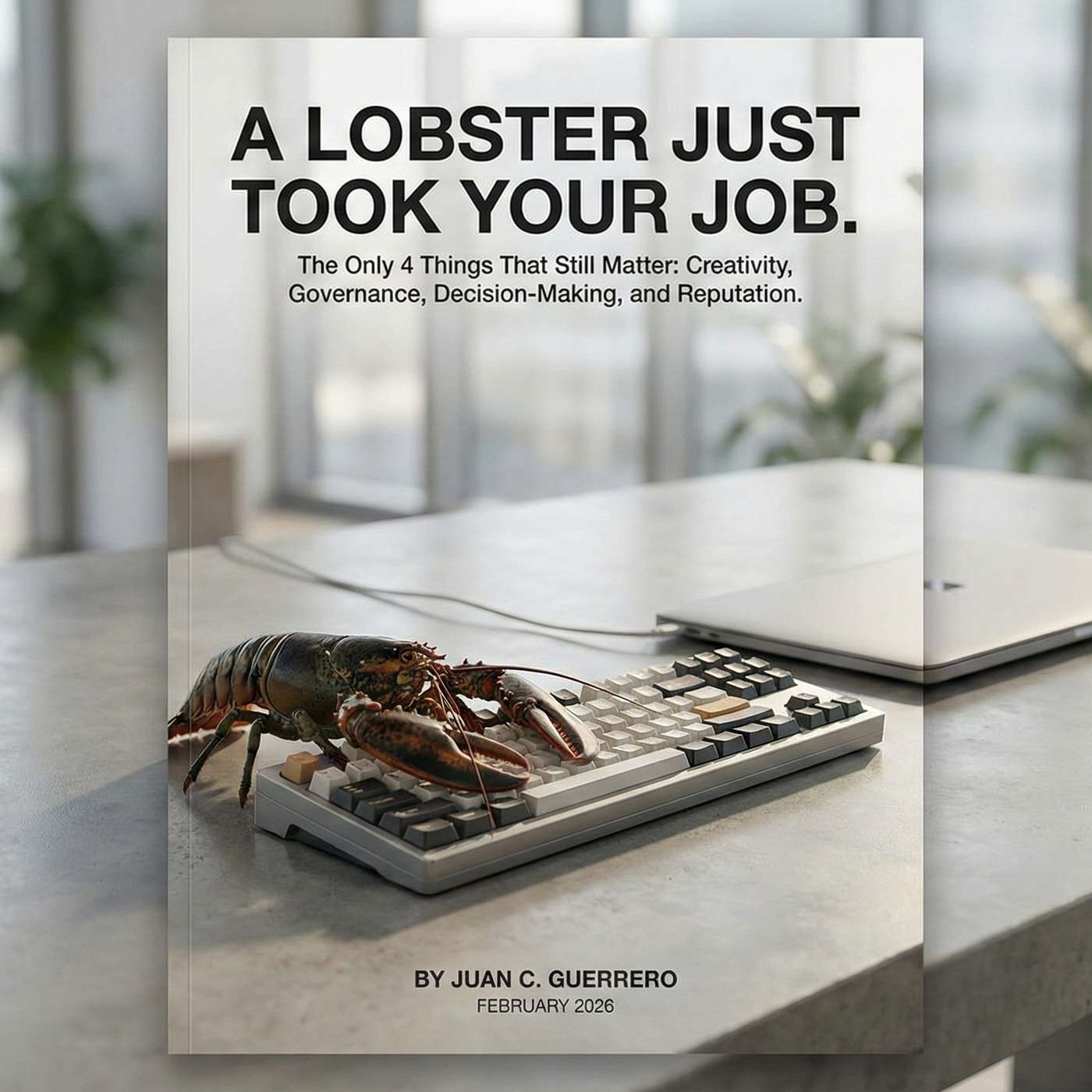
For current AI valuations to be realized, AI must deliver unprecedented efficiency, likely causing mass job displacement. This would disrupt the consumer economy that supports these companies, creating a fundamental contradiction where the condition for success undermines the system itself.

The key threat from AI isn't just its capability, but the unprecedented speed of its improvement. Unlike past technological shifts that unfolded over decades, AI agent autonomy on complex tasks has grown exponentially in just two years. This rapid acceleration is what financial systems and labor markets are not stress-tested for.

Economists are weighing two contradictory negative scenarios for AI. One where its rapid success causes massive job upheaval, and another where it fails to meet investor hype, leading to a stock market collapse and recession much like the dot-com bubble.
The AI narrative has evolved beyond tech circles to family Thanksgiving discussions. The focus is no longer on the technology's capabilities but on its financial implications, such as its impact on 401(k)s. This signals a maturation of the hype cycle where public consciousness is now dominated by market speculation.