Get your free personalized podcast brief
We scan new podcasts and send you the top 5 insights daily.
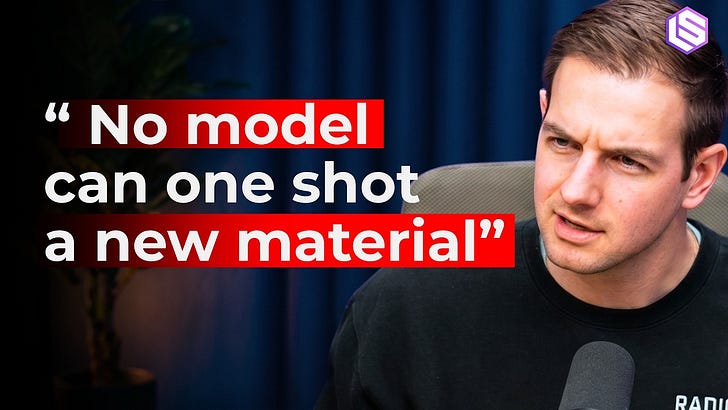
Radical AI uses a human-in-the-loop system where PhD scientists annotate lab results, like microscopy images, with their interpretations. This process effectively 'downloads' their scientific intuition, training the AI on nuanced knowledge that isn't found in textbooks.
Related Insights
AI capabilities are rapidly advancing beyond theory. Today's frontier models can troubleshoot complex laboratory experiments from a simple cell phone picture, often outperforming human PhDs. This dramatically lowers the barrier to entry for conducting sophisticated biological research.

A fascinating meta-learning loop emerged where an LLM provides real-time 'quality checks' to human subject-matter experts. This helps them learn the novel skill of how to effectively teach and 'stump' another AI, bridging the gap between their domain expertise and the mechanics of model training.
Genentech uses an iterative AI model where an algorithm predicts an experiment, scientists run it in a wet lab, and the results are fed back to improve the model. This human-in-the-loop system has dramatically increased R&D productivity, cutting molecule design time from a typical 36 months down to just 10.

The physics breakthrough provides a scalable template for AI-assisted research. The model involves AI identifying patterns and generating hypotheses from data, with human experts then responsible for rigorous validation and ensuring consistency. This is augmented, not autonomous, science.

Molly Gibson's venture, Lila Sciences, aims for AI that doesn't just analyze data but autonomously executes the entire scientific method. By connecting generative models to automated labs, the AI can formulate hypotheses, run physical experiments, and learn from the results in a continuous loop, achieving a superhuman pace of discovery.

Their 'AI Scientist' is architected as a multi-agent system. It features an orchestrator for hypotheses, a literature review agent, and specialized vision-language models for analyzing experimental data directly from lab instruments, rather than relying on one monolithic model.
The frontier of AI training is moving beyond humans ranking model outputs (RLHF). Now, high-skilled experts create detailed success criteria (like rubrics or unit tests), which an AI then uses to provide feedback to the main model at scale, a process called RLAIF.

The most valuable data for training enterprise AI is not a company's internal documents, but a recording of the actual work processes people use to create them. The ideal training scenario is for an AI to act like an intern, learning directly from human colleagues, which is far more informative than static knowledge bases.

Building biologically relevant AI is not a one-off process. It demands a continuous "lab in the loop" system where wet lab experiments generate proprietary data to train models, whose outputs are then physically tested in the lab. This iterative feedback cycle constantly refines the model's predictive accuracy.

Treat AI skills not just as prompts, but as instruction manuals embodying deep domain expertise. An expert can 'download their brain' into a skill, providing the final 10-20% of nuance that generic AI outputs lack, leading to superior results.
