Get your free personalized podcast brief
We scan new podcasts and send you the top 5 insights daily.
Unlike CMOS chips that perform simple addition/multiplication, photonic chips execute complex functions like Fourier transforms natively. This dramatically reduces data fetched from memory, targeting the 95% of energy currently consumed by data movement, not computation.

Related Insights
To achieve 1000x efficiency, Unconventional AI is abandoning the digital abstraction (bits representing numbers) that has defined computing for 80 years. Instead, they are co-designing hardware and algorithms where the physics of the substrate itself defines the neural network, much like a biological brain.

Digital computing, the standard for 80 years, is too power-hungry for scalable AI. Unconventional AI's Naveen Rao is betting on analog computing, which uses physics to perform calculations, as a more energy-efficient substrate for the unique demands of intelligent, stochastic workloads.

While most focus on building more power infrastructure to meet AI's energy needs, the truly disruptive innovation may come from creating chips and models that are massively more energy-efficient. This contrarian view suggests the real investment opportunity might be in demand-side technology, not just supply-side energy production.

Google is developing a specialized chip, "Frozen V2," that sacrifices general-purpose flexibility by "etching" a model's architecture directly onto the silicon. This is designed to make AI inference 6-10 times more efficient than its TPUs, directly addressing the massive compute costs associated with running models like Gemini.

Instead of running an entire inference task on a single GPU, the next efficiency leap will come from breaking it down. Tasks like prefill, attention, and feed-forward networks will be routed to specialized chips, such as SRAM-based accelerators, that are best suited for each job, dramatically improving performance and ROI.
![Gavin Baker - AI Market Jitters - [Invest Like the Best, EP.485] thumbnail](https://megaphone.imgix.net/podcasts/c8fca7de-8f77-11f1-ae96-ab857574605f/image/e34471e6c9b4af0375abbd710ff0fa11.jpg?ixlib=rails-4.3.1&max-w=3000&max-h=3000&fit=crop&auto=format,compress)
The fundamental primitive for AI chips isn't arbitrary; it's the multiply-accumulate (MAC) operation. This is because it directly maps to the innermost computational loop of matrix multiplication (output += input1 * input2), which is the foundational computation for most neural networks.
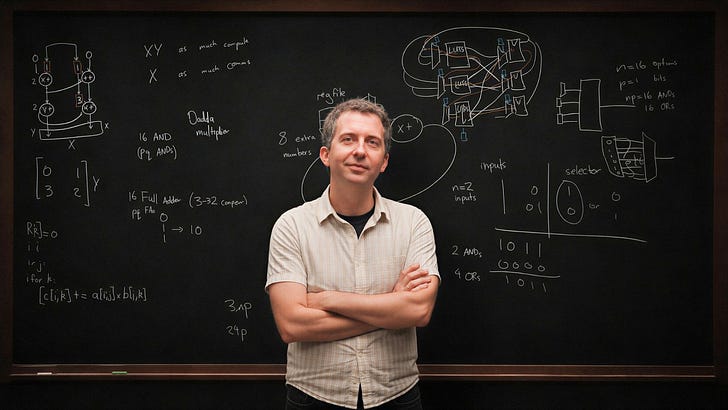
Martin Shkreli makes a case for photonic computing—using light instead of electrons—as the next major paradigm in AI hardware. He argues that because matrix multiplications (95% of a GPU's job) are a natural function of light interference, photonic chips could offer an "insane speedup" with O-of-one complexity, making them a potential successor to GPUs.

SambaNova's architecture is optimized for inference by treating it as a data movement challenge rather than a raw compute problem. By designing for efficient data flow and communication between memory and compute units, they achieve 5-10x performance improvements over traditional GPUs.

With Moore's Law over, computing progress now depends on networking vast numbers of chips. Lightmatter's photonic interconnects overcome the distance limits of copper cables, allowing thousands of GPUs kilometers apart to function as a single, cohesive supercomputer. This creates a new scaling vector for AI performance.

The intense power demands of AI inference will push data centers to adopt the "heterogeneous compute" model from mobile phones. Instead of a single GPU architecture, data centers will use disaggregated, specialized chips for different tasks to maximize power efficiency, creating a post-GPU era.
