Get your free personalized podcast brief
We scan new podcasts and send you the top 5 insights daily.
The prolonged conflict serves as a real-world R&D lab for modern warfare. While Ukraine innovates in areas like drone usage, Russia quickly copies these methods at scale. This is upskilling the Russian military, creating a more formidable future threat for NATO and the U.S.

Related Insights
A powerful partnership has formed between elite US tech talent (e.g., from Google X) and experienced Ukrainian drone units on the front line. This creates a rapid, iterative feedback loop for innovation that Russia’s slow, centralized defense industry is unable to compete with, accelerating technological superiority.

The primary threat from alliances like Russia, China, and Iran lies not in sales of ships or planes, but in the creation of 'learning communities.' These nations share hard-won lessons from their respective conflicts, such as Russia teaching Iran how to build better drones based on its experience in Ukraine. This agile knowledge transfer poses a more significant challenge to Western military superiority.

The war in Ukraine marks a historical inflection point in military technology. For the first time since the 19th century, the primary method of killing a soldier is no longer a bullet or artillery shell, but a drone. This fundamentally changes battlefield tactics and defense strategies.

Ukraine is demonstrating a new paradigm of warfare where innovating faster than the enemy can lie is paramount. They are effectively weaponizing consumer technology like drones, proving that a motivated populace can outmaneuver a corrupt, technologically stagnant superpower.

Unlike the US model of a single "drone guy" per platoon, Ukraine has entire battalions focused on drone warfare. These units have frontline labs that debrief missions and iterate on drone technology within days, creating a dramatically faster innovation cycle.

Ukraine's success against Russia demonstrates a new era of warfare, pitting innovative, AI-powered drones against traditional military might ("human meat"). This suggests future conflicts will be increasingly autonomous and remote, creating an asymmetry where cheap tech can defeat expensive platforms.
After licensing Iran's Shaheed drones for use in Ukraine, Russia improved them and developed new battlefield tactics. Russia is now sharing this advanced operational knowledge back with Iran, the system's originator, accelerating the evolution of drone warfare for both nations.

The US Army's extensive counterinsurgency experience from the Global War on Terror is largely irrelevant in modern peer-level conflicts. Forces like the Ukrainians and Russians now possess far more relevant and recent combat experience, particularly regarding drone warfare and large-scale conventional operations.
The pace of innovation is a critical factor in modern warfare. In one year, the Ukraine-Russia conflict advanced drone technology from a "2022" to a "2026" capability level. In that same period, Europe made zero progress, widening a dangerous technological gap.
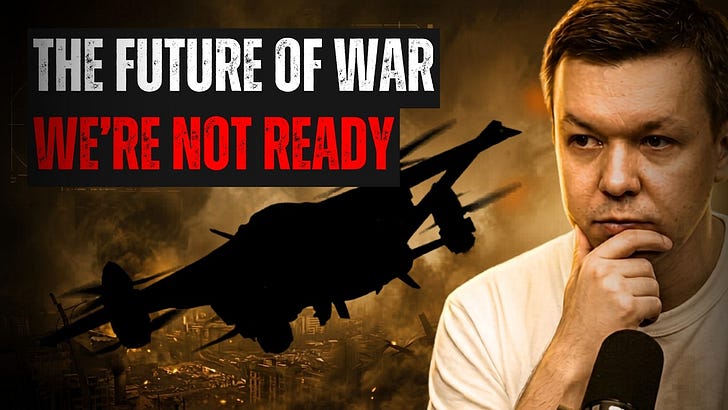
The war in Ukraine has evolved from a traditional territorial conflict into a "robot war," with drones dominating the front lines. This real-world battlefield is accelerating innovation at an "unbelievable" pace, driving new solutions for secure communications and autonomous targeting, providing critical lessons for US drone strategy.