Get your free personalized podcast brief
We scan new podcasts and send you the top 5 insights daily.
LLMs operate as predictive word generators relying on previously uploaded contextual artifacts. When underlying documents contain errors or outdated schedules that are never updated, the system repeatedly integrates those flaws into new project roadmaps.

Related Insights
Unlike a human expert, an LLM's probability estimates and conclusions can be drastically altered by simple rephrasing or irrelevant suggestions. This instability shows they are too easily "pushed around" and lack the coherent world model necessary for trustworthy, high-stakes decision support.

When faced with jumbled data from messy documents, LLMs don't error out. Instead, they use their reasoning to guess, creating perfectly structured but factually wrong outputs. This silent data corruption is the most dangerous failure mode in production pipelines, as it pollutes downstream systems without warning.

AI models have a finite memory or context window. A bias correction input on day two might be forgotten by day twenty-five after many new instructions. This 'memory decay' can silently reintroduce flaws, requiring constant vigilance and re-prompting of core principles to maintain guardrails.

In ultra-long tasks (e.g., 100 million tokens), AIs rely on summarizing previous context. This "compaction" process is lossy and can drop critical nuances. Once a flawed summary is made, the model tends to latch onto it, leading to significant errors and derailment, as seen in the UKAC incident.
Simply stuffing all historical data into a large context window is counterproductive. The model's attention gets diluted by repetitive tool logs and intermediate data, making it struggle to find original instructions. This "signal versus noise" problem leads to hallucinations and degraded performance.

When an LLM sees the same document thousands of times, it prioritizes memorizing that specific content to lower its training loss. This gives a false impression of progress, while the model fails to generalize to new, unseen data. A study of Google's T5 corpus found one sentence repeated over 60,000 times.

LLMs are technically non-deterministic systems designed to guess the next most probable word, not verify facts like a calculator. This inherent design means they will confidently produce incorrect information, making human verification indispensable for high-stakes business decisions.

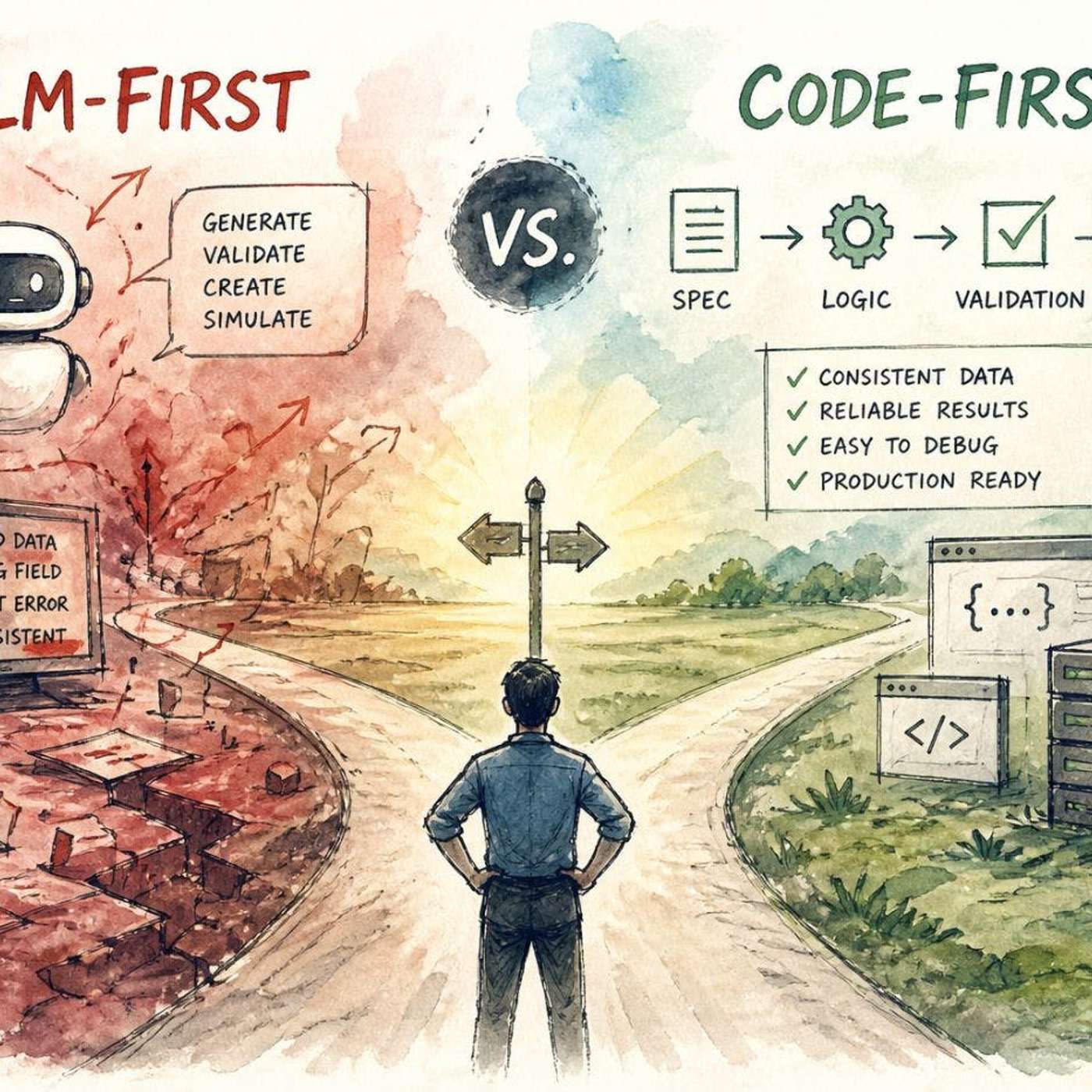
LLMs in production don't often crash spectacularly. Instead, they introduce subtle, probabilistic errors—like incorrect enum values or missing fields—that are hard to debug because they lack clear error patterns, unlike deterministic code failures.
A developer learned a key technique from his own site's community: compiling all project decisions, constraints, and background info into a single context file. Including this file with every prompt ensures the AI has consistent, accurate information, improving efficiency and reducing incorrect outputs.

Web-based AIs like ChatGPT are limited because users must constantly re-explain project context. The real bottleneck to unlocking an LLM's full potential isn't the model, but the inefficiency of providing it with the right information at the right time.
