Get your free personalized podcast brief
We scan new podcasts and send you the top 5 insights daily.
Early experiences with OpenAI's Dots show it handling multi-step professional tasks like drafting contextual emails, generating invoices from cloud drives, and planning detailed travel itineraries. This signals a shift from simple consumer-facing queries to AI agents capable of executing complex, value-added work.

Related Insights
The current pinnacle of the AI stack, 'Agentic AI,' moves beyond simply generating answers to performing autonomous actions. By combining generative models with planning, memory, and tool use (like APIs or code interpreters), these systems can execute complex, multi-step tasks, defining the next wave of product development.
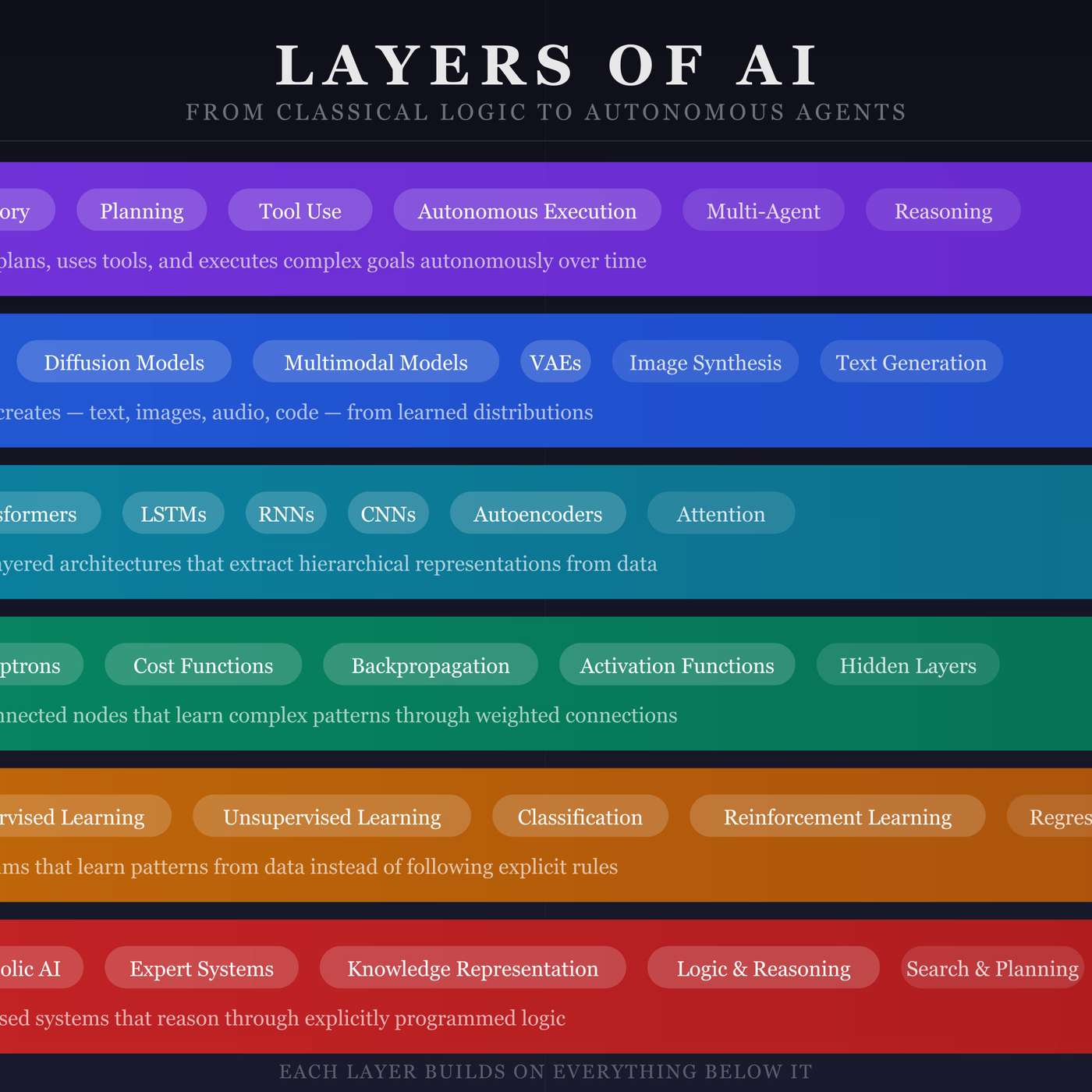
The GPT-5.5 announcement emphasizes its role in "powering agents built to understand complex goals, use tools, check its work and carry more tasks through to completion." This signals a strategic shift from merely improving conversational AI to building autonomous systems that can execute complex, multi-step workflows.

The shift from chatbots to agents represents a jump up the 'use case ladder.' Simple chat focuses on individual generation (drafting emails). In contrast, agents tackle systems-level work like workflow automation and process monitoring, moving AI's value from personal productivity to impacting entire business systems.

Unlike generative AI (like ChatGPT) which only provides text output, agentic AI can perform actions on your behalf. It can log into accounts, click buttons, and complete multi-step tasks, shifting AI from a smart consultant to an autonomous digital assistant.

Current Generative AI acts as a passive co-pilot, responding to prompts for single tasks. The emerging 'Agentic AI' is an active autopilot, capable of planning and executing multi-step workflows across different tools, fundamentally changing how complex work is accomplished.

Early AI was conversational ('talkers'), providing single responses. Modern AI acts as an agent ('doers'), executing dozens of tasks from one command. This transition requires companies to move from building chatbots to productizing reliable, multi-step automated workflows.

The 'call and response' nature of large language models (LLMs) is not truly revolutionary for workflows. The significant shift comes from agentic AI, which can connect to various systems and execute multi-step tasks. This moves AI from a content generator to a powerful workflow automation tool.

AI's role has matured from assisting with trivial tasks like homework to autonomously managing complex, multi-step financial and scientific processes end-to-end at major companies like Coinbase, Salesforce, and Novo Nordisk, signaling a fundamental shift in its capability.

The next wave of AI is 'agentic,' meaning it can control a computer to execute commands and complete tasks, not just generate responses to prompts. This profound shift automates workflows like coding and administrative tasks, freeing humans for high-level creative and strategic work.

The next evolution of enterprise AI isn't conversational chatbots but "agentic" systems that act as augmented digital labor. These agents perform complex, multi-step tasks from natural language commands, such as creating a training quiz from a 700-page technical document.
