Get your free personalized podcast brief
We scan new podcasts and send you the top 5 insights daily.
Instead of policing AI use, a novel strategy is for teachers to show students what AI produces on an assignment and grade it as a 'B-'. This sets a clear baseline, reframing AI as a starting point and challenging students to use human creativity and critical thinking to achieve a higher grade.

Related Insights
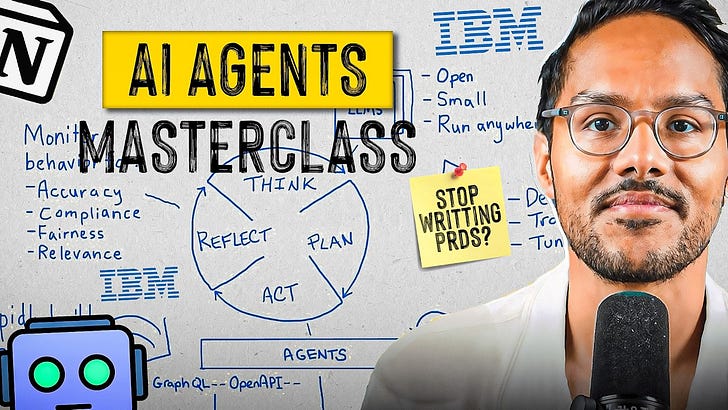
While AI tools once gave creators an edge, they now risk producing democratized, undifferentiated output. IBM's AI VP, who grew to 200k followers, now uses AI less. The new edge is spending more time on unique human thinking and using AI only for initial ideation, not final writing.
Schools ban AI like ChatGPT fearing it's a tool for cheating, but this is profoundly shortsighted. The quality of an AI's output is entirely dependent on the critical thinking behind the user's input. This makes AI the first truly scalable tool for teaching children how to think critically, a skill far more valuable than memorization.

A powerful workflow is to explicitly instruct your AI to act as a collaborative thinking partner—asking questions and organizing thoughts—while strictly forbidding it from creating final artifacts. This separates the crucial thinking phase from the generative phase, leading to better outcomes.

Users mistakenly evaluate AI tools based on the quality of the first output. However, since 90% of the work is iterative, the superior tool is the one that handles a high volume of refinement prompts most effectively, not the one with the best initial result.
Instead of manually refining a complex prompt, create a process where an AI agent evaluates its own output. By providing a framework for self-critique, including quantitative scores and qualitative reasoning, the AI can iteratively enhance its own system instructions and achieve a much stronger result.
True creative mastery emerges from an unpredictable human process. AI can generate options quickly but bypasses this journey, losing the potential for inexplicable, last-minute genius that defines truly great work. It optimizes for speed at the cost of brilliance.

ASU's president argues that if an AI can answer an assignment, the assignment has failed. The educator's role must evolve to use AI to 'up the game,' forcing students to ask more sophisticated questions, making the quality of the query—not the synthesized answer—the hallmark of learning.

The most creative use of AI isn't a single-shot generation. It's a continuous feedback loop. Designers should treat AI outputs as intermediate "throughputs"—artifacts to be edited in traditional tools and then fed back into the AI model as new inputs. This iterative remixing process is where happy accidents and true innovation occur.
In an age where AI can produce passable work, an educator's primary role shifts. Instead of focusing solely on the mechanics of a skill like writing, the more crucial and AI-proof job is to inspire students and convince them of the intrinsic value of learning that skill for themselves.
Instead of allowing AI to atrophy critical thinking by providing instant answers, leverage its "guided learning" capabilities. These features teach the process of solving a problem rather than just giving the solution, turning AI into a Socratic mentor that can accelerate learning and problem-solving abilities.