Get your free personalized podcast brief
We scan new podcasts and send you the top 5 insights daily.
Instead of just shipping customer features, high-leverage PMs are now building internal tools and agents to automate their own jobs. The goal is to scale your judgment and decision-making by eliminating manual processes like status reports and reviews, not to become another coder on the core product.

Related Insights
AI agents will automate PM tasks like competitive analysis, user feedback synthesis, and PRD writing. This efficiency gain could shift the standard PM-to-developer ratio from 1:6-10 to 1:20-30, allowing PMs to cover a much broader product surface area and focus on higher-level strategy.
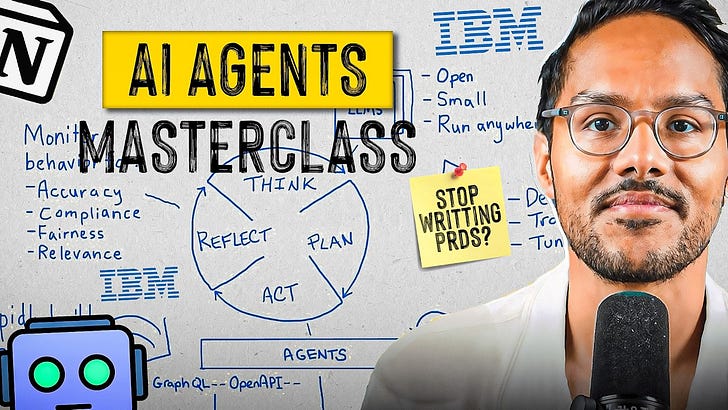
As AI tools automate coding and prototyping, the product manager's core function is no longer detailed specification writing. Instead, their value multiplies in judging, facilitating, and making the right strategic decisions quickly. The emphasis moves from the 'how' of building to the 'what' and 'why,' making decision-making the critical skill.

Instead of relying on one-off prompts, professionals can now rapidly build a collection of interconnected internal AI applications. This "personal software stack" can manage everything from investments and content creation to data analysis, creating a bespoke productivity system.

AI automates tactical tasks, shifting the PM's role from process management to de-risking delivery by developing deep customer insights. This allows PMs to spend more time confirming their instincts about customer needs, which engineering teams now demand.

Shift automation from an ad-hoc tech project to a core management responsibility. Mandate that department leads systematically eliminate monotonous tasks, forcing teams to focus exclusively on high-value, strategic work.

Ramp's internal tool, "Inspect," allows non-technical roles like PMs and designers to generate and merge production-ready code. This dramatically accelerates development for quality-of-life improvements and minor features, activating the entire company as builders, not just the engineering team.

PMs can use AI agents connected to their codebase to explore technical feasibility and iterate on ideas. This serves as a 'digital tech lead,' saving immense time for senior engineers who were previously burdened with speculative 'how hard would it be?' questions from product managers.

The PM role is shifting to that of a 'product builder.' Instead of manually sifting through data, they can use AI agents to scrape sources like Gong, Slack, and Intercom. This provides an aggregated 'voice of the customer' and a data-backed strategy in minutes, not weeks.

AI's value for PMs is augmentation, not replacement. By automating tactical tasks that consume most of a PM's day (e.g., "six out of eight hours"), AI frees up critical capacity for higher-level strategic, creative, and innovative work—the core functions of a product leader.

Use AI to manage its own development tasks. After a brain dump of project goals, have the AI create tickets in a tool like Linear. Then, let the AI work through the tickets and update its own statuses, significantly reducing your mental load and freeing you up for higher-level review.