Get your free personalized podcast brief
We scan new podcasts and send you the top 5 insights daily.
Josh Gao says large-scale robot factories doing repetitive warehouse tasks revealed a threshold of diversity. Beyond some point, adding more robot data of the same kind oversaturates the need, so Mecka tracks job and industry heat maps and adapts quality heuristics as edge cases emerge.

Related Insights
Josh Gao expects Mecka to look different as robots deploy: not just egocentric data, but a platform that collects domain data, post-trains models, and white-gloves enterprises. He compares the future role to a modern robotics systems integrator whose installed bot keeps improving with data.
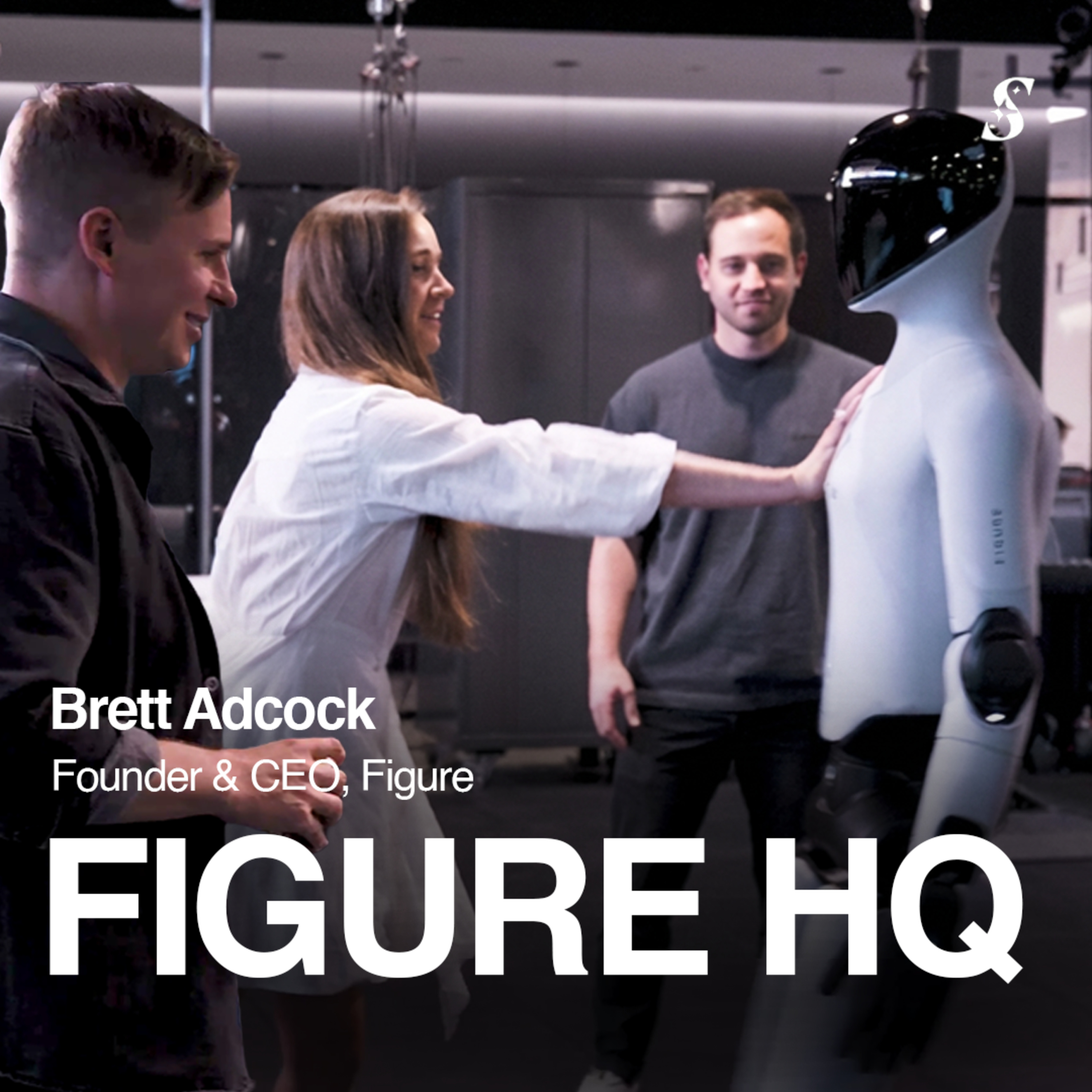
According to Figure's CEO, the company's biggest challenge is no longer hardware reliability but acquiring enormous amounts of diverse, high-quality data. This data is essential for pre-training their Helix AI model to generalize and handle countless real-world scenarios in homes and commercial settings.
What constitutes valuable training data changes dynamically as a robot model progresses. Initial cold-start stages benefit broadly from unstructured video data, but maturing models require highly targeted custom demonstration datasets for specific niche capabilities.

For physical AI systems like robots, data quality hinges on diversity, not just quantity. A robot trained to make a bed in one specific lighting condition may fail completely if the lighting changes or the bed is moved. This brittleness highlights a key challenge: training data must capture a wide variety of contexts and edge cases to enable real-world generalization.

Josh Gao says LLM pre-training data was driven by labs through web crawlers and never became a large market. In robotics, he says pre-training is already a large market because there is no free internet corpus; Mecka must create, process, and license physical-world data.
Adopting the true 'foundation model ethos' from LLMs is difficult for roboticists. It means a warehouse automation company should collect data from kitchen robots. This breadth, while seemingly unrelated, builds a generalist model that better handles the weird edge cases in the target domain than a narrowly trained specialist model.

Simply collecting more data from a deployed robot isn't enough to create a powerful learning flywheel. If the tasks are repetitive (e.g., a million car welds), the model won't generalize. Data must be diverse, acting more like an 'education program' than a fungible commodity to drive real capability growth.
At founding, Josh Gao says robot data was mostly teleoperation, which was hard to scale. He bet that first-person human video could close the vision gap and that humans and humanoids look alike, letting ordinary people contribute like a Tesla-style data fleet.
Josh Gao says Mecka's data engine is far more painful than people expect: it had to design custom hardware, distribute it to thousands of homes and businesses, install 100-gigabyte upload lines, and process hundreds of petabytes while enforcing quality gates.
Josh Gao says scaling the current data recipe by orders of magnitude will solve many constrained tasks. But a drop-in robot that handles any task amid real-world complexity, like weather, is still far off; he expects tactile, simulation, and even smell-like modalities to enter omni-model training.