Get your free personalized podcast brief
We scan new podcasts and send you the top 5 insights daily.
Google's Gemini 3.5 Transcribe signals a key evolution in voice AI. Its "smart translate mode" strips filler words and clarifies rambling thoughts to capture the user's intended meaning. This moves the technology beyond simple speech-to-text and toward a more natural, thought-to-text interface, improving usability.

Related Insights
The next paradigm for AI interfaces is shifting from passive tools (like transcription apps) to active participants. New real-time voice models that can listen and speak simultaneously will function as a live third party in conversations, offering proactive input rather than just post-hoc analysis.

GPT Live overcomes the turn-based limitations of previous voice models by continuously processing input while generating output. This allows users to interrupt and converse fluidly, moving AI interactions closer to natural human dialogue and positioning voice as a primary computing interface.

Advanced voice AI goes beyond simple transcription. It serves as an orchestration layer to manage complex, multi-threaded agentic tasks like booking travel or filing expenses. This transforms the user interaction from giving commands to delegating responsibilities, similar to interacting with a human assistant.

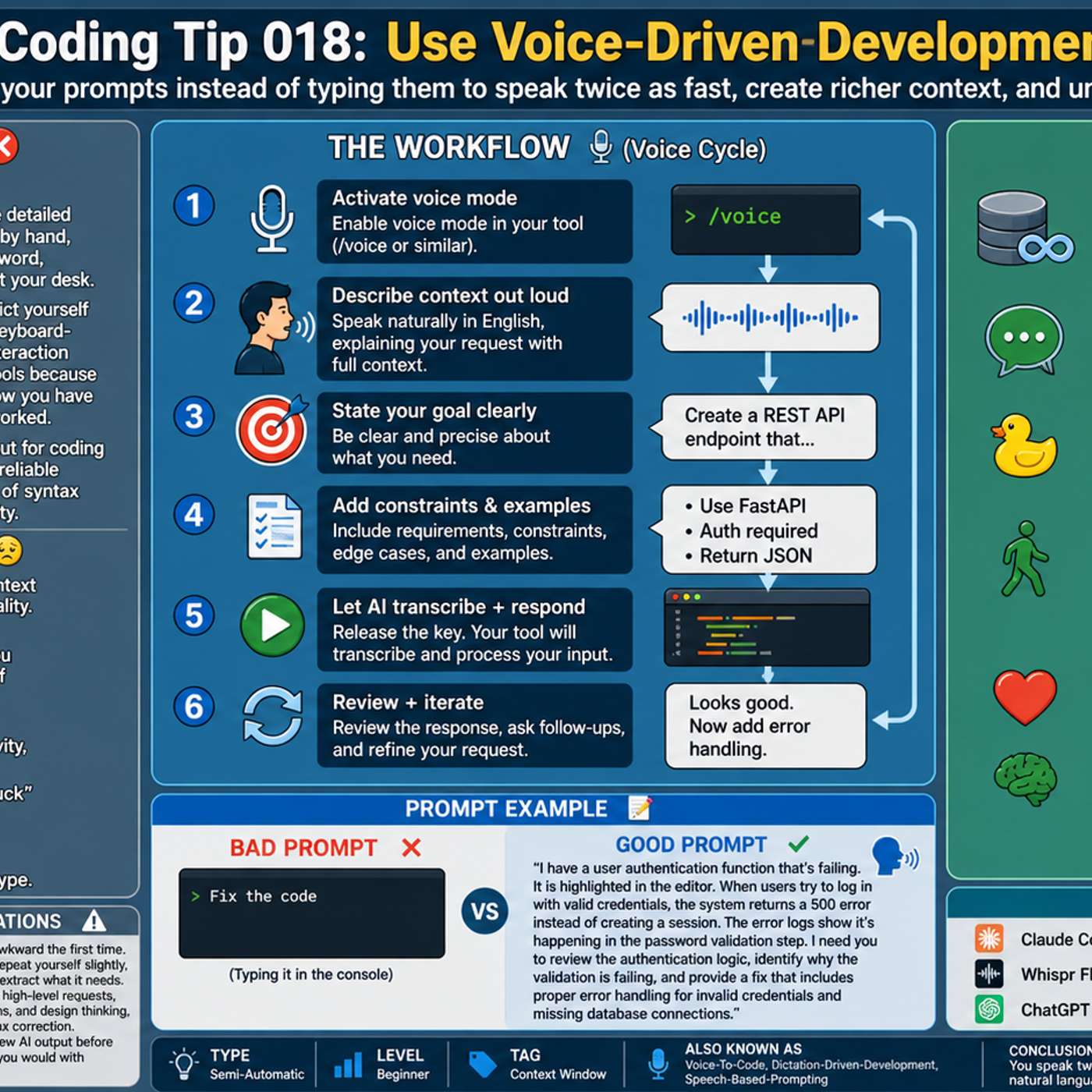
To feed AI models the rich context they require, advanced users are shifting from typing to speaking. They use high-fidelity, noise-canceling microphones to 'whisper' detailed prompts, dramatically increasing the amount of information provided per second and improving AI output quality.
Unlike past speech recognition that failed by requiring precise syntax, modern AI assistants can interpret natural, conversational language. They infer the user's intent, successfully translating it into code without needing perfectly dictated syntax like angle brackets or semicolons.
State-of-the-art voice models are no longer just transcribing words; they can be given context about their operating environment. For example, a model in a McDonald's drive-thru can be told to focus only on the person ordering and ignore children screaming in the background, dramatically improving accuracy.
The magic of ChatGPT's voice mode in a car is that it feels like another person in the conversation. Conversely, Meta's AI glasses failed when translating a menu because they acted like a screen reader, ignoring the human context of how people actually read menus. Context is everything for voice.

Using speech-to-text to talk to an AI is not just about speed. The 'art of the ramble' allows you to provide messy, uncertain, and richer context that you would filter out when typing. This gives the model access to your unpolished thought process, enabling it to help clarify your thinking and produce better results.
The key challenge for voice AI is mastering conversational flow—knowing when to speak and when to stay silent—rather than simply improving latency or voice realism. Understanding social cues is the next frontier.

Google is heavily investing in audio interaction, as seen in its "Gemini mic" feature. The ability to "ramble" at a model to generate code or structured content is seen as a fast-growing and powerful paradigm. This moves beyond simple voice commands to using natural, unstructured speech as a primary input for creative and technical work.
