Get your free personalized podcast brief
We scan new podcasts and send you the top 5 insights daily.
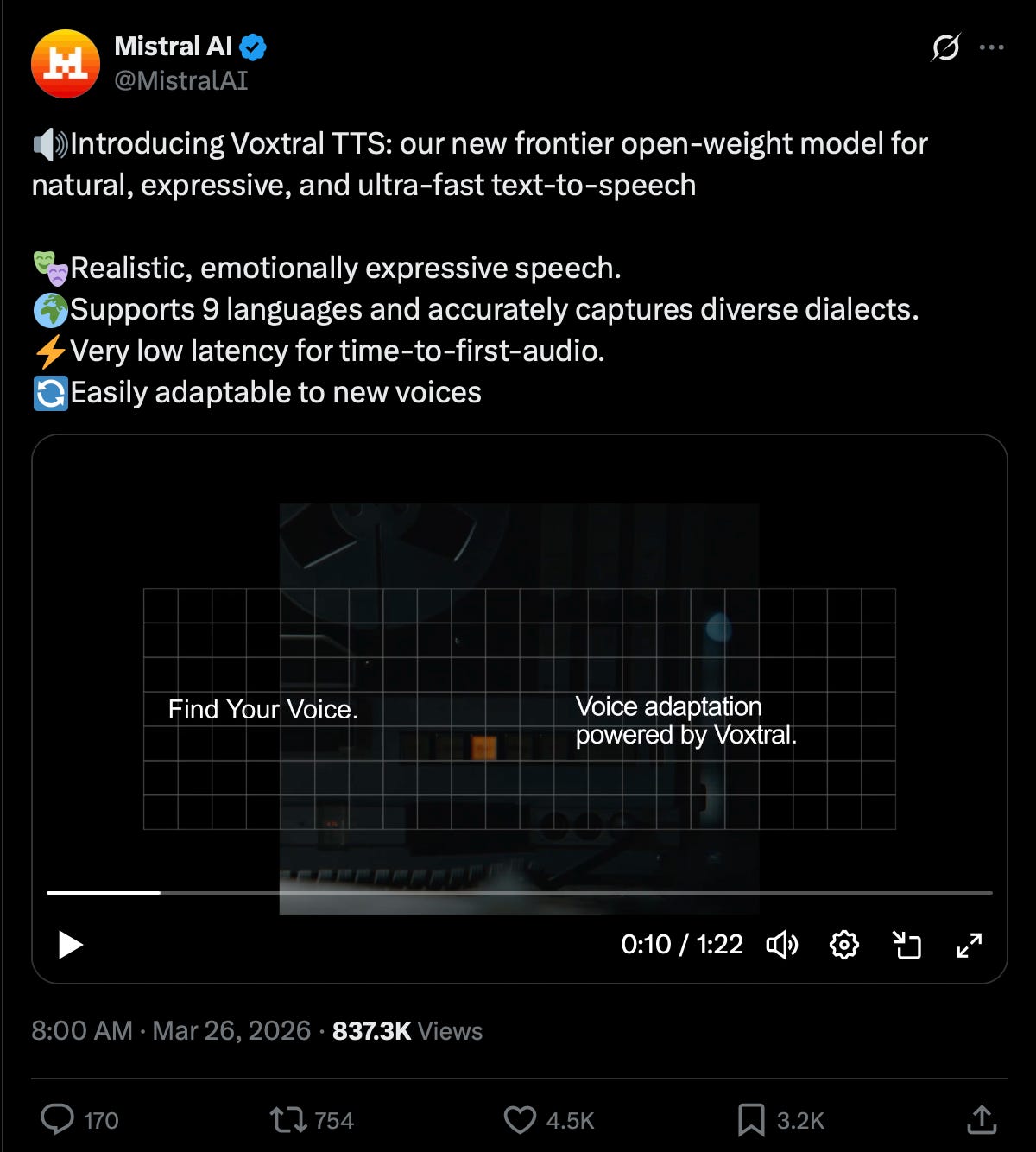
Instead of a single "omni-model," Mistral offers both large, general-purpose models and smaller, highly optimized models for specific tasks like transcription. This allows customers to choose a cost-effective solution for dedicated use cases without paying for unneeded capabilities.
Related Insights
For most enterprise tasks, massive frontier models are overkill—a "bazooka to kill a fly." Smaller, domain-specific models are often more accurate for targeted use cases, significantly cheaper to run, and more secure. They focus on being the "best-in-class employee" for a specific task, not a generalist.

Low-Rank Adaptation (LoRa) allows a single base AI model to be efficiently fine-tuned into multiple, distinct specialist models. This is a powerful strategy for companies needing varied editing capabilities, such as for different client aesthetics, without the high cost of training and maintaining separate large models.
Instead of relying solely on massive, expensive, general-purpose LLMs, the trend is toward creating smaller, focused models trained on specific business data. These "niche" models are more cost-effective to run, less likely to hallucinate, and far more effective at performing specific, defined tasks for the enterprise.

Rather than committing to a single LLM provider like OpenAI or Gemini, Hux uses multiple commercial models. They've found that different models excel at different tasks within their app. This multi-model strategy allows them to optimize for quality and latency on a per-workflow basis, avoiding a one-size-fits-all compromise.

Just as developers use various databases for different needs, AI applications will rely on a "constellation" of specialized models. Some tasks will require expensive, high-reasoning models, while others will prioritize low-latency or low-cost models. The market will become heterogeneous, not monolithic.

Enterprises will shift from relying on a single large language model to using orchestration platforms. These platforms will allow them to 'hot swap' various models—including smaller, specialized ones—for different tasks within a single system, optimizing for performance, cost, and use case without being locked into one provider.

Initially, even OpenAI believed a single, ultimate 'model to rule them all' would emerge. This thinking has completely changed to favor a proliferation of specialized models, creating a healthier, less winner-take-all ecosystem where different models serve different needs.

Mistral's R&D strategy involves dedicated teams focusing on single capabilities like coding (Devstral) or vision (PixTravel). Once these specialized models mature, their functionalities are merged into a unified, more powerful mixture-of-experts model like "Mistral Small".
An emerging rule from enterprise deployments is to use small, fine-tuned models for well-defined, domain-specific tasks where they excel. Large models should be reserved for generic, open-ended applications with unknown query types where their broad knowledge base is necessary. This hybrid approach optimizes performance and cost.

The trend toward specialized AI models is driven by economics, not just performance. A single, monolithic model trained to be an expert in everything would be massive and prohibitively expensive to run continuously for a specific task. Specialization keeps models smaller and more cost-effective for scaled deployment.
