Get your free personalized podcast brief
We scan new podcasts and send you the top 5 insights daily.
Bryan Stevenson argues that beyond the physical brutality, slavery's most damaging legacy is the narrative of racial difference created to allow enslavers to see themselves as moral. This ideology of racial hierarchy persists today, enabling moral disengagement and perpetuating injustice.

Related Insights
The current conflict between universal rights and ethno-nationalism isn't new; it is a direct resurgence of a counter-narrative crafted in the 1830s by Southern intellectuals who argued that only the Anglo-Saxon race could handle liberty, in order to defend slavery.

Countering the idea of passive progress, Bryan Stevenson asserts that justice is not inevitable. The moral arc of the universe bends only when people maintain hope and persistently struggle against injustice, even during periods of backlash and regression. Hopelessness is the primary enemy of progress.
The Plessy v. Ferguson decision institutionalized segregation by arguing that if segregation created a 'badge of inferiority,' it was not due to the law itself. The court claimed it was because the 'colored race chooses to put that construction upon it,' blaming victims for their interpretation of discrimination.

While "fake news" is ephemeral, "fake history" creates enduring, distorted paradigms—like the belief that only white people enslaved others—which fundamentally poisons how people interpret present-day reality and social issues.

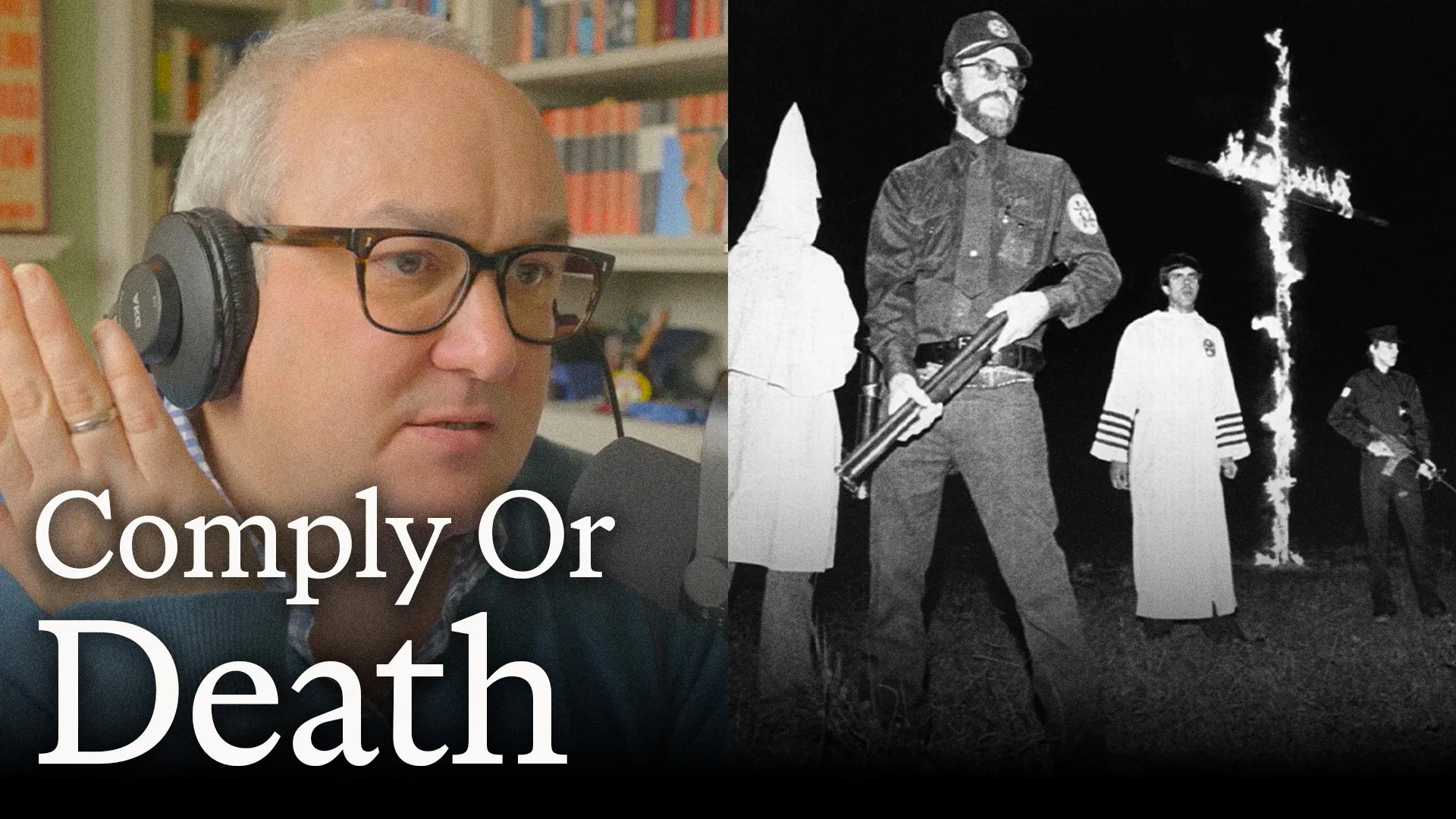
The Klan's terror campaign was a holistic effort to restore pre-war racial hierarchy. Beyond suppressing votes, they targeted Black churches, schools, landowners, and even women who displayed self-respect. This reveals a broader goal: to crush any sign of Black autonomy and re-establish total white supremacy in every aspect of Southern life.
Even if slavery became inefficient for industrial production, its core appeal is its malleability. Throughout history, it has served timeless human desires for sexual exploitation, luxury status symbols (owning people), loyal servants, and even government bureaucrats. This adaptability makes it a threat in any economic system, including modern ones.
There's a vast distance between knowing something is wrong and acting on it. Like modern people walking past the homeless or eating meat despite ethical concerns, societies for centuries possessed the moral insight that slavery was wrong but did nothing. Successful movements are the rare exception, not the norm.
Following its demise, the KKK's violent legacy was completely sanitized by the 'Lost Cause' mythology. Academic historians and popular culture, most notably D.W. Griffith's 1915 film 'The Birth of a Nation', recast the Klan not as racist terrorists but as swashbuckling defenders of civilization, a narrative that enabled its eventual rebirth.
During the American Revolution, Britain and the colonies used slavery to attack each other's character. Each side accused the other of hypocrisy without any genuine commitment to abolition. This political mud-slinging was crucial because it transformed slavery from a normal fact of life into a blameworthy, immoral act in the public consciousness.
The idea that growing wealth and education automatically lead to more compassionate values is historically false. Wealthy societies, from the Roman Empire to 18th-century Europe and Belle Époque France, have often been the most deeply committed to slavery and colonialism, using their resources to create more efficient systems of oppression.