Get your free personalized podcast brief
We scan new podcasts and send you the top 5 insights daily.
The initial success of AI in coding is a natural outcome. Like early PC users who built tools for computers, software developers, as the primary early adopters of LLMs, logically focused on applying the new technology to their own workflows first.

Related Insights
The most significant productivity gains come from applying AI to every stage of development, including research, planning, product marketing, and status updates. Limiting AI to just code generation misses the larger opportunity to automate the entire engineering process.

To predict AI's future impact on the broader economy, observe its current capabilities in software development. AI models are consistently about a year ahead in coding ability compared to other domains, providing a reliable preview of the automation coming to other knowledge-work sectors.

Block's CTO observes a U-shaped curve in AI adoption among engineers. The most junior engineers embrace it naturally, like digital natives. The most senior engineers are also highly eager, as they recognize the potential to automate tedious tasks they've performed countless times, freeing them up for high-level architectural work.

Leading engineers like OpenAI's Andre Karpathy describe recent AI tools not as incremental improvements but as the biggest workflow change in decades. The paradigm has shifted from humans writing code with AI help to AI writing code with human guidance.

AI labs deliberately targeted coding first not just to aid developers, but because AI that can write code can help build the next, smarter version of itself. This creates a rapid, self-reinforcing cycle of improvement that accelerates the entire field's progress.

AI tools are most readily adopted for tedious tasks engineers dislike, such as performing code reviews, fixing lint errors, and managing CI processes. This automation makes the core job of an engineer more focused on creative, high-impact work, thereby increasing job satisfaction.

AI tools don't make junior developers senior; they accelerate existing workflows. Juniors produce junior-level code at a senior's pace, while seniors produce high-quality code at a supernatural speed. The tool magnifies the user's existing skill and discipline, for better or worse.

AI's ability to code seems like advanced reasoning, but it's actually just navigating the most complete archive of human knowledge ever created. Programming's version control, documentation, and forums provide a perfectly mapped territory for AI to search, not a complex problem for it to solve through intelligence.
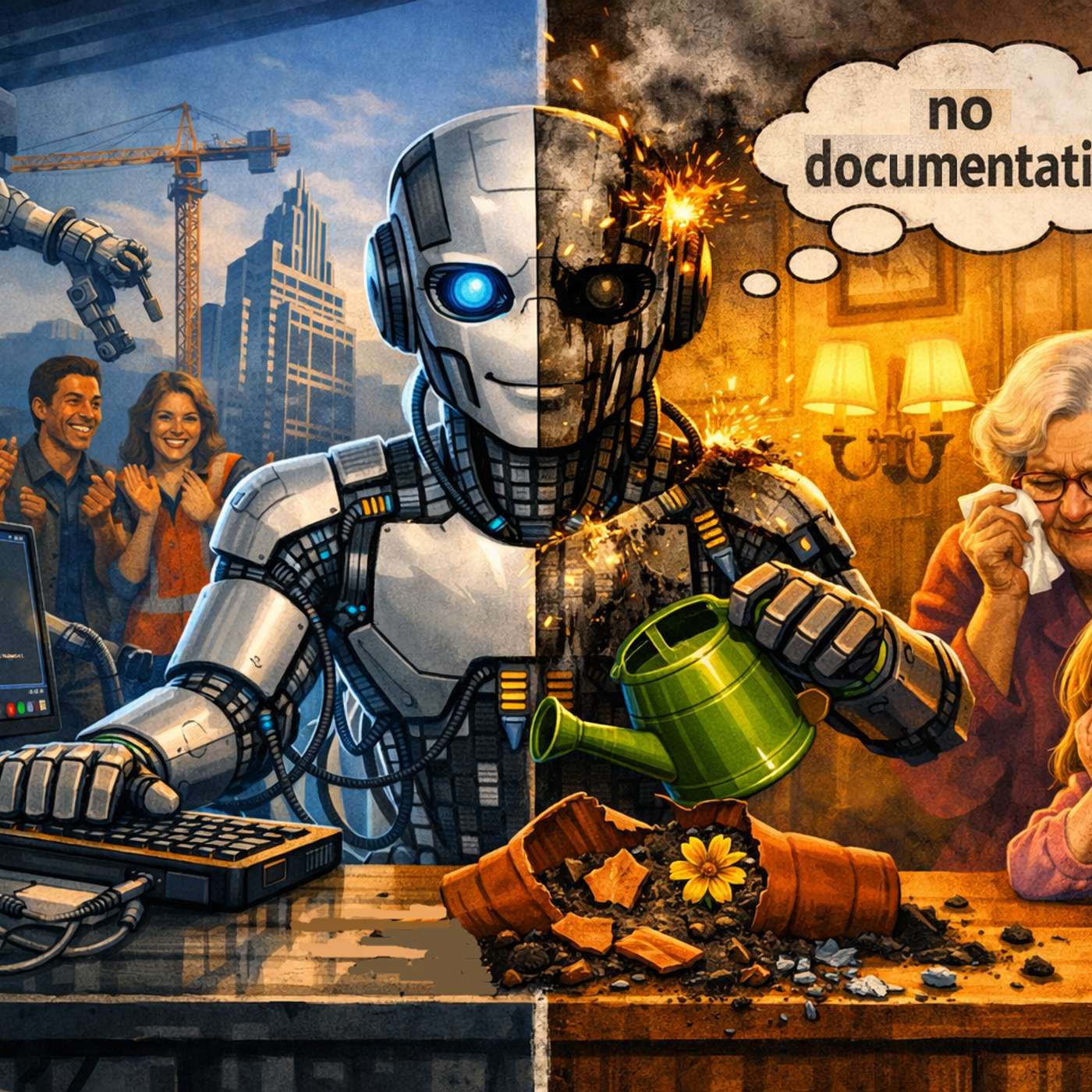
The AI productivity boom is confined to tech because developers have fewer adoption hurdles. Coding is a text-only medium with self-contained context in a codebase. In contrast, roles like marketing or law require complex data setup and workflow re-engineering, slowing down the productivity gains seen in macro-economic data.

The tech industry mistakenly assumes AI's rapid success in coding will replicate across all knowledge work. Coding is an ideal use case: text-based, easily verifiable, and used by technical experts. Other fields lack this perfect setup, meaning widespread AI agent adoption will be much slower.
