Get your free personalized podcast brief
We scan new podcasts and send you the top 5 insights daily.
The competition between data platforms and model companies is not about providing a better tool. It is a battle to define the future enterprise operating model, where core processes are executed by a collaboration of humans and AI agents, fundamentally changing roles and workflows.

Related Insights
The move toward AI agents is more than a technological upgrade; it's a fundamental economic shift. Businesses are now adopting "hyperproductive alternatives to human labor," which changes not only the tools used but the very roles and activities humans perform. This disruption is accelerating rapidly and changing the fundamentals of business.
Don't think of AI as replacing roles. Instead, envision a new organizational structure where every human employee manages a team of their own specialized AI agents. This model enhances individual capabilities without eliminating the human team, making everyone more effective.

The battle for enterprise AI is being fought on two fronts. Data platforms like Snowflake build agents from a governed data foundation (Data+AI), while model companies like OpenAI push general agents down into enterprise systems (AI+Data). The winner controls the core workflow.
As AI evolves from single-task tools to autonomous agents, the human role transforms. Instead of simply using AI, professionals will need to manage and oversee multiple AI agents, ensuring their actions are safe, ethical, and aligned with business goals, acting as a critical control layer.

The current 'copilot' trend is just a stepping stone. The real disruption will come from the 'co-work era,' where autonomous agents handle complex workflows. SaaS companies merely adding AI features will be outcompeted unless they own a core system-of-record or have a truly defensible AI strategy.

Soon, discussing AI as a feature will be table stakes. The strategic conversation will evolve to focus on AI as a new operating model, centering on how to manage and orchestrate a hybrid workforce of human and AI agents to optimize the entire customer journey.

Unlike previous technologies that integrated into existing workflows, AI agents require us to fundamentally re-engineer our work processes to make them effective. Early adopters who adapt their operations to how agents "think" will gain compounding advantages over competitors.
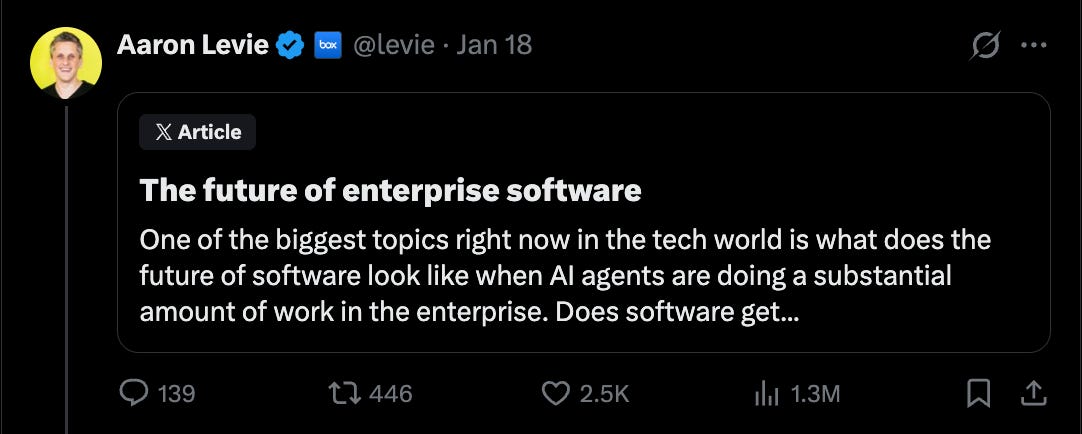
Companies will move beyond simply giving employees AI tools by building organizational infrastructure to support agent-driven work. This will create entirely new job families focused on coordination, evaluation, and strategy, such as "Agent Ops Engineers," "Context Librarians," and "Experiment Portfolio Managers."

The future of software isn't just AI-powered features. It's a fundamental shift from tools that assist humans to autonomous agents that perform tasks. Human roles will evolve from *doing* the work to *orchestrating* thousands of these agents.
Historically, organizational structures existed to manage information flow. AI can now encode that institutional knowledge into agents that democratize data and decision-making. This enables small, autonomous teams to execute faster without the need for traditional management layers for communication.
