Get your free personalized podcast brief
We scan new podcasts and send you the top 5 insights daily.
SaaStr avoids a single, monolithic AI. Instead, they create distinct agents (VP of Marketing, VP of Customer Success) and treat them as separate entities. This architectural choice keeps them focused and allows for tailored interactions without creating a complex, all-knowing system.

Related Insights
To avoid confusing users, SaaStr created separate AI personas. "Jason AI" focuses on high-level SaaS advice, while "Amelia AI" handles specific event-related questions. This distinction ensures each agent is highly effective in its domain and prevents brand dilution from a single, less-specialized bot.

To build a useful multi-agent AI system, model the agents after your existing human team. Create specialized agents for distinct roles like 'approvals,' 'document drafting,' or 'administration' to replicate and automate a proven workflow, rather than designing a monolithic, abstract AI.
To ensure optimal performance, each AI agent at SaaStr is given one primary objective. The AI VP of Marketing's goal is to "own the number." This singular focus ensures all its data analysis, campaign ideas, and actions are goal-seeking and aligned, preventing it from getting overloaded.
Building a single, all-purpose AI is like hiring one person for every company role. To maximize accuracy and creativity, build multiple custom GPTs, each trained for a specific function like copywriting or operations, and have them collaborate.
A one-size-fits-all AI assistant is suboptimal. The host's system splits responsibilities: "Holmes" focuses on personalized AI tool recommendations for individual employees' workflows, while "Mycroft" handles the company's overarching AI strategy, governance, and roadmap. This separation ensures both micro and macro-level needs are met effectively.

The strategy for a one-person AI-powered business isn't a single 'do-everything' agent. Instead, it's creating a team of specialized agents in different 'channels'—one for lead gen, one for blog content, one for analytics—mirroring a company's departmental structure.

Separating AI agents into distinct roles (e.g., a technical expert and a customer-facing communicator) mirrors real-world team specializations. This allows for tailored configurations, like different 'temperature' settings for creativity versus accuracy, improving overall performance and preventing role confusion.
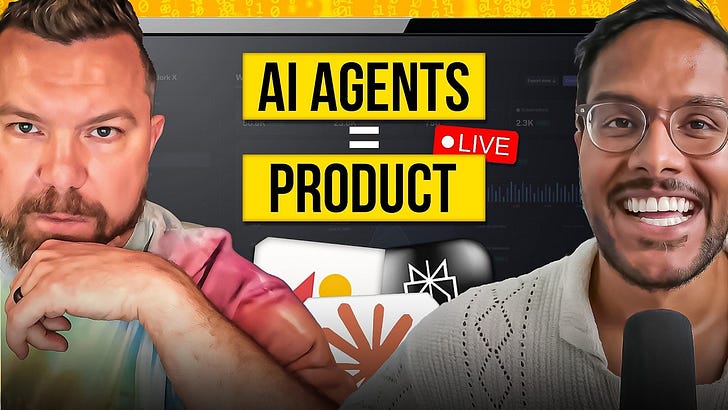
The most powerful AI systems consist of specialized agents with distinct roles (e.g., individual coaching, corporate strategy, knowledge base) that interact. This modular approach, exemplified by the Holmes, Mycroft, and 221B agents, creates a more robust and scalable solution than a single, all-knowing agent.
Instead of a monolithic AI, create a team of agents with specific roles (e.g., 'Debbie the assistant,' 'Soren the engineer'). This human-like model makes it easier to manage capabilities, control access, and conceptualize the system's functions because it maps to our innate understanding of human teams.

Instead of creating one monolithic "Ultron" agent, build a team of specialized agents (e.g., Chief of Staff, Content). This parallels existing business mental models, making the system easier for humans to understand, manage, and scale.